How to connect CCEL: classic Bible commentaries, sermons and Christian classics (ccel.org) to ChatGPT
Add the Firecrawl plugin to ChatGPT once and it can call the CCEL: classic Bible commentaries, sermons and Christian classics (ccel.org) API and every other provider in Firecrawl Alexandria, with no CCEL: classic Bible commentaries, sermons and Christian classics (ccel.org) integration code.
To connect CCEL: classic Bible commentaries, sermons and Christian classics (ccel.org) to ChatGPT, add the Firecrawl plugin to ChatGPT, sign in on a Firecrawl team with Alexandria enabled, and ask for CCEL: classic Bible commentaries, sermons and Christian classics (ccel.org) data in plain language. The connection works in ChatGPT and Codex, and you set it up once.
ChatGPT uses CCEL: classic Bible commentaries, sermons and Christian classics (ccel.org) as an MCP tool through Firecrawl's hosted MCP server, so you don't install or host a separate MCP server for CCEL: classic Bible commentaries, sermons and Christian classics (ccel.org).
ChatGPT is OpenAI's AI assistant. Plugins add tools from other services, and the Firecrawl plugin adds web search, scraping and every data provider in Firecrawl Alexandria.
How do I connect CCEL: classic Bible commentaries, sermons and Christian classics (ccel.org) to ChatGPT?
Install the Firecrawl plugin
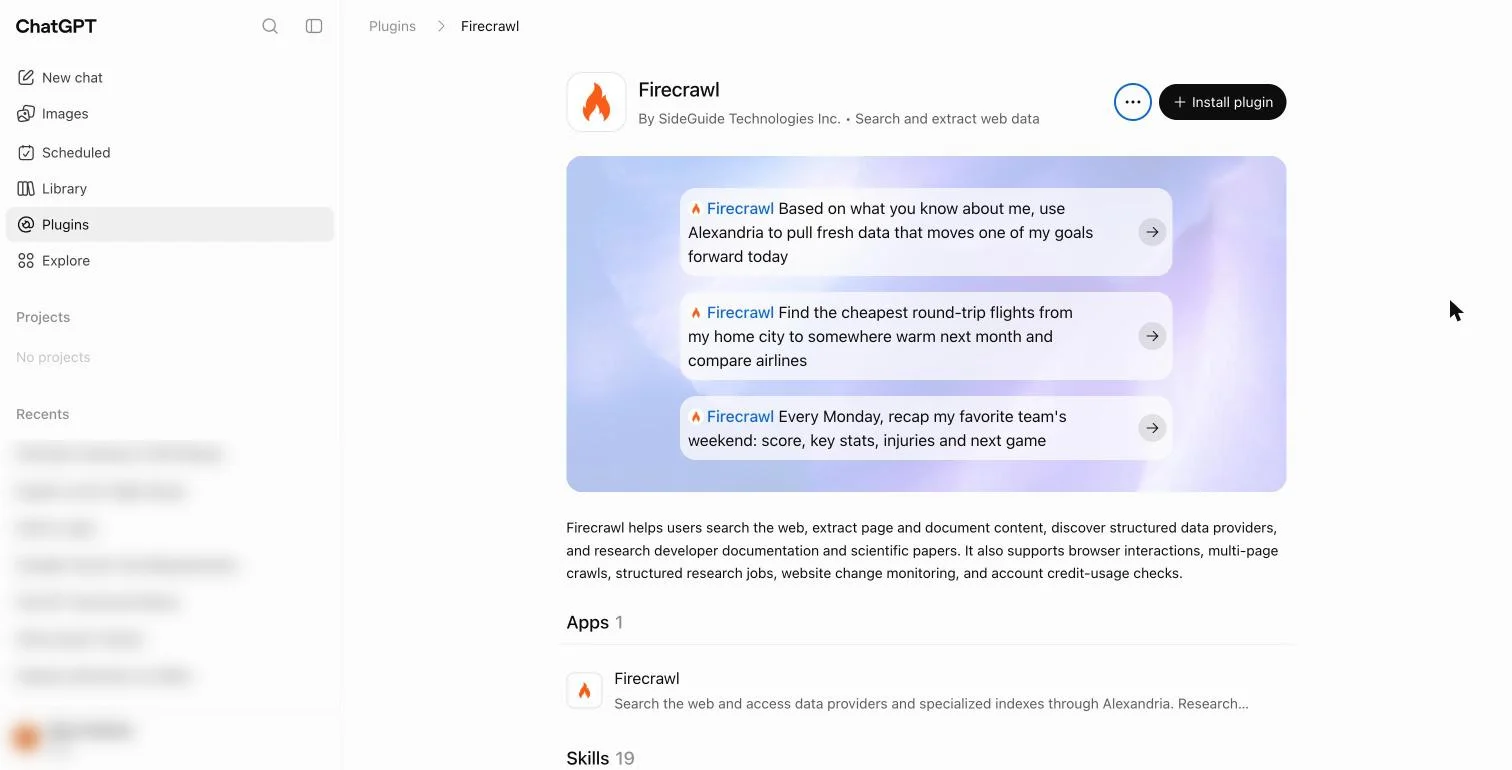
Open the Firecrawl listing in ChatGPT's plugin directory and select Install plugin. You can also open Plugins in ChatGPT or Codex and search for Firecrawl.
Connect your Firecrawl account
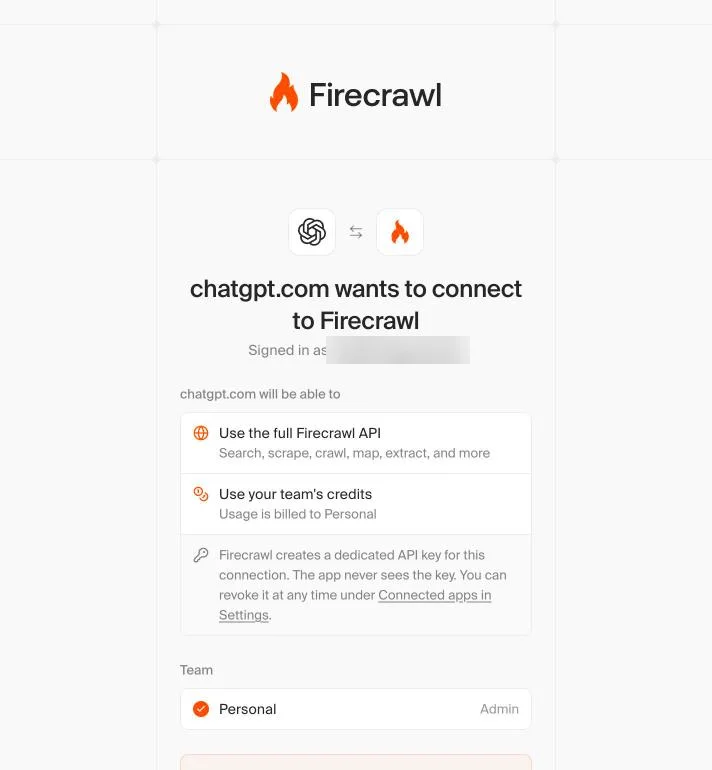
ChatGPT opens Firecrawl in your browser. Sign in, choose a team with Alexandria enabled, and approve access. No account yet? You can create one for free in the same flow.
Attach Firecrawl to a chat
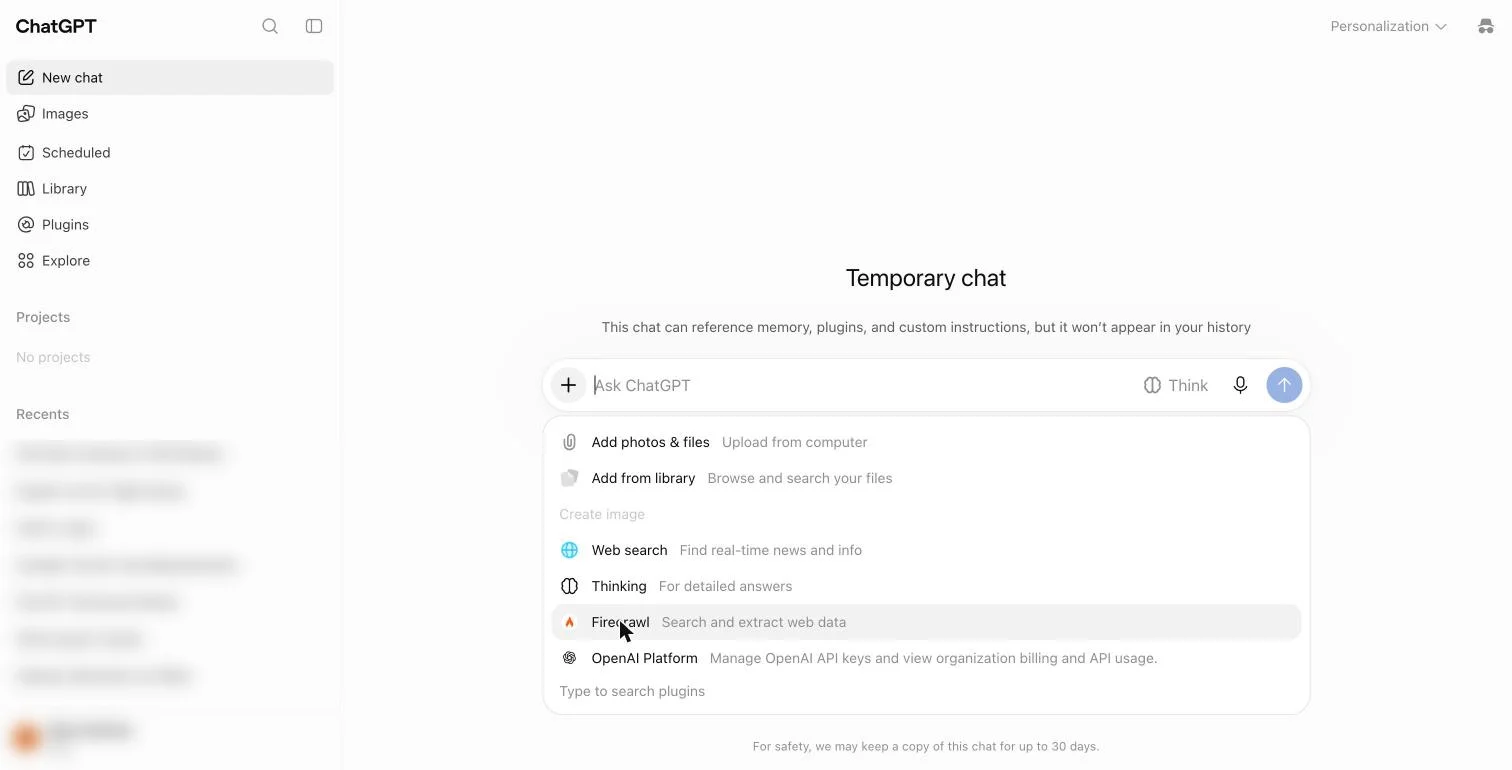
Start a new chat so it loads the plugin, open the + menu and choose Firecrawl. You can also ask ChatGPT to use Firecrawl by name.
Ask ChatGPT for the data
Ask in plain language and mention CCEL: classic Bible commentaries, sermons and Christian classics (ccel.org) or Firecrawl Alexandria. ChatGPT finds the CCEL: classic Bible commentaries, sermons and Christian classics (ccel.org) capability that fits and runs it. For example:
Use Firecrawl to answer this: What did Albert Barnes write about John 3:16?
What can ChatGPT do with CCEL: classic Bible commentaries, sermons and Christian classics (ccel.org)?
Public-domain Bible commentaries, sermons and Christian classics from the Christian Classics Ethereal Library (ccel.org, Calvin University). Commentary on any verse from the CCEL Study Bible (John Calvin, Matthew Henry, Matthew Henry Concise, Jamieson-Fausset-Brown); every commentary CCEL indexes for a chapter (Barnes' Notes, Wesley's Notes, MacLaren's Expositions, the Expositor's Bible, B. W. Johnson, McGarvey, Lightfoot, Church Fathers homilies); classic sermons and meditations on a passage (Spurgeon, Wesley, Flavel, Chrysostom); the text of any public-domain work section by URL or id (such as Matthew Henry mhc5.iv.iv); the commentary catalogue; tables of contents of works (Calvin's Institutes, Schaff's Church Fathers, Aquinas' Summa); and author pages with life dates. Every item carries its source URL, identifiers and a licence field; works that may still be under copyright are left out.
ChatGPT can run any of CCEL: classic Bible commentaries, sermons and Christian classics (ccel.org)'s 7 capabilities through Alexandria. Each call is billed in Firecrawl credits on your Firecrawl team.
- Get author: A CCEL author page: name, short description, birth and death dates, a licence field derived from them, a biography, and the author's works on CCEL with their ids. Costs 5 Firecrawl credits per call.
- Get commentary: Verse-keyed commentary from CCEL's Study Bible for any Bible verse or chapter: John Calvin's Commentaries, Matthew Henry's Commentary on the Whole Bible, Matthew Henry's Concise Commentary, or Jamieson-Fausset-Brown; for example JFB on John 3:16 or Calvin on Psalm 23. Returns the commentary text for the passage with the Bible references it cites, the authors with life dates, publication years and a licence field. Costs 5 Firecrawl credits per call.
- Get section: Read one section of a public-domain work on CCEL by its URL or by work plus section id: a commentary chapter such as Matthew Henry mhc5.iv.iv (John 3), Barnes' note on John 3:16 (ntnotes vii.iii.xvi), a Wesley note, a Spurgeon sermon, an Expositor's Bible chapter. Returns the readable text with headings and cited Bible references, the work and author with life dates, a licence field, and the previous and next section ids for paging through the work. Costs 5 Firecrawl credits per call.
- Get work contents: The table of contents of any public-domain work on CCEL: every section id with its title, nesting level and URL, plus the work title, author with life dates and a licence field. Works include Calvin's Institutes, Schaff's Ante-Nicene and Nicene Fathers (schaff/anf01, schaff/npnf101...), Aquinas' Summa, Matthew Henry's volumes and every commentary list_commentaries returns. Costs 5 Firecrawl credits per call.
- List commentaries: Browse or search the classic Bible commentaries and Bible study works CCEL (Christian Classics Ethereal Library) hosts: Barnes' Notes, Calvin's Commentaries, Matthew Henry, Jamieson-Fausset-Brown, Wesley's Notes, the Expositor's Bible, MacLaren's Expositions, Pusey on the Minor Prophets, Spurgeon's Treasury of David, Aquinas' Catena Aurea, Gray's Christian Workers' Commentary and more. Each work has its id, title, author with life dates and a licence field; only public-domain works are listed. Costs 5 Firecrawl credits per call.
- Passage commentaries: Every classic commentary CCEL indexes for a Bible chapter, from its Study Bible: Barnes' Notes, Calvin, Matthew Henry, JFB, Wesley's Notes, MacLaren's Expositions, the Expositor's Bible, B. W. Johnson's People's New Testament, McGarvey's Four-Fold Gospel, Lightfoot, Church Fathers homilies (NPNF) and others, grouped by author with the exact sections that discuss the passage. Works that may still be under copyright are listed as excluded, not returned. Costs 5 Firecrawl credits per call.
- Passage sermons: Classic sermons and devotional meditations CCEL indexes for a Bible chapter: Spurgeon's sermons and Morning and Evening, John Wesley, John Flavel, Horace Bushnell, Jowett, Chrysostom and Augustine homilies (NPNF) and more, grouped by author with links to the sections. Modern pieces and works that may be under copyright are listed as excluded, not returned. Costs 5 Firecrawl credits per call.
What should I ask ChatGPT?
Name CCEL: classic Bible commentaries, sermons and Christian classics (ccel.org) or Firecrawl Alexandria in the prompt so ChatGPT reaches for it. Each example opens in ChatGPT with the prompt filled in.
- Use Firecrawl to answer this: What did Albert Barnes write about John 3:16?
- Use Firecrawl to give me Jamieson-Fausset-Brown on John 3:16.
- Use Firecrawl to answer this: Which classic commentaries discuss Psalm 23 on CCEL?
- Use Firecrawl to find Spurgeon sermons on John 3.
Troubleshooting
Why doesn't ChatGPT use CCEL: classic Bible commentaries, sermons and Christian classics (ccel.org)?
Start a new chat after installing so ChatGPT loads the plugin, then attach Firecrawl from the + menu and name CCEL: classic Bible commentaries, sermons and Christian classics (ccel.org) or Firecrawl Alexandria in the prompt.
How do I switch the Firecrawl team ChatGPT uses?
Open the Firecrawl plugin page in ChatGPT, uninstall it from the menu next to Settings, then install it again and choose the other team on Firecrawl's consent screen.
Why does ChatGPT say CCEL: classic Bible commentaries, sermons and Christian classics (ccel.org) isn't available?
Alexandria needs a Firecrawl team with Alexandria enabled. Reinstall the plugin and pick that team when you approve access.
Use CCEL: classic Bible commentaries, sermons and Christian classics (ccel.org) in other AI apps
The same Firecrawl account reaches CCEL: classic Bible commentaries, sermons and Christian classics (ccel.org) from other AI apps. Pick one for its setup steps:
- CCEL: classic Bible commentaries, sermons and Christian classics (ccel.org) in Claude
- CCEL: classic Bible commentaries, sermons and Christian classics (ccel.org) in Cursor
- CCEL: classic Bible commentaries, sermons and Christian classics (ccel.org) in Grok Bot
 CCEL: classic Bible commentaries, sermons and Christian classics (ccel.org) in Muse
Other data providers you can connect to ChatGPT
Frequently Asked Questions
What is Firecrawl?
Firecrawl is the web data API to search, scrape and interact with the web at scale. It turns websites into clean, LLM-ready data for AI agents and apps. The Firecrawl plugin brings those tools into ChatGPT, along with every data provider in Firecrawl Alexandria.
What is Firecrawl Alexandria?
Firecrawl Alexandria is Firecrawl's library of 550+ data providers for AI agents, CCEL: classic Bible commentaries, sermons and Christian classics (ccel.org) among them. Each provider returns structured data through documented capabilities. ChatGPT finds the capability that fits your question and calls it through the Firecrawl plugin, so you don't write any integration code. Alexandria needs a Firecrawl account signed in on a team with Alexandria enabled, or an API key from such a team; keyless connections don't include it.
Is there a CCEL: classic Bible commentaries, sermons and Christian classics (ccel.org) MCP server for ChatGPT?
ChatGPT reaches CCEL: classic Bible commentaries, sermons and Christian classics (ccel.org) through Firecrawl's hosted MCP server, which serves CCEL: classic Bible commentaries, sermons and Christian classics (ccel.org) and every other Alexandria provider as tools. Add the Firecrawl plugin once and you don't install or host a separate MCP server for CCEL: classic Bible commentaries, sermons and Christian classics (ccel.org).
What does connecting CCEL: classic Bible commentaries, sermons and Christian classics (ccel.org) to ChatGPT unlock?
ChatGPT can run all 7 of CCEL: classic Bible commentaries, sermons and Christian classics (ccel.org)'s capabilities, including Get author, Get commentary and Get section, from any chat, with structured results it can sort, compare and summarize. For example, ask: "Use Firecrawl to answer this: What did Albert Barnes write about John 3:16?" In the same conversation, ChatGPT can combine CCEL: classic Bible commentaries, sermons and Christian classics (ccel.org) with Firecrawl's web search and scraping and the other providers in Firecrawl Alexandria.
Do I need my own CCEL: classic Bible commentaries, sermons and Christian classics (ccel.org) account or API key to use it in ChatGPT?
No. ChatGPT calls CCEL: classic Bible commentaries, sermons and Christian classics (ccel.org) through Firecrawl Alexandria and each call is billed in Firecrawl credits, so you don't need a separate CCEL: classic Bible commentaries, sermons and Christian classics (ccel.org) account or API key.
How much does it cost to use CCEL: classic Bible commentaries, sermons and Christian classics (ccel.org) in ChatGPT?
Each CCEL: classic Bible commentaries, sermons and Christian classics (ccel.org) call costs 5 Firecrawl credits. The capability list on this page shows each price and its unit. The credits come from the Firecrawl team you connect to ChatGPT, and finding the right capability is free.
Can ChatGPT use other providers besides CCEL: classic Bible commentaries, sermons and Christian classics (ccel.org)?
Yes. The same Firecrawl plugin reaches every provider in Firecrawl Alexandria, along with Firecrawl's web search and scraping, so you connect once.
Can I use CCEL: classic Bible commentaries, sermons and Christian classics (ccel.org) in other AI apps?
Yes. Connect Firecrawl to Claude, Cursor, Grok Bot, Muse signed in on a Firecrawl team with Alexandria enabled, or use the Firecrawl MCP server, CLI or API with an API key from that team, and the same CCEL: classic Bible commentaries, sermons and Christian classics (ccel.org) capabilities are available there. Keyless connections don't include Alexandria.