How to connect CelesTrak GP orbital elements and SATCAT to Cursor
Add the Firecrawl MCP server to Cursor once and it can call the CelesTrak GP orbital elements and SATCAT API and every other provider in Firecrawl Alexandria, with no CelesTrak GP orbital elements and SATCAT integration code.
To connect CelesTrak GP orbital elements and SATCAT to Cursor, add the Firecrawl MCP server to Cursor, sign in on a Firecrawl team with Alexandria enabled, and ask for CelesTrak GP orbital elements and SATCAT data in plain language. The connection works in Cursor's agent and chat, and you set it up once.
Cursor uses CelesTrak GP orbital elements and SATCAT as an MCP tool through Firecrawl's hosted MCP server, so you don't install or host a separate MCP server for CelesTrak GP orbital elements and SATCAT.
Cursor is an AI code editor. Its agent uses MCP servers for outside tools, and the Firecrawl MCP server adds web search, scraping and every data provider in Firecrawl Alexandria.
How do I connect CelesTrak GP orbital elements and SATCAT to Cursor?
Install the Firecrawl MCP server
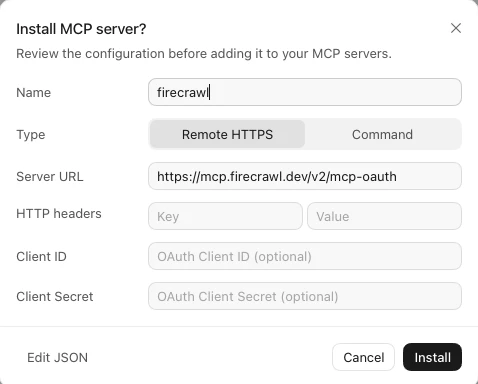
Open the install dialog in Cursor, check that the URL is Firecrawl's hosted server, then select Install.
Connect your Firecrawl account
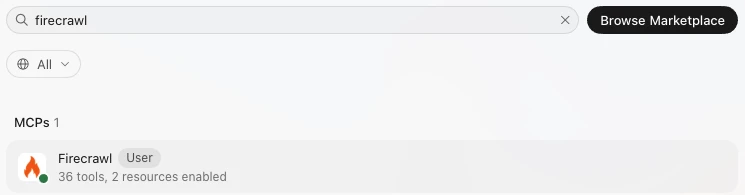
Use the server's sign-in option in Cursor's MCP settings. Firecrawl opens in your browser: sign in, choose a team with Alexandria enabled, and approve access. A green dot next to Firecrawl means it's connected.
Ask Cursor's agent for the data
In the agent chat, ask in plain language and mention CelesTrak GP orbital elements and SATCAT or Firecrawl Alexandria. The agent finds the CelesTrak GP orbital elements and SATCAT capability that fits and runs it. For example:
Use Firecrawl to give me the latest TLE for the ISS (NORAD 25544).
What can Cursor do with CelesTrak GP orbital elements and SATCAT?
Current GP (general perturbations) orbital element sets from CelesTrak, the long-running public redistributor of US Space Force 18 SDS satellite tracking data: by NORAD catalog number, by name, by international designator (launch) or by CelesTrak group (stations, last-30-days, visual, gps-ops, weather and more). Also the satellite catalog (SATCAT): owner or country, launch date and site, decay date, object type, operational status, radar cross section and orbit summary for any object by catalog number, name, international designator or group, with owner, launch date, decay, object type and active filters. Each element set carries the CCSDS OMM keywords exactly as CelesTrak's JSON publishes them, the TLE lines when the catalog number fits the TLE format, the epoch and its age, and derived period, apogee and perigee.
Cursor can run any of CelesTrak GP orbital elements and SATCAT's 5 capabilities through Alexandria. Each call is billed in Firecrawl credits on your Firecrawl team.
- Gp by catalog number: The current GP element set for one object by NORAD catalog number: OMM keywords (epoch, mean motion, eccentricity, inclination, RAAN, argument of perigee, mean anomaly, B*, mean motion derivatives, rev number), TLE lines for catalog numbers up to 99999, epoch age and derived period, apogee and perigee. Source: CelesTrak gp.php?CATNR=N (JSON, plus TLE). Data refreshes about every 2 hours (CelesTrak usage policy: download once per update); epoch_age_hours shows freshness. Objects cataloged since 2026-07-11 have 6-digit catalog numbers and no TLE, only OMM. Costs 5 Firecrawl credits per call.
- Gp group: Current GP element sets for one CelesTrak group, as listed on https://celestrak.org/NORAD/elements/: stations, last-30-days, visual, weather, noaa, goes, resource, sarsat, tdrss, geo, intelsat, ses, iridium-NEXT, oneweb, orbcomm, globalstar, amateur, gnss, gps-ops, glo-ops, galileo, beidou, sbas, science, geodetic, engineering, education, military, radar, cubesat and others. The very large active and starlink lists are refused because CelesTrak rate-limits them; search or look up by catalog number instead. Source: CelesTrak gp.php?GROUP= (JSON, plus TLE). Data refreshes about every 2 hours (CelesTrak usage policy: download once per update); epoch_age_hours shows freshness. Objects cataloged since 2026-07-11 have 6-digit catalog numbers and no TLE, only OMM. Costs 5 Firecrawl credits per call.
- Gp search: Search current GP element sets by object name (substring, case-insensitive, at least 3 characters) or by international designator: a launch (YYYY-NNN returns every tracked object from it) or one object (YYYY-NNNA). Returns up to limit element sets with OMM keywords, TLE lines where available and derived orbit size. Source: CelesTrak gp.php?NAME= or ?INTDES= (JSON, plus TLE). An empty element_sets list means CelesTrak tracks nothing matching. Data refreshes about every 2 hours (CelesTrak usage policy: download once per update); epoch_age_hours shows freshness. Objects cataloged since 2026-07-11 have 6-digit catalog numbers and no TLE, only OMM. Costs 5 Firecrawl credits per call.
- Satcat by catalog number: The SATCAT record for one object by NORAD catalog number: name, international designator, object type (payload, rocket body, debris), operational status, owner or country, launch date and site, decay date (reentered objects included), period, inclination, apogee, perigee, radar cross section and orbit center/type. Source: CelesTrak satcat/records.php (JSON). The SATCAT updates manually once or twice a day (CelesTrak usage policy: download once per update). Costs 5 Firecrawl credits per call.
- Satcat search: Search the SATCAT by object name (substring, case-insensitive, at least 3 characters), international designator (launch year YYYY, launch YYYY-NNN or object YYYY-NNNA) or CelesTrak group, then filter by owner or country code, object type, decay status (on_orbit or decayed), launch date range and active payloads. Payload, on-orbit and active filters run at CelesTrak (PAYLOADS, ONORBIT, ACTIVE) so only matching records download; owner, launch date, decayed and non-payload type filters run on the returned records. Returns up to limit records in CelesTrak's order with total and truncated; an empty records list means nothing matched. Source: CelesTrak satcat/records.php (JSON). The SATCAT updates manually once or twice a day (CelesTrak usage policy: download once per update). Costs 5 Firecrawl credits per call.
What should I ask Cursor?
Name CelesTrak GP orbital elements and SATCAT or Firecrawl Alexandria in the prompt so Cursor reaches for it. Each example opens in Cursor with the prompt filled in.
- Use Firecrawl to give me the latest TLE for the ISS (NORAD 25544).
- Use Firecrawl to answer this: What objects from the Starship launch are being tracked and what are their apogee and perigee?
- Use Firecrawl to list the orbital elements of every space station currently in orbit.
- Use Firecrawl to answer this: Who owns NORAD 48274, when was it launched and is it still in orbit?
Troubleshooting
Why can't Cursor find CelesTrak GP orbital elements and SATCAT?
If Firecrawl's tools in Cursor stop at search, scrape and parse, the connection is keyless and doesn't include Alexandria. Finish the sign-in from Cursor's MCP settings, or add an API key from a team with Alexandria enabled.
Firecrawl shows a red dot in Cursor. What should I do?
Open Cursor's MCP settings, sign in to Firecrawl again, and restart the agent chat so it loads the tools.
Use CelesTrak GP orbital elements and SATCAT in other AI apps
The same Firecrawl account reaches CelesTrak GP orbital elements and SATCAT from other AI apps. Pick one for its setup steps:
- CelesTrak GP orbital elements and SATCAT in ChatGPT
- CelesTrak GP orbital elements and SATCAT in Claude
- CelesTrak GP orbital elements and SATCAT in Grok Bot
 CelesTrak GP orbital elements and SATCAT in Muse
Other data providers you can connect to Cursor
Frequently Asked Questions
What is Firecrawl?
Firecrawl is the web data API to search, scrape and interact with the web at scale. It turns websites into clean, LLM-ready data for AI agents and apps. The Firecrawl MCP server brings those tools into Cursor, along with every data provider in Firecrawl Alexandria.
What is Firecrawl Alexandria?
Firecrawl Alexandria is Firecrawl's library of 550+ data providers for AI agents, CelesTrak GP orbital elements and SATCAT among them. Each provider returns structured data through documented capabilities. Cursor finds the capability that fits your question and calls it through the Firecrawl MCP server, so you don't write any integration code. Alexandria needs a Firecrawl account signed in on a team with Alexandria enabled, or an API key from such a team; keyless connections don't include it.
Is there a CelesTrak GP orbital elements and SATCAT MCP server for Cursor?
Cursor reaches CelesTrak GP orbital elements and SATCAT through Firecrawl's hosted MCP server, which serves CelesTrak GP orbital elements and SATCAT and every other Alexandria provider as tools. Add the Firecrawl MCP server once and you don't install or host a separate MCP server for CelesTrak GP orbital elements and SATCAT.
What does connecting CelesTrak GP orbital elements and SATCAT to Cursor unlock?
Cursor can run all 5 of CelesTrak GP orbital elements and SATCAT's capabilities, including Gp by catalog number, Gp group and Gp search, from any chat, with structured results it can sort, compare and summarize. For example, ask: "Use Firecrawl to give me the latest TLE for the ISS (NORAD 25544)." In the same conversation, Cursor can combine CelesTrak GP orbital elements and SATCAT with Firecrawl's web search and scraping and the other providers in Firecrawl Alexandria.
Do I need my own CelesTrak GP orbital elements and SATCAT account or API key to use it in Cursor?
No. Cursor calls CelesTrak GP orbital elements and SATCAT through Firecrawl Alexandria and each call is billed in Firecrawl credits, so you don't need a separate CelesTrak GP orbital elements and SATCAT account or API key.
How much does it cost to use CelesTrak GP orbital elements and SATCAT in Cursor?
Each CelesTrak GP orbital elements and SATCAT call costs 5 Firecrawl credits. The capability list on this page shows each price and its unit. The credits come from the Firecrawl team you connect to Cursor, and finding the right capability is free.
Can Cursor use other providers besides CelesTrak GP orbital elements and SATCAT?
Yes. The same Firecrawl MCP server reaches every provider in Firecrawl Alexandria, along with Firecrawl's web search and scraping, so you connect once.
Can I use CelesTrak GP orbital elements and SATCAT in other AI apps?
Yes. Connect Firecrawl to ChatGPT, Claude, Grok Bot, Muse signed in on a Firecrawl team with Alexandria enabled, or use the Firecrawl MCP server, CLI or API with an API key from that team, and the same CelesTrak GP orbital elements and SATCAT capabilities are available there. Keyless connections don't include Alexandria.