How to connect Claude Code Docs to Cursor
Add the Firecrawl MCP server to Cursor once and it can call the Claude Code Docs API and every other provider in Firecrawl Alexandria, with no Claude Code Docs integration code.
To connect Claude Code Docs to Cursor, add the Firecrawl MCP server to Cursor, sign in on a Firecrawl team with Alexandria enabled, and ask for Claude Code Docs data in plain language. The connection works in Cursor's agent and chat, and you set it up once.
Cursor uses Claude Code Docs as an MCP tool through Firecrawl's hosted MCP server, so you don't install or host a separate MCP server for Claude Code Docs.
Cursor is an AI code editor. Its agent uses MCP servers for outside tools, and the Firecrawl MCP server adds web search, scraping and every data provider in Firecrawl Alexandria.
How do I connect Claude Code Docs to Cursor?
Install the Firecrawl MCP server
Open the install dialog in Cursor, check that the URL is Firecrawl's hosted server, then select Install.
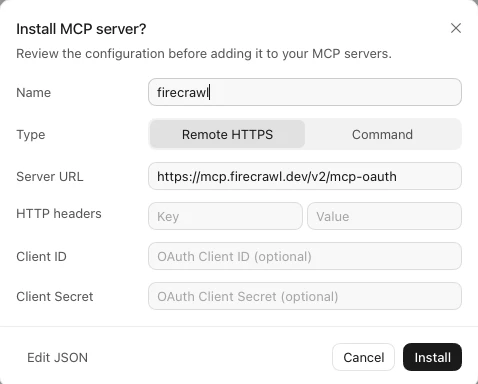
Connect your Firecrawl account
Use the server's sign-in option in Cursor's MCP settings. Firecrawl opens in your browser: sign in, choose a team with Alexandria enabled, and approve access. A green dot next to Firecrawl means it's connected.
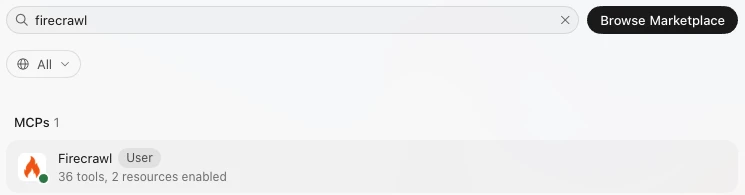
Ask Cursor's agent for the data
In the agent chat, ask in plain language and mention Claude Code Docs or Firecrawl Alexandria. The agent finds the Claude Code Docs capability that fits and runs it. For example:
Use Firecrawl to run Claude Code Docs' Changelog capability. Inspect the Alexandria inputs, ask for any missing required details, and return a small sample with sources.
What can Cursor do with Claude Code Docs?
Official Claude Code documentation from code.claude.com: semantic docs search through Anthropic's public docs MCP server, any page as clean Markdown with an outline and section reads, the full page index, the release changelog by version, and the configuration reference tables (settings keys, hook events, environment variables, skill and subagent frontmatter). Public agent-facing sources only; no login or key.
Cursor can run any of Claude Code Docs's 5 capabilities through Alexandria. Each call is billed in Firecrawl credits on your Firecrawl team.
- Changelog: Claude Code release notes from the official changelog page (GET /docs/en/changelog.md), newest first: version, date and each change item with its category. Filter by exact `version`, `since_version` (strictly newer) or `q` (items containing the text); paginated with `limit`/`offset`. An unknown `version` is `not_found`. Costs 5 Firecrawl credits per call.
- Config reference: Claude Code configuration surfaces as records, parsed from the official reference tables: every settings key (settings-reference: key, description, topic, scope), hook event (hooks: event, when it fires), environment variable (env-vars: variable, purpose), skill frontmatter field (skills) and subagent frontmatter field (sub-agents). Each record links to its section when the page has one. Costs 5 Firecrawl credits per call.
- Get page: One Claude Code docs page as clean Markdown (GET /docs/{language}/{path}.md, the docs' agent-facing rendering) with title, description, an outline of headings with anchors, and the content. `section` (heading text or anchor, case-insensitive) returns only that heading and its subsections. Accepts a page path or a docs URL; an anchor in the URL selects that section. Unknown pages and sections are `not_found`. Costs 5 Firecrawl credits per call.
- List pages: The Claude Code docs page index (llms.txt) as records: title, page path, URL, Markdown URL, description and navigation group. Filter by `q` (title, path or description) and `group`; paginated with `limit`/`offset`. Costs 5 Firecrawl credits per call.
- Search docs: Search the official Claude Code docs through Anthropic's public Mintlify docs MCP server (`search_claude_code_docs`). Returns ranked hits in the vendor's order with title, URL, page path, section anchor and a Markdown snippet. The search is semantic, so it can return loosely related hits for unusual queries. Costs 5 Firecrawl credits per call.
What should I ask Cursor?
Name Claude Code Docs or Firecrawl Alexandria in the prompt so Cursor reaches for it. Each example opens in Cursor with the prompt filled in.
- Use Firecrawl to run Claude Code Docs' Changelog capability. Inspect the Alexandria inputs, ask for any missing required details, and return a small sample with sources.
- Use Firecrawl to run Claude Code Docs' Config reference capability. Inspect the Alexandria inputs, ask for any missing required details, and return a small sample with sources.
- Use Firecrawl to run Claude Code Docs' Get page capability. Inspect the Alexandria inputs, ask for any missing required details, and return a small sample with sources.
- Use Firecrawl to run Claude Code Docs' List pages capability. Inspect the Alexandria inputs, ask for any missing required details, and return a small sample with sources.
Troubleshooting
Why can't Cursor find Claude Code Docs?
If Firecrawl's tools in Cursor stop at search, scrape and parse, the connection is keyless and doesn't include Alexandria. Finish the sign-in from Cursor's MCP settings, or add an API key from a team with Alexandria enabled.
Firecrawl shows a red dot in Cursor. What should I do?
Open Cursor's MCP settings, sign in to Firecrawl again, and restart the agent chat so it loads the tools.
Use Claude Code Docs in other AI apps
The same Firecrawl account reaches Claude Code Docs from other AI apps. Pick one for its setup steps:
- Claude Code Docs in ChatGPT
- Claude Code Docs in Claude
- Claude Code Docs in Grok Bot
 Claude Code Docs in Muse
Other data providers you can connect to Cursor
Frequently Asked Questions
What is Firecrawl?
Firecrawl is the web data API to search, scrape and interact with the web at scale. It turns websites into clean, LLM-ready data for AI agents and apps. The Firecrawl MCP server brings those tools into Cursor, along with every data provider in Firecrawl Alexandria.
What is Firecrawl Alexandria?
Firecrawl Alexandria is Firecrawl's library of 550+ data providers for AI agents, Claude Code Docs among them. Each provider returns structured data through documented capabilities. Cursor finds the capability that fits your question and calls it through the Firecrawl MCP server, so you don't write any integration code. Alexandria needs a Firecrawl account signed in on a team with Alexandria enabled, or an API key from such a team; keyless connections don't include it.
Is there a Claude Code Docs MCP server for Cursor?
Cursor reaches Claude Code Docs through Firecrawl's hosted MCP server, which serves Claude Code Docs and every other Alexandria provider as tools. Add the Firecrawl MCP server once and you don't install or host a separate MCP server for Claude Code Docs.
What does connecting Claude Code Docs to Cursor unlock?
Cursor can run all 5 of Claude Code Docs's capabilities, including Changelog, Config reference and Get page, from any chat, with structured results it can sort, compare and summarize. In the same conversation, Cursor can combine Claude Code Docs with Firecrawl's web search and scraping and the other providers in Firecrawl Alexandria.
Do I need my own Claude Code Docs account or API key to use it in Cursor?
No. Cursor calls Claude Code Docs through Firecrawl Alexandria and each call is billed in Firecrawl credits, so you don't need a separate Claude Code Docs account or API key.
How much does it cost to use Claude Code Docs in Cursor?
Each Claude Code Docs call costs 5 Firecrawl credits. The capability list on this page shows each price and its unit. The credits come from the Firecrawl team you connect to Cursor, and finding the right capability is free.
Can Cursor use other providers besides Claude Code Docs?
Yes. The same Firecrawl MCP server reaches every provider in Firecrawl Alexandria, along with Firecrawl's web search and scraping, so you connect once.
Can I use Claude Code Docs in other AI apps?
Yes. Connect Firecrawl to ChatGPT, Claude, Grok Bot, Muse signed in on a Firecrawl team with Alexandria enabled, or use the Firecrawl MCP server, CLI or API with an API key from that team, and the same Claude Code Docs capabilities are available there. Keyless connections don't include Alexandria.