How to connect crates.io to Cursor
Add the Firecrawl MCP server to Cursor once and it can call the crates.io API and every other provider in Firecrawl Alexandria, with no crates.io integration code.
To connect crates.io to Cursor, add the Firecrawl MCP server to Cursor, sign in on a Firecrawl team with Alexandria enabled, and ask for crates.io data in plain language. The connection works in Cursor's agent and chat, and you set it up once.
Cursor uses crates.io as an MCP tool through Firecrawl's hosted MCP server, so you don't install or host a separate MCP server for crates.io.
Cursor is an AI code editor. Its agent uses MCP servers for outside tools, and the Firecrawl MCP server adds web search, scraping and every data provider in Firecrawl Alexandria.
How do I connect crates.io to Cursor?
Install the Firecrawl MCP server
Open the install dialog in Cursor, check that the URL is Firecrawl's hosted server, then select Install.
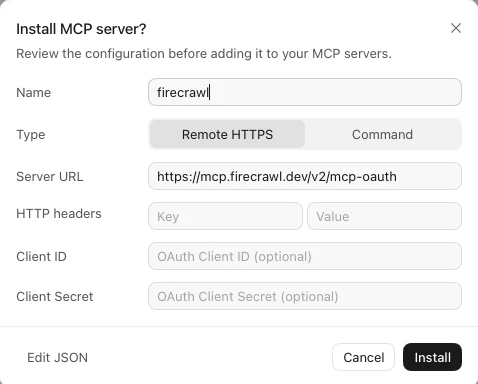
Connect your Firecrawl account
Use the server's sign-in option in Cursor's MCP settings. Firecrawl opens in your browser: sign in, choose a team with Alexandria enabled, and approve access. A green dot next to Firecrawl means it's connected.
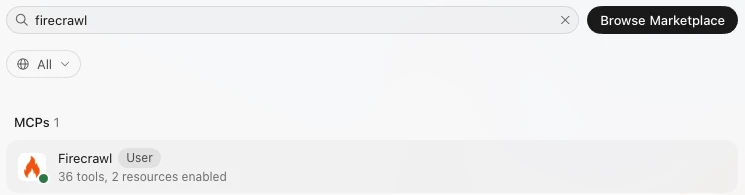
Ask Cursor's agent for the data
In the agent chat, ask in plain language and mention crates.io or Firecrawl Alexandria. The agent finds the crates.io capability that fits and runs it. For example:
Use Firecrawl to run crates.io's Get crate capability. Inspect the Alexandria inputs, ask for any missing required details, and return a small sample with sources.
What can Cursor do with crates.io?
crates.io, the Rust package registry: crate search and listing by category, keyword, letter or owner; crate records with keywords, categories and the default version; full version history with release tracks; per-version dependencies; reverse dependencies; 90-day daily download series; owners, users and the front-page summary.
Cursor can run any of crates.io's 10 capabilities through Alexandria. Each call is billed in Firecrawl credits on your Firecrawl team.
- Get crate: One crate's record from crates.io (`GET /api/v1/crates/{name}?include=keywords,categories,downloads,default_version`): description, links, download totals, timestamps, keywords, categories, the default version in full (features, license, size, checksum, publisher, MSRV) and the API links to its versions, owners, downloads and reverse dependencies. Costs 5 Firecrawl credits per call.
- Get downloads: Daily download counts for the last 90 days (`GET /api/v1/crates/{name}/downloads?include=versions`, or `/api/v1/crates/{name}/{version}/downloads` with `version`): one row per UTC calendar day, the window total, and for a whole crate the split across its five most downloaded versions in the window (the rest are summed under `other`). Costs 5 Firecrawl credits per call.
- Get owners: Owners of a crate (`GET /api/v1/crates/{name}/owners`): users and GitHub teams with their crates.io ids, logins, names, GitHub URLs and avatars. Costs 5 Firecrawl credits per call.
- Get summary: crates.io's front-page summary (`GET /api/v1/summary`): total crates and downloads, the ten newest crates, most downloaded (all-time and recent), just updated, and the most popular keywords and categories. Costs 5 Firecrawl credits per call.
- Get user: A crates.io user by login (`GET /api/v1/users/{login}` and `/users/{id}/stats`): id, login, display name, GitHub URL and avatar, account creation date, linked accounts and total downloads across every crate they own. Costs 5 Firecrawl credits per call.
- Get version: One published version of a crate with its dependencies (`GET /api/v1/crates/{name}/{version}` and `/dependencies`): publish time, downloads, yank state, license, archive size and checksum, MSRV, edition, features, publisher, trusted-publishing flag, line counts, and every dependency with its version requirement, kind (normal/dev/build), optionality, features and target. Costs 5 Firecrawl credits per call.
- List categories: crates.io's category tree as a flat list (`GET /api/v1/categories`): slug, display name, description, crate count and creation date, alphabetical or by crate count. Pages of `per_page`; `cursor` is the next page number. Costs 5 Firecrawl credits per call.
- List reverse dependencies: Crates that depend on a crate (`GET /api/v1/crates/{name}/reverse_dependencies`), most downloaded first: for each dependent, its crate name and the version that declares the dependency, the requirement, kind, optionality, features and target, and the dependent's download count. Pages of `per_page`; `cursor` is the next page number. Costs 5 Firecrawl credits per call.
- List versions: All published versions of a crate (`GET /api/v1/crates/{name}/versions`), newest first by `date` or by `semver`, with each version's downloads, yank state, license, size, checksum, MSRV, edition, features and publisher, plus the release tracks (highest version per major/minor line). Pages of `per_page` versions; `cursor` is crates.io's opaque seek token. Costs 5 Firecrawl credits per call.
- Search crates: Search or list crates on crates.io (`GET /api/v1/crates`). Full-text `query`, or filter by `category` slug, `keyword`, first `letter`, owner `user_id` / `team_id`, or an explicit list of `names`; sort by relevance, downloads, recent downloads, recent updates, newest or alphabetically. Each row is the crate's listing record: versions summary, download totals, links and timestamps. Pages of `per_page` rows; `cursor` is the next page number. Relevance-sorted results stop at 1000 (crates.io refuses deeper pages). Costs 5 Firecrawl credits per call.
What should I ask Cursor?
Name crates.io or Firecrawl Alexandria in the prompt so Cursor reaches for it. Each example opens in Cursor with the prompt filled in.
- Use Firecrawl to run crates.io's Get crate capability. Inspect the Alexandria inputs, ask for any missing required details, and return a small sample with sources.
- Use Firecrawl to run crates.io's Get downloads capability. Inspect the Alexandria inputs, ask for any missing required details, and return a small sample with sources.
- Use Firecrawl to run crates.io's Get owners capability. Inspect the Alexandria inputs, ask for any missing required details, and return a small sample with sources.
- Use Firecrawl to run crates.io's Get summary capability. Inspect the Alexandria inputs, ask for any missing required details, and return a small sample with sources.
Troubleshooting
Why can't Cursor find crates.io?
If Firecrawl's tools in Cursor stop at search, scrape and parse, the connection is keyless and doesn't include Alexandria. Finish the sign-in from Cursor's MCP settings, or add an API key from a team with Alexandria enabled.
Firecrawl shows a red dot in Cursor. What should I do?
Open Cursor's MCP settings, sign in to Firecrawl again, and restart the agent chat so it loads the tools.
Use crates.io in other AI apps
The same Firecrawl account reaches crates.io from other AI apps. Pick one for its setup steps:

Other data providers you can connect to Cursor
Frequently Asked Questions
What is Firecrawl?
Firecrawl is the web data API to search, scrape and interact with the web at scale. It turns websites into clean, LLM-ready data for AI agents and apps. The Firecrawl MCP server brings those tools into Cursor, along with every data provider in Firecrawl Alexandria.
What is Firecrawl Alexandria?
Firecrawl Alexandria is Firecrawl's library of 550+ data providers for AI agents, crates.io among them. Each provider returns structured data through documented capabilities. Cursor finds the capability that fits your question and calls it through the Firecrawl MCP server, so you don't write any integration code. Alexandria needs a Firecrawl account signed in on a team with Alexandria enabled, or an API key from such a team; keyless connections don't include it.
Is there a crates.io MCP server for Cursor?
Cursor reaches crates.io through Firecrawl's hosted MCP server, which serves crates.io and every other Alexandria provider as tools. Add the Firecrawl MCP server once and you don't install or host a separate MCP server for crates.io.
What does connecting crates.io to Cursor unlock?
Cursor can run all 10 of crates.io's capabilities, including Get crate, Get downloads and Get owners, from any chat, with structured results it can sort, compare and summarize. In the same conversation, Cursor can combine crates.io with Firecrawl's web search and scraping and the other providers in Firecrawl Alexandria.
Do I need my own crates.io account or API key to use it in Cursor?
No. Cursor calls crates.io through Firecrawl Alexandria and each call is billed in Firecrawl credits, so you don't need a separate crates.io account or API key.
How much does it cost to use crates.io in Cursor?
Each crates.io call costs 5 Firecrawl credits. The capability list on this page shows each price and its unit. The credits come from the Firecrawl team you connect to Cursor, and finding the right capability is free.
Can Cursor use other providers besides crates.io?
Yes. The same Firecrawl MCP server reaches every provider in Firecrawl Alexandria, along with Firecrawl's web search and scraping, so you connect once.
Can I use crates.io in other AI apps?
Yes. Connect Firecrawl to ChatGPT, Claude, Grok Bot, Muse signed in on a Firecrawl team with Alexandria enabled, or use the Firecrawl MCP server, CLI or API with an API key from that team, and the same crates.io capabilities are available there. Keyless connections don't include Alexandria.