How to connect NYC Open Data property records (ACRIS, PLUTO, DOB) to ChatGPT
Add the Firecrawl plugin to ChatGPT once and it can call the NYC Open Data property records (ACRIS, PLUTO, DOB) API and every other provider in Firecrawl Alexandria, with no NYC Open Data property records (ACRIS, PLUTO, DOB) integration code.
To connect NYC Open Data property records (ACRIS, PLUTO, DOB) to ChatGPT, add the Firecrawl plugin to ChatGPT, sign in on a Firecrawl team with Alexandria enabled, and ask for NYC Open Data property records (ACRIS, PLUTO, DOB) data in plain language. The connection works in ChatGPT and Codex, and you set it up once.
ChatGPT uses NYC Open Data property records (ACRIS, PLUTO, DOB) as an MCP tool through Firecrawl's hosted MCP server, so you don't install or host a separate MCP server for NYC Open Data property records (ACRIS, PLUTO, DOB).
ChatGPT is OpenAI's AI assistant. Plugins add tools from other services, and the Firecrawl plugin adds web search, scraping and every data provider in Firecrawl Alexandria.
How do I connect NYC Open Data property records (ACRIS, PLUTO, DOB) to ChatGPT?
Install the Firecrawl plugin
Open the Firecrawl listing in ChatGPT's plugin directory and select Install plugin. You can also open Plugins in ChatGPT or Codex and search for Firecrawl.
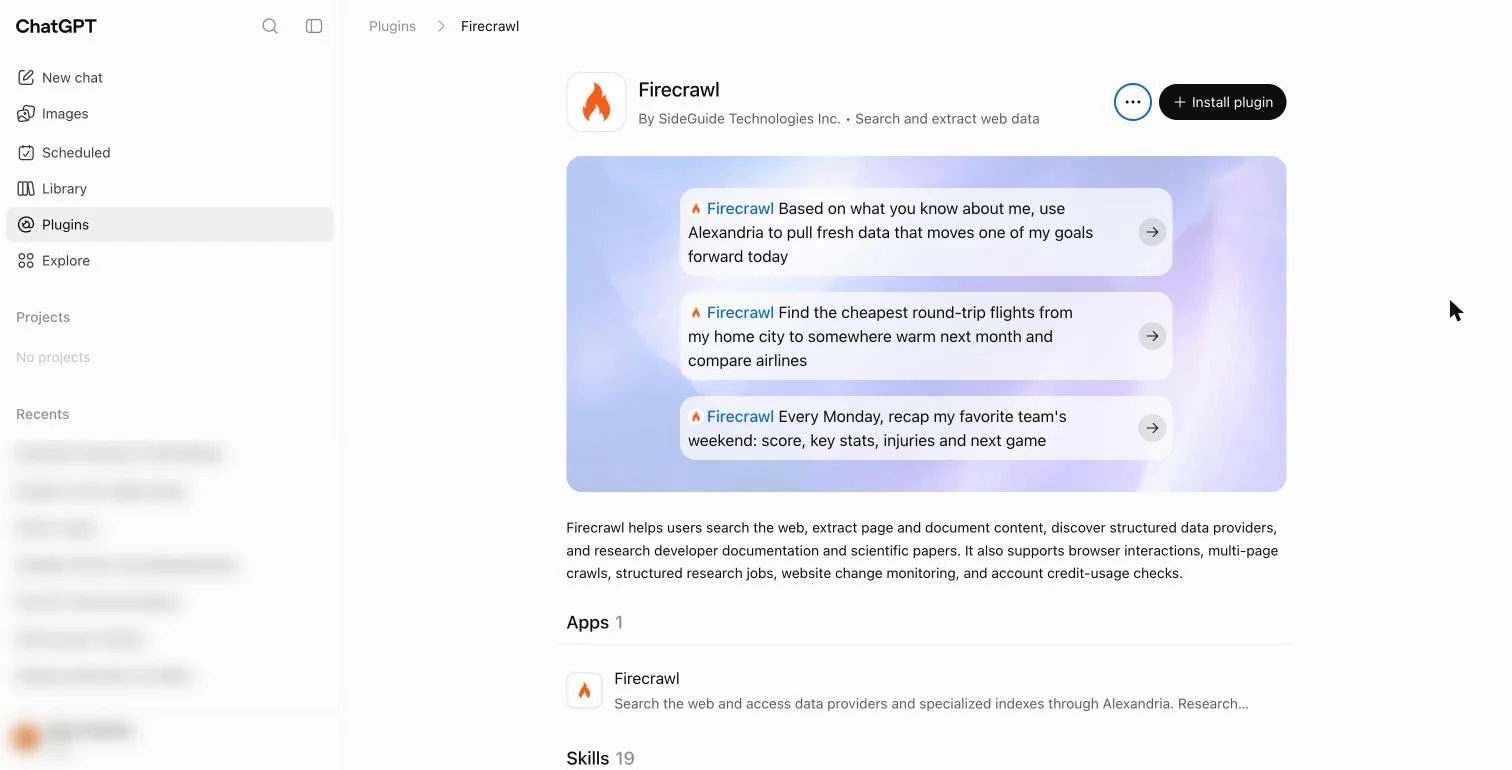
Connect your Firecrawl account
ChatGPT opens Firecrawl in your browser. Sign in, choose a team with Alexandria enabled, and approve access. No account yet? You can create one for free in the same flow.
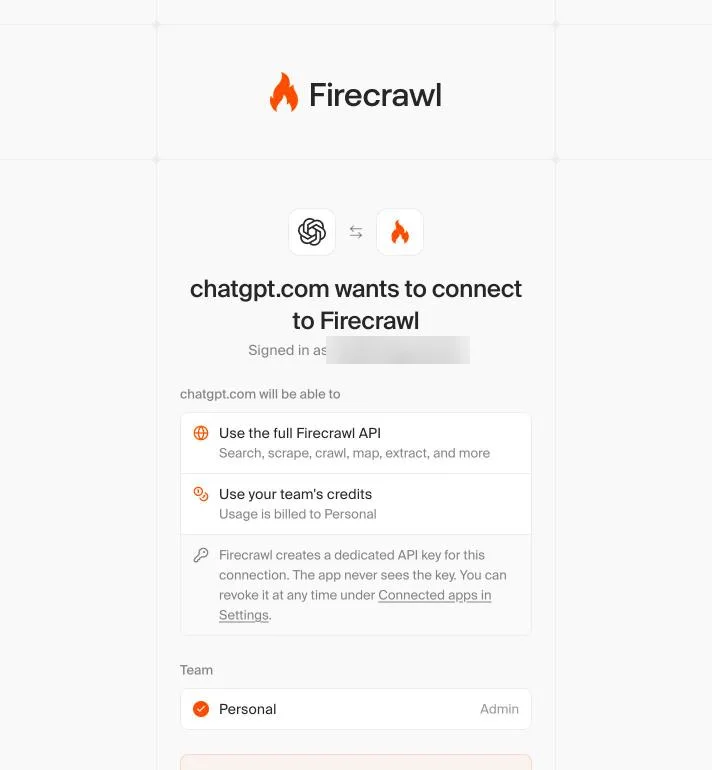
Attach Firecrawl to a chat
Start a new chat so it loads the plugin, open the + menu and choose Firecrawl. You can also ask ChatGPT to use Firecrawl by name.
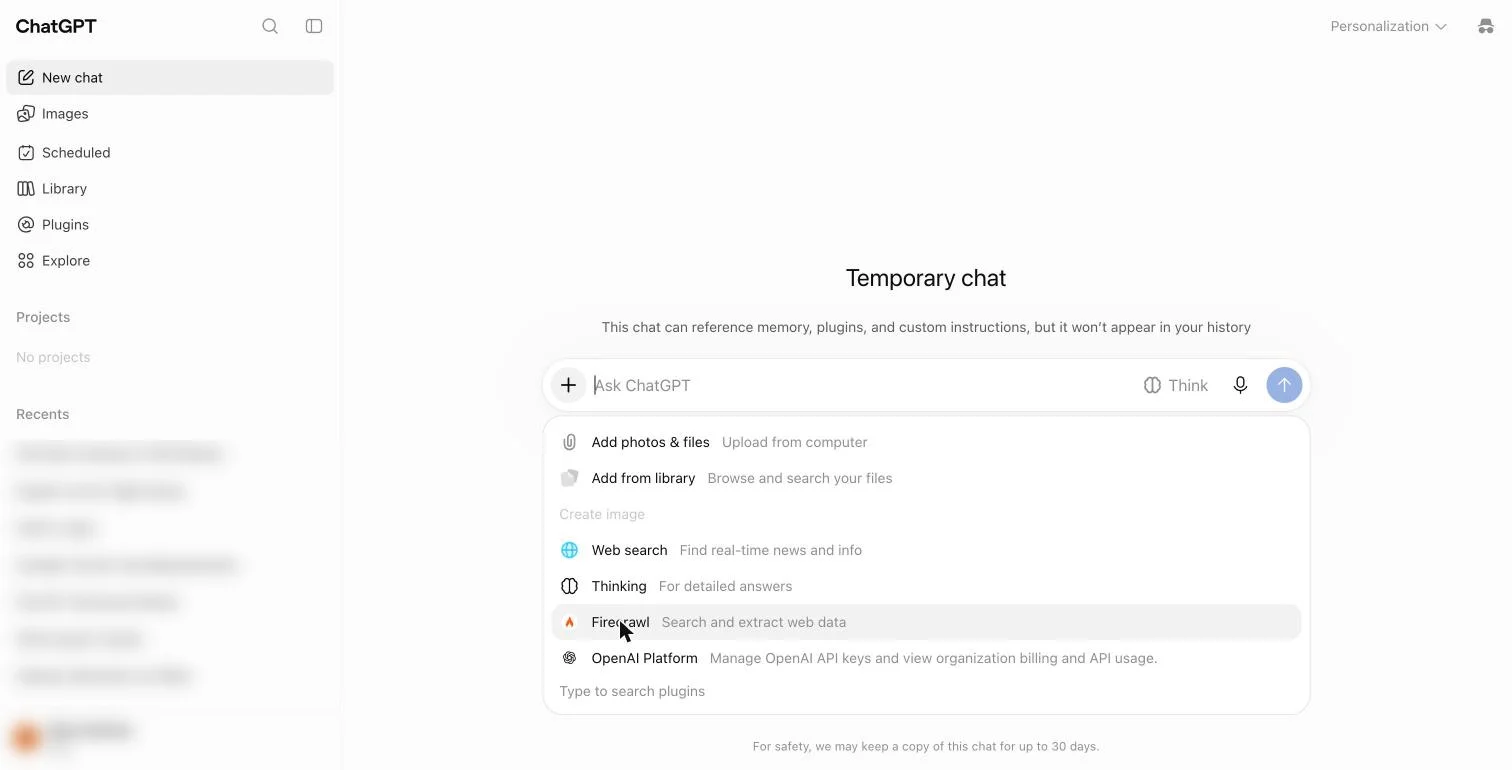
Ask ChatGPT for the data
Ask in plain language and mention NYC Open Data property records (ACRIS, PLUTO, DOB) or Firecrawl Alexandria. ChatGPT finds the NYC Open Data property records (ACRIS, PLUTO, DOB) capability that fits and runs it. For example:
Use Firecrawl to look up 350 5th Avenue, Manhattan, and show the MapPLUTO owner of record, assessed value, zoning and building characteristics.
What can ChatGPT do with NYC Open Data property records (ACRIS, PLUTO, DOB)?
New York City property records through NYC Open Data's Socrata SODA API and the Department of City Planning GeoSearch geocoder: resolve an address to BBL/BIN, read the MapPLUTO lot record (owner of record, building class, assessed value, zoning), list and read ACRIS recorded documents (deeds, mortgages, parties), list DOB permits and DOB/ECB violations by building, and work with building permits in the shared permits contract: search DOB NOW and legacy BIS permits by address, ZIP, borough, BIN, BBL, contractor or licence number, permit type and dates (DOB NOW also by the daily load that added or changed a row, for polling), read one permit with every renewal, and rank contractors by permits issued and estimated job cost. Anonymous; no app token. Permit records carry the NYC Open Data Terms of Use, DOB attribution and their source URL.
ChatGPT can run any of NYC Open Data property records (ACRIS, PLUTO, DOB)'s 9 capabilities through Alexandria. Each call is billed in Firecrawl credits on your Firecrawl team.
- Acris document: One recorded ACRIS document by its 16-character document id (or an a836-acris.nyc.gov DocumentDetail URL), assembled from four NYC Open Data SODA datasets: Real Property Master (bnx9-e6tj) for CRFN, type, dates and amount; Real Property Parties (636b-3b5g) for grantor/grantee/mortgagor names and addresses; Real Property Legals (8h5j-fqxa) for the lots it is recorded against; Document Control Codes (7isb-wh4c) to decode the type into a description, class and the meaning of each party slot. An id the Master dataset does not have is `not_found` (the open-data extract lags the live register; the `acris_url` page may already exist); a malformed id is `invalid_input`. Costs 5 Firecrawl credits per call.
- Acris documents: Recorded ACRIS real-property documents (deeds, mortgages, agreements, liens, ...) against one tax lot, from NYC Open Data: ACRIS Real Property Legals (8h5j-fqxa) filtered by borough/block/lot gives the document ids, then ACRIS Real Property Master (bnx9-e6tj) supplies type, dates, CRFN and amount for that page in one `$where=document_id in(...)` call. Ordered newest first (document ids are date-prefixed; pre-1966 `FT_` microfilm ids sort last). Optional `doc_type` keeps only that ACRIS code (e.g. DEED) within each page; the page still advances through all the lot's documents, so a filtered page may hold fewer than `limit` documents while `next_cursor` is set. Paged with `limit` / `cursor` (row offset into Legals). A lot with no recorded documents but present in PLUTO is a successful empty page; a BBL that neither ACRIS nor PLUTO knows is `not_found`. The open-data extract lags the live City Register by weeks (Master last updated 2026-09-08 at capture); `acris_url` links each document to the authoritative page. Costs 5 Firecrawl credits per call.
- Dob permits: Permits issued by the Department of Buildings for one building (BIN), from NYC Open Data DOB Permit Issuance (SODA dataset ipu4-2q9a, the BIS system: every construction, plumbing, equipment and demolition permit since 1989, updated daily). Ordered newest job first (`job__ DESC, permit_sequence__ DESC`: job numbers are 9-digit and increase over time; renewals of one job follow the initial permit). Each row is shaped (job number, types, status, ISO dates, permittee and owner business names) and carried whole in `fields`. Paged with `limit` / `cursor`. An empty first page triggers a cross-check of the DOB Violations and ECB Violations datasets for the same BIN: no row anywhere is `not_found` (unknown BIN); a known building with no permits is a successful empty page. DOB NOW filings (post-2020 work filed outside BIS) are not in this dataset. Costs 5 Firecrawl credits per call.
- Dob violations: Violations against one building (BIN) from NYC Open Data: `kind: dob` reads DOB Violations (SODA 3h2n-5cm9; violations issued by DOB inspectors, with disposition) and `kind: ecb` reads DOB ECB Violations (6bgk-3dad; Environmental Control Board / OATH summonses with hearing status, severity, penalties, amounts paid and balance due). Ordered by `issue_date DESC`. Rows are shaped into one common record (`kind` says which fields apply) and carried whole in `fields`. Paged with `limit` / `cursor`. An empty first page triggers a cross-check of the sibling DOB datasets (permits and the other violation kind) for the same BIN: no row anywhere is `not_found`; a known building with no violations of that kind is a successful empty page. Costs 5 Firecrawl credits per call.
- Property: The MapPLUTO tax-lot record for one BBL from NYC Open Data (SODA dataset 64uk-42ks, Department of City Planning): owner of record (`owner_name`, `owner_type`), address, building class, land use, year built and altered, floors, units, lot and building areas (sq ft), Department of Finance assessed land/total values (USD), zoning districts, landmark status, community and council districts, coordinates and the PLUTO release version. `pluto` carries the complete row exactly as published (all ~90 columns, strings). An unknown or retired BBL (SODA answers `[]`) is `not_found`; a malformed BBL is `invalid_input`. Links: `acris_url` opens the ACRIS document search pre-scoped to the lot. Costs 5 Firecrawl credits per call.
- Resolve address: Resolve a free-text NYC address to its Borough-Block-Lot (BBL) and Building Identification Number (BIN) with the Department of City Planning's GeoSearch API (https://geosearch.planninglabs.nyc/v2/search, a Pelias geocoder over the Property Address Directory). Returns up to `limit` candidate matches ordered by GeoSearch relevance, each with the normalized address, borough, ZIP, coordinates and the PAD `bbl` / `bin` that key every other function of this program. Zero matches is a successful empty result (`count: 0`), not an error. Anonymous, no token. Costs 5 Firecrawl credits per call.
- Contractor activity: Rank NYC contractors (DOB permittees) by permits issued in an issue-date window, with one grouped SoQL query over DOB NOW: Build – Approved Permits (default) or BIS DOB Permit Issuance (source bis). Optional permit type, ZIP, borough and contractor-name filters. Each contractor has business name, licensee name, DOB licence number and type, distinct permits, job filings, total estimated job cost of those filings (DOB NOW only; each filing counted once), first and last issue date in the window, source_url and licence. Costs 5 Firecrawl credits per call.
- Get permit: One NYC building permit by DOB permit number, from DOB NOW (B01110047-S3-ST) or BIS (123499883-02-EW-MH; BIS's own 123499883-02-EW MH also works), recognised by its form. Returns the shared permit fields for the newest issuance (DOB NOW combined permits list each work type on its own row; permit_type joins them), every issuance newest first (initial permit and renewals, with work type, filing reason, status, issue and expiry dates), and raw, the newest row with every published column except owner names, home addresses, phone numbers and site staff names. An unknown permit number is not_found; a string that is not a DOB permit number is invalid_input. Costs 5 Firecrawl credits per call.
- Search permits: Search New York City building permits from the Department of Buildings on NYC Open Data, newest first: DOB NOW: Build – Approved Permits (rbx6-tga4, default, permits since 2016) or the legacy BIS DOB Permit Issuance (ipu4-2q9a, since 1989) with source bis. Filter by address words, ZIP, borough, BIN, BBL (parcel_id), contractor name or licence number, permit type, status, issue date window, and for DOB NOW by the date a daily load added or changed the row (updated_since) and minimum estimated job cost; BIS adds the filing date window. Each record has the shared permit fields: permit number, work type, filing reason, status, issue and expiry dates, address, borough, ZIP, coordinates, BBL, BIN, estimated job cost, job description, the permittee (licensed contractor) with licence number, updated_at, source_url and licence. An empty page is a valid result. Costs 5 Firecrawl credits per call.
What should I ask ChatGPT?
Name NYC Open Data property records (ACRIS, PLUTO, DOB) or Firecrawl Alexandria in the prompt so ChatGPT reaches for it. Each example opens in ChatGPT with the prompt filled in.
- Use Firecrawl to look up 350 5th Avenue, Manhattan, and show the MapPLUTO owner of record, assessed value, zoning and building characteristics.
- Use Firecrawl to list the latest 10 ACRIS recorded documents for 350 5th Avenue, Manhattan, with types, recording dates, CRFNs and recorded amounts.
- Use Firecrawl to read NYC ACRIS document 2013100700087001 and show its deed parties, recorded amount and associated tax lots.
- Use Firecrawl to list the latest 10 DOB permits and latest 10 ECB violations for 350 5th Avenue, Manhattan, including violation hearing status and balances where reported.
Troubleshooting
Why doesn't ChatGPT use NYC Open Data property records (ACRIS, PLUTO, DOB)?
Start a new chat after installing so ChatGPT loads the plugin, then attach Firecrawl from the + menu and name NYC Open Data property records (ACRIS, PLUTO, DOB) or Firecrawl Alexandria in the prompt.
How do I switch the Firecrawl team ChatGPT uses?
Open the Firecrawl plugin page in ChatGPT, uninstall it from the menu next to Settings, then install it again and choose the other team on Firecrawl's consent screen.
Why does ChatGPT say NYC Open Data property records (ACRIS, PLUTO, DOB) isn't available?
Alexandria needs a Firecrawl team with Alexandria enabled. Reinstall the plugin and pick that team when you approve access.
Use NYC Open Data property records (ACRIS, PLUTO, DOB) in other AI apps
The same Firecrawl account reaches NYC Open Data property records (ACRIS, PLUTO, DOB) from other AI apps. Pick one for its setup steps:
- NYC Open Data property records (ACRIS, PLUTO, DOB) in Claude
- NYC Open Data property records (ACRIS, PLUTO, DOB) in Cursor
- NYC Open Data property records (ACRIS, PLUTO, DOB) in Grok Bot
 NYC Open Data property records (ACRIS, PLUTO, DOB) in Muse
Other data providers you can connect to ChatGPT
Frequently Asked Questions
What is Firecrawl?
Firecrawl is the web data API to search, scrape and interact with the web at scale. It turns websites into clean, LLM-ready data for AI agents and apps. The Firecrawl plugin brings those tools into ChatGPT, along with every data provider in Firecrawl Alexandria.
What is Firecrawl Alexandria?
Firecrawl Alexandria is Firecrawl's library of 550+ data providers for AI agents, NYC Open Data property records (ACRIS, PLUTO, DOB) among them. Each provider returns structured data through documented capabilities. ChatGPT finds the capability that fits your question and calls it through the Firecrawl plugin, so you don't write any integration code. Alexandria needs a Firecrawl account signed in on a team with Alexandria enabled, or an API key from such a team; keyless connections don't include it.
Is there a NYC Open Data property records (ACRIS, PLUTO, DOB) MCP server for ChatGPT?
ChatGPT reaches NYC Open Data property records (ACRIS, PLUTO, DOB) through Firecrawl's hosted MCP server, which serves NYC Open Data property records (ACRIS, PLUTO, DOB) and every other Alexandria provider as tools. Add the Firecrawl plugin once and you don't install or host a separate MCP server for NYC Open Data property records (ACRIS, PLUTO, DOB).
What does connecting NYC Open Data property records (ACRIS, PLUTO, DOB) to ChatGPT unlock?
ChatGPT can run all 9 of NYC Open Data property records (ACRIS, PLUTO, DOB)'s capabilities, including Acris document, Acris documents and Dob permits, from any chat, with structured results it can sort, compare and summarize. For example, ask: "Use Firecrawl to look up 350 5th Avenue, Manhattan, and show the MapPLUTO owner of record, assessed value, zoning and building characteristics." In the same conversation, ChatGPT can combine NYC Open Data property records (ACRIS, PLUTO, DOB) with Firecrawl's web search and scraping and the other providers in Firecrawl Alexandria.
Do I need my own NYC Open Data property records (ACRIS, PLUTO, DOB) account or API key to use it in ChatGPT?
No. ChatGPT calls NYC Open Data property records (ACRIS, PLUTO, DOB) through Firecrawl Alexandria and each call is billed in Firecrawl credits, so you don't need a separate NYC Open Data property records (ACRIS, PLUTO, DOB) account or API key.
How much does it cost to use NYC Open Data property records (ACRIS, PLUTO, DOB) in ChatGPT?
Each NYC Open Data property records (ACRIS, PLUTO, DOB) call costs 5 Firecrawl credits. The capability list on this page shows each price and its unit. The credits come from the Firecrawl team you connect to ChatGPT, and finding the right capability is free.
Can ChatGPT use other providers besides NYC Open Data property records (ACRIS, PLUTO, DOB)?
Yes. The same Firecrawl plugin reaches every provider in Firecrawl Alexandria, along with Firecrawl's web search and scraping, so you connect once.
Can I use NYC Open Data property records (ACRIS, PLUTO, DOB) in other AI apps?
Yes. Connect Firecrawl to Claude, Cursor, Grok Bot, Muse signed in on a Firecrawl team with Alexandria enabled, or use the Firecrawl MCP server, CLI or API with an API key from that team, and the same NYC Open Data property records (ACRIS, PLUTO, DOB) capabilities are available there. Keyless connections don't include Alexandria.