How to connect U.S. Drought Monitor to Cursor
Add the Firecrawl MCP server to Cursor once and it can call the U.S. Drought Monitor API and every other provider in Firecrawl Alexandria, with no U.S. Drought Monitor integration code.
To connect U.S. Drought Monitor to Cursor, add the Firecrawl MCP server to Cursor, sign in on a Firecrawl team with Alexandria enabled, and ask for U.S. Drought Monitor data in plain language. The connection works in Cursor's agent and chat, and you set it up once.
Cursor uses U.S. Drought Monitor as an MCP tool through Firecrawl's hosted MCP server, so you don't install or host a separate MCP server for U.S. Drought Monitor.
Cursor is an AI code editor. Its agent uses MCP servers for outside tools, and the Firecrawl MCP server adds web search, scraping and every data provider in Firecrawl Alexandria.
How do I connect U.S. Drought Monitor to Cursor?
Install the Firecrawl MCP server
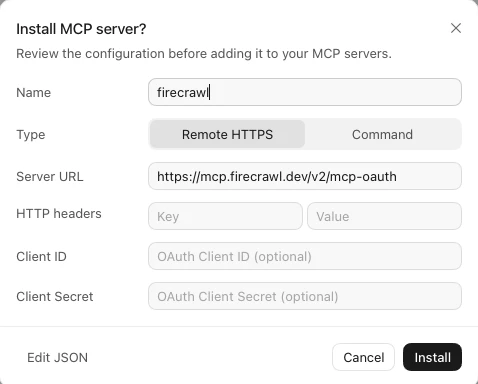
Open the install dialog in Cursor, check that the URL is Firecrawl's hosted server, then select Install.
Connect your Firecrawl account
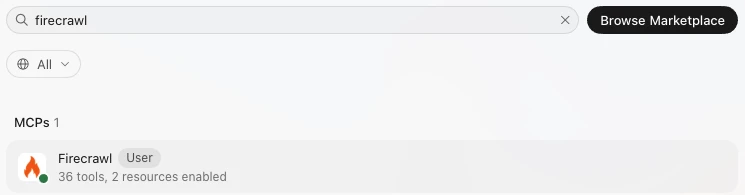
Use the server's sign-in option in Cursor's MCP settings. Firecrawl opens in your browser: sign in, choose a team with Alexandria enabled, and approve access. A green dot next to Firecrawl means it's connected.
Ask Cursor's agent for the data
In the agent chat, ask in plain language and mention U.S. Drought Monitor or Firecrawl Alexandria. The agent finds the U.S. Drought Monitor capability that fits and runs it. For example:
Use Firecrawl to run U.S. Drought Monitor's Drought current capability. Inspect the Alexandria inputs, ask for any missing required details, and return a small sample with sources.
What can Cursor do with U.S. Drought Monitor?
U.S. Drought Monitor (National Drought Mitigation Center) for a piece of ground: the current map's drought categories over a GeoJSON geometry, weekly county history since 2000, the 2000-2020 spatial archive and the map calendar. Public, anonymous NDMC ArcGIS layers and statistics services.
Cursor can run any of U.S. Drought Monitor's 4 capabilities through Alexandria. Each call is billed in Firecrawl credits on your Firecrawl team.
- Drought current: Share of a geometry in each U.S. Drought Monitor category (None, D0 abnormally dry to D4 exceptional drought) on the current weekly map, with the counties it touches and their county-level shares. Exact when the geometry sits inside one category polygon (`spatial_precision: polygon`); when a category boundary crosses it, shares are estimated from up to 16 interior sample points (`grid_cell`). A Point gets the category at that point. Costs 5 Firecrawl credits per call.
- Drought history: Weekly U.S. Drought Monitor statistics for every county a geometry touches: percent of county area in None/D0-D4 and the Drought Severity and Coverage Index (DSCI), one row per map week, from 2000-01-04 to the current map. `statistics` picks `categorical` (exclusive classes, sum to 100; default) or `traditional` (cumulative: d0 = D0 or worse). One page covers up to 53 weeks; `next_cursor` continues a longer window. Costs 5 Firecrawl credits per call.
- Drought history spatial: Weekly drought categories that touched a geometry between 2000-01-04 and 2020-11-17, from NDMC's USDM_archive polygon layer (exact against the archived map polygons, `spatial_precision: polygon`). Weeks with no entry had no D0-D4 polygon over the geometry. One page covers up to 53 weeks; `next_cursor` continues. For weeks after 2020-11-17 use drought_history (county statistics). Costs 5 Firecrawl credits per call.
- Drought map dates: The U.S. Drought Monitor calendar and national summary: the current map date (Tuesday), release date (Thursday), valid period, the national area and percent in each category from the USDM_current layer, and the list of all weekly map dates back to 2000-01-04 (newest first, `limit` of them). Costs 5 Firecrawl credits per call.
What should I ask Cursor?
Name U.S. Drought Monitor or Firecrawl Alexandria in the prompt so Cursor reaches for it. Each example opens in Cursor with the prompt filled in.
- Use Firecrawl to run U.S. Drought Monitor's Drought current capability. Inspect the Alexandria inputs, ask for any missing required details, and return a small sample with sources.
- Use Firecrawl to run U.S. Drought Monitor's Drought history capability. Inspect the Alexandria inputs, ask for any missing required details, and return a small sample with sources.
- Use Firecrawl to run U.S. Drought Monitor's Drought history spatial capability. Inspect the Alexandria inputs, ask for any missing required details, and return a small sample with sources.
- Use Firecrawl to run U.S. Drought Monitor's Drought map dates capability. Inspect the Alexandria inputs, ask for any missing required details, and return a small sample with sources.
Troubleshooting
Why can't Cursor find U.S. Drought Monitor?
If Firecrawl's tools in Cursor stop at search, scrape and parse, the connection is keyless and doesn't include Alexandria. Finish the sign-in from Cursor's MCP settings, or add an API key from a team with Alexandria enabled.
Firecrawl shows a red dot in Cursor. What should I do?
Open Cursor's MCP settings, sign in to Firecrawl again, and restart the agent chat so it loads the tools.
Use U.S. Drought Monitor in other AI apps
The same Firecrawl account reaches U.S. Drought Monitor from other AI apps. Pick one for its setup steps:
- U.S. Drought Monitor in ChatGPT
- U.S. Drought Monitor in Claude
- U.S. Drought Monitor in Grok Bot
 U.S. Drought Monitor in Muse
Other data providers you can connect to Cursor
Frequently Asked Questions
What is Firecrawl?
Firecrawl is the web data API to search, scrape and interact with the web at scale. It turns websites into clean, LLM-ready data for AI agents and apps. The Firecrawl MCP server brings those tools into Cursor, along with every data provider in Firecrawl Alexandria.
What is Firecrawl Alexandria?
Firecrawl Alexandria is Firecrawl's library of 550+ data providers for AI agents, U.S. Drought Monitor among them. Each provider returns structured data through documented capabilities. Cursor finds the capability that fits your question and calls it through the Firecrawl MCP server, so you don't write any integration code. Alexandria needs a Firecrawl account signed in on a team with Alexandria enabled, or an API key from such a team; keyless connections don't include it.
Is there a U.S. Drought Monitor MCP server for Cursor?
Cursor reaches U.S. Drought Monitor through Firecrawl's hosted MCP server, which serves U.S. Drought Monitor and every other Alexandria provider as tools. Add the Firecrawl MCP server once and you don't install or host a separate MCP server for U.S. Drought Monitor.
What does connecting U.S. Drought Monitor to Cursor unlock?
Cursor can run all 4 of U.S. Drought Monitor's capabilities, including Drought current, Drought history and Drought history spatial, from any chat, with structured results it can sort, compare and summarize. In the same conversation, Cursor can combine U.S. Drought Monitor with Firecrawl's web search and scraping and the other providers in Firecrawl Alexandria.
Do I need my own U.S. Drought Monitor account or API key to use it in Cursor?
No. Cursor calls U.S. Drought Monitor through Firecrawl Alexandria and each call is billed in Firecrawl credits, so you don't need a separate U.S. Drought Monitor account or API key.
How much does it cost to use U.S. Drought Monitor in Cursor?
Each U.S. Drought Monitor call costs 5 Firecrawl credits. The capability list on this page shows each price and its unit. The credits come from the Firecrawl team you connect to Cursor, and finding the right capability is free.
Can Cursor use other providers besides U.S. Drought Monitor?
Yes. The same Firecrawl MCP server reaches every provider in Firecrawl Alexandria, along with Firecrawl's web search and scraping, so you connect once.
Can I use U.S. Drought Monitor in other AI apps?
Yes. Connect Firecrawl to ChatGPT, Claude, Grok Bot, Muse signed in on a Firecrawl team with Alexandria enabled, or use the Firecrawl MCP server, CLI or API with an API key from that team, and the same U.S. Drought Monitor capabilities are available there. Keyless connections don't include Alexandria.