How to connect FEMA to ChatGPT
Add the Firecrawl plugin to ChatGPT once and it can call the FEMA API and every other provider in Firecrawl Alexandria, with no FEMA integration code.
To connect FEMA to ChatGPT, add the Firecrawl plugin to ChatGPT, sign in on a Firecrawl team with Alexandria enabled, and ask for FEMA data in plain language. The connection works in ChatGPT and Codex, and you set it up once.
ChatGPT uses FEMA as an MCP tool through Firecrawl's hosted MCP server, so you don't install or host a separate MCP server for FEMA.
ChatGPT is OpenAI's AI assistant. Plugins add tools from other services, and the Firecrawl plugin adds web search, scraping and every data provider in Firecrawl Alexandria.
How do I connect FEMA to ChatGPT?
Install the Firecrawl plugin
Open the Firecrawl listing in ChatGPT's plugin directory and select Install plugin. You can also open Plugins in ChatGPT or Codex and search for Firecrawl.
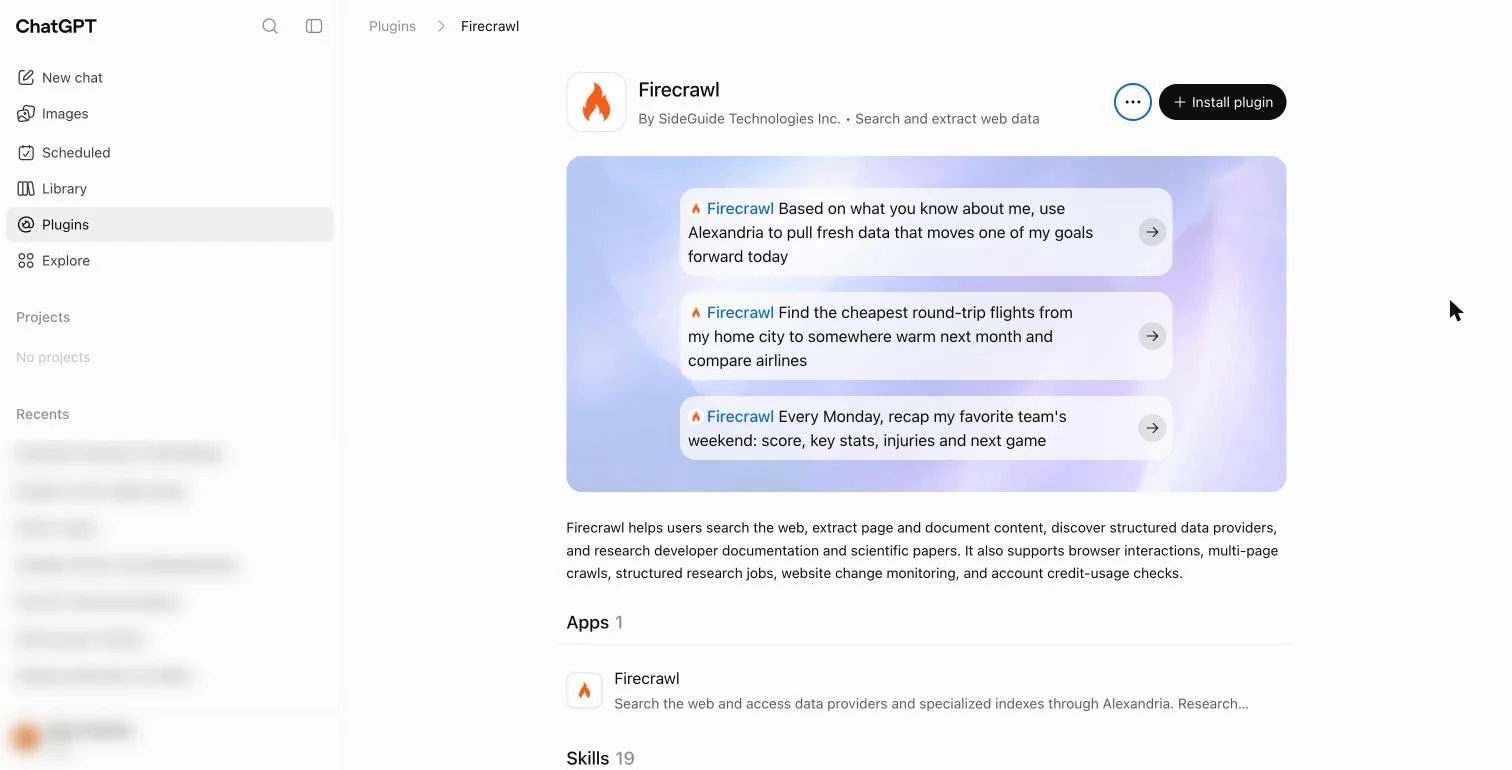
Connect your Firecrawl account
ChatGPT opens Firecrawl in your browser. Sign in, choose a team with Alexandria enabled, and approve access. No account yet? You can create one for free in the same flow.
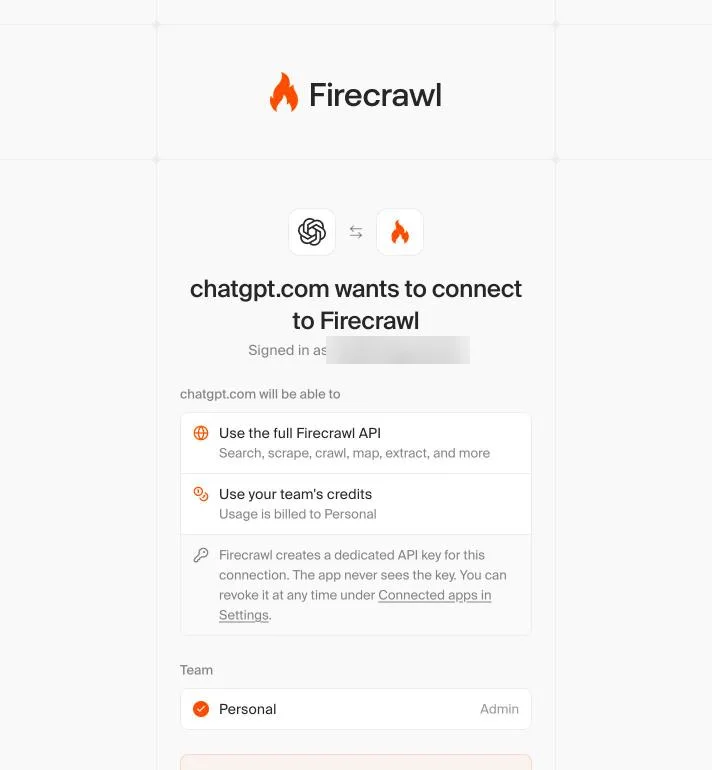
Attach Firecrawl to a chat
Start a new chat so it loads the plugin, open the + menu and choose Firecrawl. You can also ask ChatGPT to use Firecrawl by name.
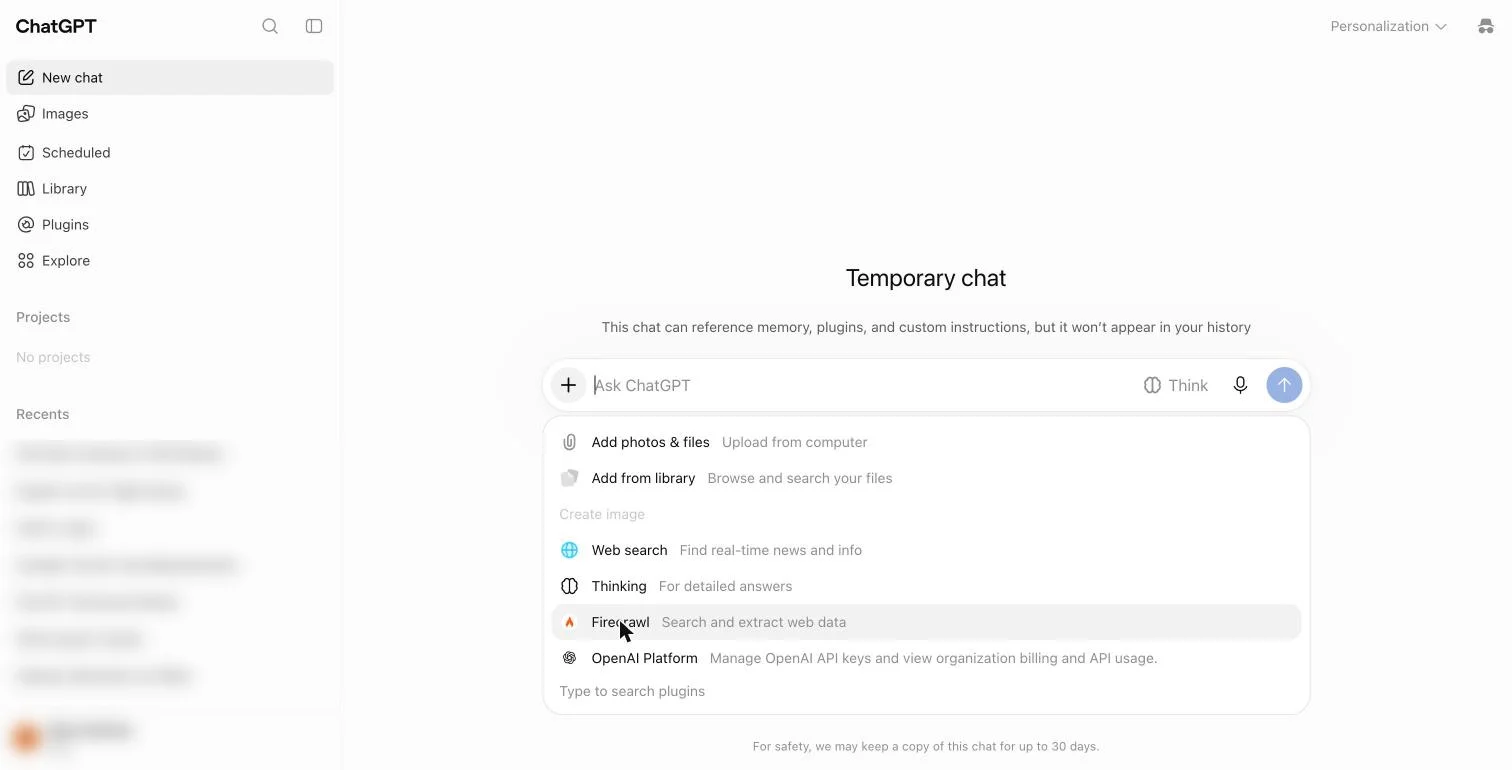
Ask ChatGPT for the data
Ask in plain language and mention FEMA or Firecrawl Alexandria. ChatGPT finds the FEMA capability that fits and runs it. For example:
Use Firecrawl to run FEMA's Get dataset fields capability. Inspect the Alexandria inputs, ask for any missing required details, and return a small sample with sources.
What can ChatGPT do with FEMA?
FEMA (fema.gov): the disaster-survivor referral directories (the national list and the 56 state and territory local-level lists, including American Samoa, the Northern Mariana Islands, the U.S. Virgin Islands, Guam and Puerto Rico) with service category, entity, type of assistance and telephone numbers, parsed from the server-rendered pages; and the anonymous OpenFEMA JSON API: disaster declaration search (DisasterDeclarationsSummaries v2), one disaster's declaration record, designated areas and funding totals, the dataset catalog (with refresh cadence, deprecation successors and bulk-file hand-offs), per-dataset data dictionaries, a generic OData query over any OpenFEMA dataset, and the collection contract over any dataset version: source_status (count, newest lastRefresh, publication id, deprecation, files), records_list (full listing pinned to one publication, segmentable by field equality and calendar year), records_changes (modified-since on lastRefresh) and records_get (one record by id). Also the National Risk Index (NRI v1.20, December 2025) table downloads: release status with file sizes and ETag MD5 hashes, paginated state, county, census-tract and tribal rows (risk, expected annual loss, social vulnerability, community resilience and 18 hazard blocks) pinned to one publication, single-row lookups by FIPS, the hazard catalogue and the data dictionary.
ChatGPT can run any of FEMA's 17 capabilities through Alexandria. Each call is billed in Firecrawl credits on your Firecrawl team.
- Get dataset fields: The data dictionary of one OpenFEMA dataset (/api/open/v1/DataSetFields filtered by entity and version): every field with its name, title, description, type, nullability, searchability and primary-key flag, in the dataset's sort order. An entity/version pair with no fields is `not_found`. Costs 5 Firecrawl credits per call.
- Get disaster: One FEMA disaster by disaster number from three OpenFEMA datasets: the web-facing declaration record (FemaWebDisasterDeclarations v1: name, state, dates, region, program flags, GIS links), its designated areas with program types (FemaWebDeclarationAreas v1) and its funding totals (FemaWebDisasterSummaries v1: IHP, HA, ONA, PA, HMGP obligations; null when FEMA publishes none yet). Field names are OpenFEMA's own (camelCase). An unknown disaster number is `not_found`. Costs 5 Firecrawl credits per call.
- Get local referrals: One state or territory local-level referral directory (/assistance/individual/disaster-survivors/state-local-referral-lists/{slug}): every row of the page's referral table with service category, entity, the entity's link when the page has one, the type of assistance, the telephone cell as written and the phone numbers parsed from it, plus the page's last-updated timestamp and Drupal node id. Rows are returned in page order; a cell the page leaves blank is null. Costs 5 Firecrawl credits per call.
- Get national referrals: The National Referral List (/assistance/individual/disaster-survivors/national-referral-list): the service categories the list covers and every row of the national-level referral table (category, entity, link, type of assistance, telephone text and parsed phone numbers), with the page's last-updated timestamp. Costs 5 Firecrawl credits per call.
- List datasets: The OpenFEMA dataset catalog (/api/open/v1/DataSets): every published dataset with its entity name, API version, title, record count, last refresh, data dictionary and landing page URLs and any deprecation notice, sorted by name; optionally narrowed to names containing a substring. `name` + `version` feed `get_dataset_fields` and `query_dataset`; each row also carries lastDataSetRefresh (reload time), accrualPeriodicity (refresh cadence), depNewURL (successor), webService, the catalogue hash and the bulk-file distribution (collection contract datasets/list). Costs 5 Firecrawl credits per call.
- List referral directories: The State and Local Level Referral Lists index (/assistance/individual/disaster-survivors/state-local-referral-lists): the 24 disaster recovery service categories FEMA lists and every state or territory referral directory with its name, page slug and URL (56 entries, territories included). Slugs feed `get_local_referrals`. Costs 5 Firecrawl credits per call.
- Nri dictionary: The NRI data dictionary (NRIDataDictionary.csv, shipped inside every table zip and read from the 653 KB States zip): one row per field of the NRI layers with alias, type, length, relevant layer, metric type and version; optionally filtered by a substring of the field name. Costs 5 Firecrawl credits per call.
- Nri get: One NRI row by its own id: counties by STCOFIPS or NRI_ID (30031 / C30031), states by STATEFIPS, NRI_ID or USPS code (30 / S30 / MT), tribal tables by OID_ or NRI_ID (first match, with match_count), tracts by TRACTFIPS or NRI_ID (30031000100 / T30031000100). The one-fetch tables are scanned from one zip download; a tract is found by a binary search of 64 KiB Range reads over the 634 MB CSV (about 15 reads; Connecticut tracts from one tail read), all pinned to one file MD5. Costs 5 Firecrawl credits per call.
- Nri hazards: The NRI hazard catalogue (NRI_HazardInfo.csv, shipped inside every table zip and read from the 653 KB States zip): the 18 hazards with their four-letter column prefixes (AVLN, CFLD, CWAV, DRGT, ERQK, HAIL, HWAV, HRCN, ISTM, IFLD, LNDS, LTNG, SWND, TRND, TSUN, VLCN, WFIR, WNTW), period of record, frequency model and which expected-annual-loss components apply. Costs 5 Firecrawl credits per call.
- Nri list: Rows of one NRI table as records pinned to a publication. states, counties, tribal_counties and tribal_tracts are one zip fetch per page (653 KB to 26.6 MB) with an optional state filter and `limit`/`cursor` row paging; tracts (634 MB) are read by byte range, one Range request of `page_bytes` per page cut at the last row boundary, cursor = publication MD5 + next byte offset. Any page whose file MD5 differs from the cursor's fails with invalid_input `publication_changed`. Costs 5 Firecrawl credits per call.
See all 17 capabilities and their inputs on the FEMA API page.
What should I ask ChatGPT?
Name FEMA or Firecrawl Alexandria in the prompt so ChatGPT reaches for it. Each example opens in ChatGPT with the prompt filled in.
- Use Firecrawl to run FEMA's Get dataset fields capability. Inspect the Alexandria inputs, ask for any missing required details, and return a small sample with sources.
- Use Firecrawl to run FEMA's Get disaster capability. Inspect the Alexandria inputs, ask for any missing required details, and return a small sample with sources.
- Use Firecrawl to run FEMA's Get local referrals capability. Inspect the Alexandria inputs, ask for any missing required details, and return a small sample with sources.
- Use Firecrawl to run FEMA's Get national referrals capability. Inspect the Alexandria inputs, ask for any missing required details, and return a small sample with sources.
Troubleshooting
Why doesn't ChatGPT use FEMA?
Start a new chat after installing so ChatGPT loads the plugin, then attach Firecrawl from the + menu and name FEMA or Firecrawl Alexandria in the prompt.
How do I switch the Firecrawl team ChatGPT uses?
Open the Firecrawl plugin page in ChatGPT, uninstall it from the menu next to Settings, then install it again and choose the other team on Firecrawl's consent screen.
Why does ChatGPT say FEMA isn't available?
Alexandria needs a Firecrawl team with Alexandria enabled. Reinstall the plugin and pick that team when you approve access.
Use FEMA in other AI apps
The same Firecrawl account reaches FEMA from other AI apps. Pick one for its setup steps:

Other data providers you can connect to ChatGPT
Frequently Asked Questions
What is Firecrawl?
Firecrawl is the web data API to search, scrape and interact with the web at scale. It turns websites into clean, LLM-ready data for AI agents and apps. The Firecrawl plugin brings those tools into ChatGPT, along with every data provider in Firecrawl Alexandria.
What is Firecrawl Alexandria?
Firecrawl Alexandria is Firecrawl's library of 550+ data providers for AI agents, FEMA among them. Each provider returns structured data through documented capabilities. ChatGPT finds the capability that fits your question and calls it through the Firecrawl plugin, so you don't write any integration code. Alexandria needs a Firecrawl account signed in on a team with Alexandria enabled, or an API key from such a team; keyless connections don't include it.
Is there a FEMA MCP server for ChatGPT?
ChatGPT reaches FEMA through Firecrawl's hosted MCP server, which serves FEMA and every other Alexandria provider as tools. Add the Firecrawl plugin once and you don't install or host a separate MCP server for FEMA.
What does connecting FEMA to ChatGPT unlock?
ChatGPT can run all 17 of FEMA's capabilities, including Get dataset fields, Get disaster and Get local referrals, from any chat, with structured results it can sort, compare and summarize. In the same conversation, ChatGPT can combine FEMA with Firecrawl's web search and scraping and the other providers in Firecrawl Alexandria.
Do I need my own FEMA account or API key to use it in ChatGPT?
No. ChatGPT calls FEMA through Firecrawl Alexandria and each call is billed in Firecrawl credits, so you don't need a separate FEMA account or API key.
How much does it cost to use FEMA in ChatGPT?
Each FEMA call costs 5 Firecrawl credits. The capability list on this page shows each price and its unit. The credits come from the Firecrawl team you connect to ChatGPT, and finding the right capability is free.
Can ChatGPT use other providers besides FEMA?
Yes. The same Firecrawl plugin reaches every provider in Firecrawl Alexandria, along with Firecrawl's web search and scraping, so you connect once.
Can I use FEMA in other AI apps?
Yes. Connect Firecrawl to Claude, Cursor, Grok Bot, Muse signed in on a Firecrawl team with Alexandria enabled, or use the Firecrawl MCP server, CLI or API with an API key from that team, and the same FEMA capabilities are available there. Keyless connections don't include Alexandria.