How to connect NCBI GEO to Claude
Add the Firecrawl connector to Claude once and it can call the NCBI GEO API and every other provider in Firecrawl Alexandria, with no NCBI GEO integration code.
To connect NCBI GEO to Claude, add the Firecrawl connector to Claude, sign in on a Firecrawl team with Alexandria enabled, and ask for NCBI GEO data in plain language. The connection works in Claude on the web, Claude Desktop and Cowork, and you set it up once.
Claude uses NCBI GEO as an MCP tool through Firecrawl's hosted MCP server, so you don't install or host a separate MCP server for NCBI GEO.
Claude is Anthropic's AI assistant. Connectors give it tools from other services, and the Firecrawl connector adds web search, scraping and every data provider in Firecrawl Alexandria.
How do I connect NCBI GEO to Claude?
Add the Firecrawl connector
Open the Firecrawl connector in Claude's connector directory and select Connect to Claude. In Claude Desktop you can also go to Customize, then Connectors, and search for Firecrawl.
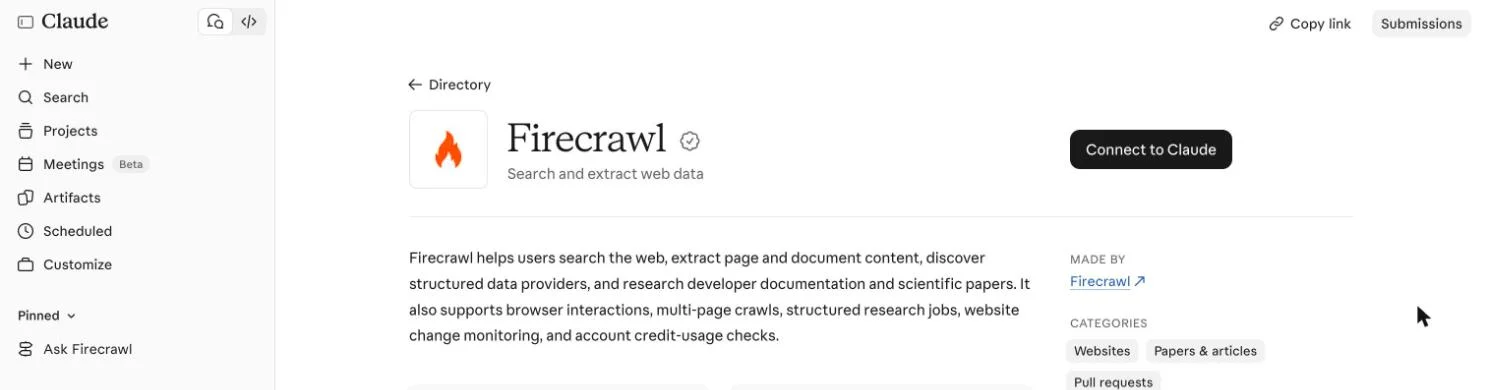
Connect your Firecrawl account
Claude opens Firecrawl in your browser. Sign in, choose a team with Alexandria enabled, and approve access. No account yet? You can create one for free in the same flow.
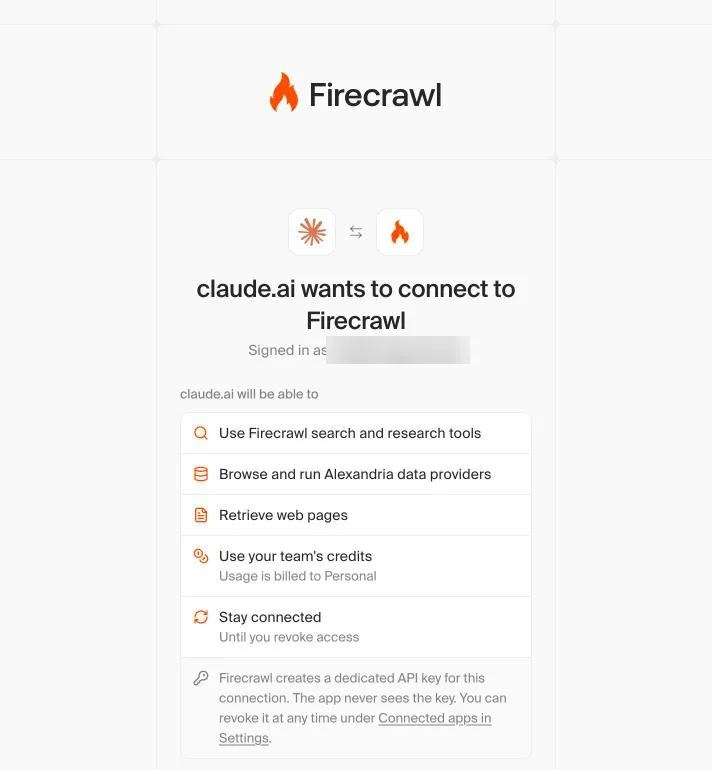
Turn on Firecrawl in a chat
In a new conversation, open the + menu, go to Connectors and switch on Firecrawl.
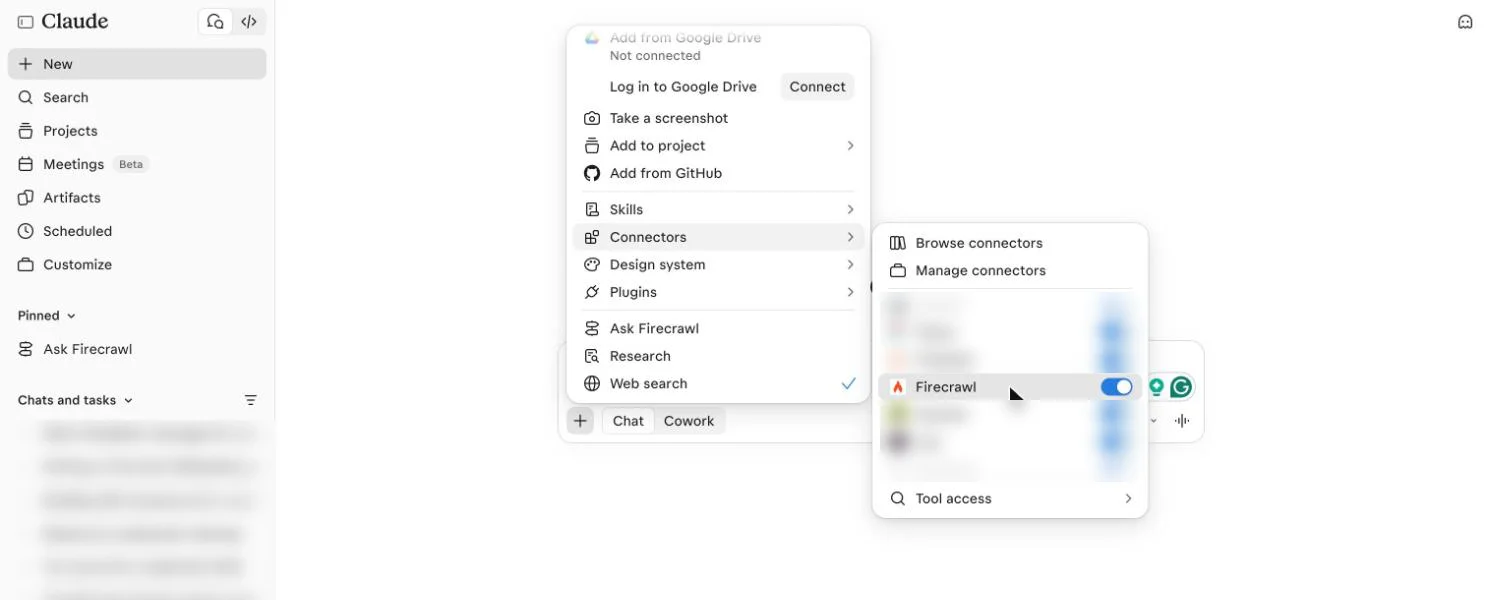
Ask Claude for the data
Ask in plain language and mention NCBI GEO or Firecrawl Alexandria. Claude finds the NCBI GEO capability that fits, checks its inputs and runs it. For example:
Use Firecrawl to find GEO RNA-seq series on breast cancer in human samples released in 2024.
What can Claude do with NCBI GEO?
NCBI Gene Expression Omnibus (GEO), the public archive of functional genomics data: search GEO series, curated DataSets, platforms and samples by text, organism, experiment type, platform and release date, and read a series (summary, overall design, platforms, organisms, samples, PubMed links, supplementary files), a sample (characteristics, protocols, sequencing library) or a platform. Uses NCBI E-utilities (db=gds) and the GEO accession viewer's SOFT text; no key or login.
Claude can run any of NCBI GEO's 4 capabilities through Alexandria. Each call is billed in Firecrawl credits on your Firecrawl team.
- Platform: One GEO platform (GPL) from the GEO accession viewer's SOFT text: title, technology, distribution, organisms, manufacturer and protocol, description, web links, contact, related platforms, annotation-table row count and the number of series and samples that used it. Unknown accessions are `not_found`. Costs 5 Firecrawl credits per call.
- Sample: One GEO sample (GSM) from the GEO accession viewer's SOFT text: title, type, dates, per-channel source, organism, characteristics (tag/value), molecule, label and protocols, description, data processing, sequencing library strategy/source/selection and instrument, platform, containing series, supplementary files, related BioSample/SRA records and data-table row count. Unknown and still-private accessions are `not_found`. Costs 5 Firecrawl credits per call.
- Search: Search GEO DataSets (NCBI E-utilities esearch + esummary, db=gds) with Entrez query syntax plus filters for record type (`GSE` series by default, `GDS`, `GPL`, `GSM` or `all`), organism, experiment type, platform and release-date range. Returns the total count, the Entrez translation of the term and one summary per hit (accession, title, summary, organisms, experiment types, platforms, sample count, release date, PubMed ids, supplementary file types, BioProject, file directory). Offset-paginated; an empty result is a valid empty page. Costs 5 Firecrawl credits per call.
- Series: One GEO series (GSE) from the GEO accession viewer's SOFT text, with sample titles from E-utilities esummary: title, summary, overall design, experiment types, release/submission/last-update dates, contributors and contact (name, institute, country), platforms, organisms with taxonomy ids, sample count and sample list (accession and title), linked PubMed ids, supplementary file URLs, related BioProject/SRA/SuperSeries records and the file directory. Unknown and still-private accessions are `not_found`. Costs 5 Firecrawl credits per call.
What should I ask Claude?
Name NCBI GEO or Firecrawl Alexandria in the prompt so Claude reaches for it. Each example opens in Claude with the prompt filled in.
- Use Firecrawl to find GEO RNA-seq series on breast cancer in human samples released in 2024.
- Use Firecrawl to answer this: Which GEO series used the Affymetrix HG-U133A platform (GPL96) for lymphoma?
- Use Firecrawl to show the overall design, samples and supplementary files of GEO series GSE183947.
- Use Firecrawl to find a GEO series on Alzheimer's disease and list the characteristics of its first sample.
Troubleshooting
Why doesn't Claude use NCBI GEO?
The connector has to be on in each conversation. Open the + menu, go to Connectors and check that Firecrawl is switched on, then ask again and name NCBI GEO or Firecrawl Alexandria in the prompt.
Claude says it can't reach the Firecrawl server. What should I do?
Open Customize, then Connectors, disconnect Firecrawl and connect it again. On a Team or Enterprise plan, an owner has to allow the connector before members can add it.
Why does Claude say NCBI GEO isn't available?
Alexandria needs a Firecrawl team with Alexandria enabled. Reconnect Firecrawl and pick that team on the consent screen.
Use NCBI GEO in other AI apps
The same Firecrawl account reaches NCBI GEO from other AI apps. Pick one for its setup steps:

Other data providers you can connect to Claude
Frequently Asked Questions
What is Firecrawl?
Firecrawl is the web data API to search, scrape and interact with the web at scale. It turns websites into clean, LLM-ready data for AI agents and apps. The Firecrawl connector brings those tools into Claude, along with every data provider in Firecrawl Alexandria.
What is Firecrawl Alexandria?
Firecrawl Alexandria is Firecrawl's library of 550+ data providers for AI agents, NCBI GEO among them. Each provider returns structured data through documented capabilities. Claude finds the capability that fits your question and calls it through the Firecrawl connector, so you don't write any integration code. Alexandria needs a Firecrawl account signed in on a team with Alexandria enabled, or an API key from such a team; keyless connections don't include it.
Is there a NCBI GEO MCP server for Claude?
Claude reaches NCBI GEO through Firecrawl's hosted MCP server, which serves NCBI GEO and every other Alexandria provider as tools. Add the Firecrawl connector once and you don't install or host a separate MCP server for NCBI GEO.
What does connecting NCBI GEO to Claude unlock?
Claude can run all 4 of NCBI GEO's capabilities, including Platform, Sample and Search, from any chat, with structured results it can sort, compare and summarize. For example, ask: "Use Firecrawl to find GEO RNA-seq series on breast cancer in human samples released in 2024." In the same conversation, Claude can combine NCBI GEO with Firecrawl's web search and scraping and the other providers in Firecrawl Alexandria.
Do I need my own NCBI GEO account or API key to use it in Claude?
No. Claude calls NCBI GEO through Firecrawl Alexandria and each call is billed in Firecrawl credits, so you don't need a separate NCBI GEO account or API key.
How much does it cost to use NCBI GEO in Claude?
Each NCBI GEO call costs 5 Firecrawl credits. The capability list on this page shows each price and its unit. The credits come from the Firecrawl team you connect to Claude, and finding the right capability is free.
Can Claude use other providers besides NCBI GEO?
Yes. The same Firecrawl connector reaches every provider in Firecrawl Alexandria, along with Firecrawl's web search and scraping, so you connect once.
Can I use NCBI GEO in other AI apps?
Yes. Connect Firecrawl to ChatGPT, Cursor, Grok Bot, Muse signed in on a Firecrawl team with Alexandria enabled, or use the Firecrawl MCP server, CLI or API with an API key from that team, and the same NCBI GEO capabilities are available there. Keyless connections don't include Alexandria.