How to connect GitHub to ChatGPT
Add the Firecrawl plugin to ChatGPT once and it can call the GitHub API and every other provider in Firecrawl Alexandria, with no GitHub integration code.
To connect GitHub to ChatGPT, add the Firecrawl plugin to ChatGPT, sign in on a Firecrawl team with Alexandria enabled, and ask for GitHub data in plain language. The connection works in ChatGPT and Codex, and you set it up once.
ChatGPT uses GitHub as an MCP tool through Firecrawl's hosted MCP server, so you don't install or host a separate MCP server for GitHub.
ChatGPT is OpenAI's AI assistant. Plugins add tools from other services, and the Firecrawl plugin adds web search, scraping and every data provider in Firecrawl Alexandria.
How do I connect GitHub to ChatGPT?
Install the Firecrawl plugin
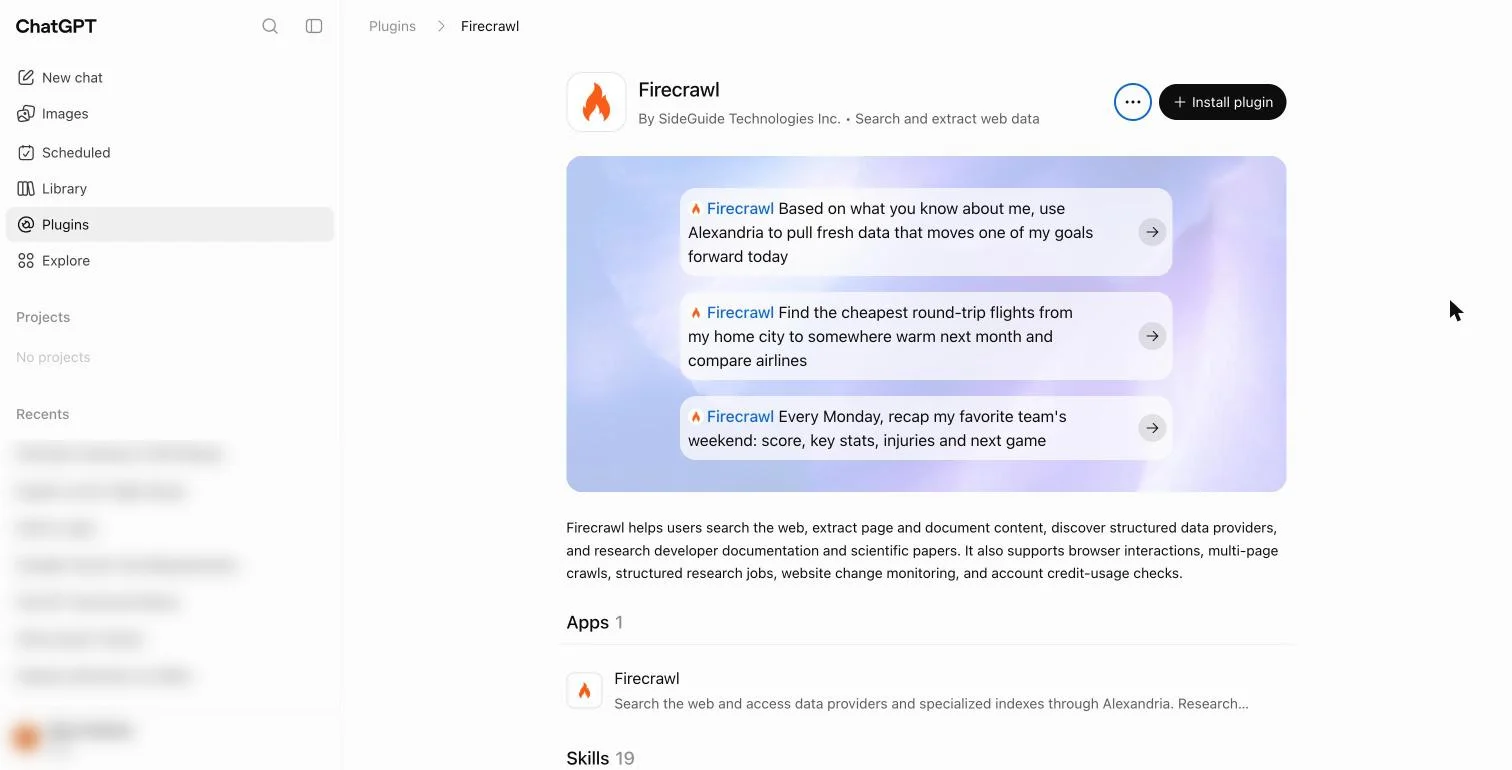
Open the Firecrawl listing in ChatGPT's plugin directory and select Install plugin. You can also open Plugins in ChatGPT or Codex and search for Firecrawl.
Connect your Firecrawl account
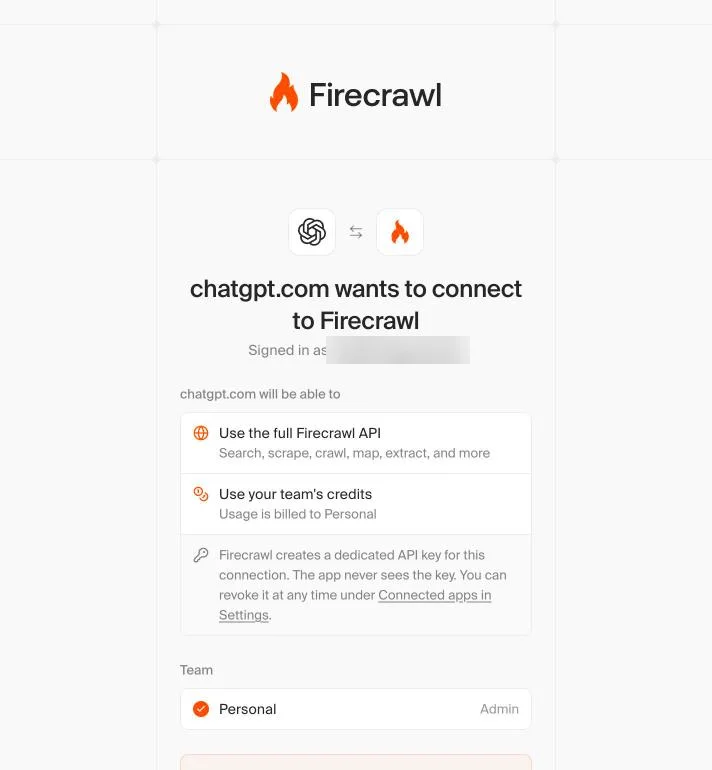
ChatGPT opens Firecrawl in your browser. Sign in, choose a team with Alexandria enabled, and approve access. No account yet? You can create one for free in the same flow.
Attach Firecrawl to a chat
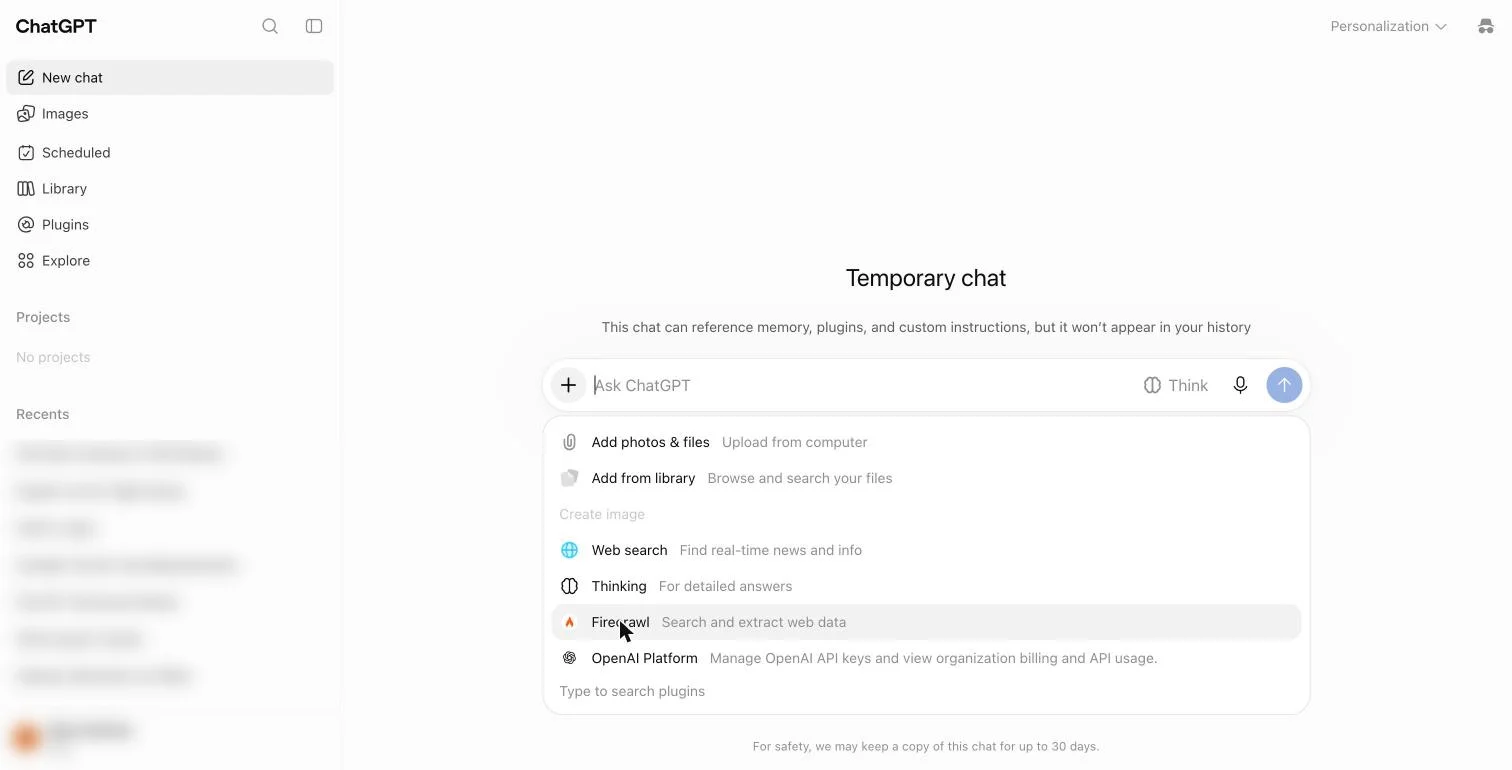
Start a new chat so it loads the plugin, open the + menu and choose Firecrawl. You can also ask ChatGPT to use Firecrawl by name.
Ask ChatGPT for the data
Ask in plain language and mention GitHub or Firecrawl Alexandria. ChatGPT finds the GitHub capability that fits and runs it. For example:
Use Firecrawl to answer this: How many stars and forks does firecrawl/firecrawl have and when was it created?
What can ChatGPT do with GitHub?
Public GitHub repositories, releases, issues, labels, contributors and raw file contents, plus the GitHub Advisory Database: reviewed, unreviewed and malware advisories with EPSS, CWEs and credits, and repositories' own security advisories, plus public user and organization profiles (counts, bio, company, location, top repositories and languages) and user search by location, language, followers and repository count. No email or contact data is returned: GitHub's Acceptable Use Policy forbids selling users' personal information.
ChatGPT can run any of GitHub's 15 capabilities through Alexandria. Each call is billed in Firecrawl credits on your Firecrawl team.
- Advisory: One GitHub Advisory Database record by GHSA id, CVE id or github.com/advisories URL: type (reviewed, unreviewed or malware), severity, CVSS v3 and v4, the EPSS exploit probability and percentile, CWE ids with names, every affected package with its vulnerable range, first patched version and vulnerable functions, credits (finder, reporter, remediation developer ...), references, the markdown description, and the GitHub review, NVD publication and withdrawal dates. Adds over osv-dev vuln and nvd-nist-gov cve: EPSS, CWE names, credit roles, the advisory type and vulnerable functions in one record. A CVE shared by several GHSA records returns the reviewed one and lists the rest. An unknown id is not_found. CC BY 4.0, attribute GitHub. Costs 5 Firecrawl credits per call.
- Contributors: One page of a repository's contributors ordered by commit count on the default branch, with login, account type and contribution count. Anonymous (email-only) contributors are not listed. GitHub refuses this listing for repositories with very large histories (for example torvalds/linux), which surfaces as an error naming the reason. Costs 5 Firecrawl credits per call.
- File: The text of one file in a public GitHub repository at a branch, tag or commit, given as a raw.githubusercontent.com URL, a github.com blob URL, or repo plus path (ref defaults to HEAD, the default branch). One ranged GET to raw.githubusercontent.com, which does not use the REST API's 60/hour quota. Returns at most the first 1 MiB: size_bytes is the full size and truncated marks a cut file, reported as partial. A binary or non-UTF-8 file fails with invalid_input (not_text); a missing file, ref or repository is not_found. Costs 1 Firecrawl credit per call.
- Issue counts: Exact issue counts for a repository (pull requests excluded, unlike the repository's open_issues_count): the total for the given state plus one count per requested label, from GitHub's issue search. Makes 1 + labels.length search requests; at most 5 labels per call because GitHub allows 10 keyless searches per minute per IP. Costs 5 Firecrawl credits per call.
- Issues: One page of a repository's issues filtered by state and labels (all given labels must match), sorted by created/updated/comments. Pull requests are excluded unless include_pull_requests is true, so a page may hold fewer than per_page records; pull_requests_excluded says how many were dropped. Each record carries title, state, labels, assignees, milestone, comment and reaction counts, body and timestamps. Costs 5 Firecrawl credits per call.
- Labels: The labels defined in a repository (name, color, description, whether GitHub-default), one page of up to 100. Use the names with issues and issue_counts. Costs 5 Firecrawl credits per call.
- Latest release: The latest published, non-prerelease, non-draft release of a repository with its release notes (Markdown body), tag, publish date, author and downloadable assets. found=false with release=null when the repository exists but has no published release. Costs 5 Firecrawl credits per call.
- Malware advisories: Malicious-package advisories from the GitHub Advisory Database (type malware), newest first by default: the package and ecosystem, the malicious version range, CWE-506 style weaknesses, references (often the OpenSSF malicious-packages report) and publication dates. Filter by ecosystem, package names and a publication date range; one cursor page of up to 100. OSV.dev and NVD have no malware browsing, so this is the feed to check a dependency list or watch an ecosystem for newly flagged packages. CC BY 4.0, attribute GitHub. Costs 5 Firecrawl credits per call.
- Releases: One page of a repository's releases, newest first, including pre-releases and drafts visible to the public, each with tag, name, notes body, publish date and assets. Paginate with page/per_page; has_next says whether another page exists. Costs 5 Firecrawl credits per call.
- Repo: One GitHub repository by owner/name or URL: stars, forks, watchers, open issue+PR count, creation/last-push dates, primary language, topics, license, default branch, homepage and flags (archived, fork, template). One request to GET /repos/{owner}/{name}; an unknown repository is an error. Costs 5 Firecrawl credits per call.
See all 15 capabilities and their inputs on the GitHub API page.
What should I ask ChatGPT?
Name GitHub or Firecrawl Alexandria in the prompt so ChatGPT reaches for it. Each example opens in ChatGPT with the prompt filled in.
- Use Firecrawl to answer this: How many stars and forks does firecrawl/firecrawl have and when was it created?
- Use Firecrawl to answer this: What are the latest published release notes for denoland/deno, including its tag and publication date?
- Use Firecrawl to answer this: How many open bug-labelled issues does microsoft/TypeScript have, excluding pull requests?
- Use Firecrawl to find the five most-starred public Rust CLI repositories and list the top five contributors by commit count for each.
Troubleshooting
Why doesn't ChatGPT use GitHub?
Start a new chat after installing so ChatGPT loads the plugin, then attach Firecrawl from the + menu and name GitHub or Firecrawl Alexandria in the prompt.
How do I switch the Firecrawl team ChatGPT uses?
Open the Firecrawl plugin page in ChatGPT, uninstall it from the menu next to Settings, then install it again and choose the other team on Firecrawl's consent screen.
Why does ChatGPT say GitHub isn't available?
Alexandria needs a Firecrawl team with Alexandria enabled. Reinstall the plugin and pick that team when you approve access.
Use GitHub in other AI apps
The same Firecrawl account reaches GitHub from other AI apps. Pick one for its setup steps:

Other data providers you can connect to ChatGPT
Frequently Asked Questions
What is Firecrawl?
Firecrawl is the web data API to search, scrape and interact with the web at scale. It turns websites into clean, LLM-ready data for AI agents and apps. The Firecrawl plugin brings those tools into ChatGPT, along with every data provider in Firecrawl Alexandria.
What is Firecrawl Alexandria?
Firecrawl Alexandria is Firecrawl's library of 550+ data providers for AI agents, GitHub among them. Each provider returns structured data through documented capabilities. ChatGPT finds the capability that fits your question and calls it through the Firecrawl plugin, so you don't write any integration code. Alexandria needs a Firecrawl account signed in on a team with Alexandria enabled, or an API key from such a team; keyless connections don't include it.
Is there a GitHub MCP server for ChatGPT?
ChatGPT reaches GitHub through Firecrawl's hosted MCP server, which serves GitHub and every other Alexandria provider as tools. Add the Firecrawl plugin once and you don't install or host a separate MCP server for GitHub.
What does connecting GitHub to ChatGPT unlock?
ChatGPT can run all 15 of GitHub's capabilities, including Advisory, Contributors and File, from any chat, with structured results it can sort, compare and summarize. For example, ask: "Use Firecrawl to answer this: How many stars and forks does firecrawl/firecrawl have and when was it created?" In the same conversation, ChatGPT can combine GitHub with Firecrawl's web search and scraping and the other providers in Firecrawl Alexandria.
Do I need my own GitHub account or API key to use it in ChatGPT?
No. ChatGPT calls GitHub through Firecrawl Alexandria and each call is billed in Firecrawl credits, so you don't need a separate GitHub account or API key.
How much does it cost to use GitHub in ChatGPT?
GitHub calls cost from 1 to 5 Firecrawl credits, depending on the capability. The capability list on this page shows each price and its unit. The credits come from the Firecrawl team you connect to ChatGPT, and finding the right capability is free.
Can ChatGPT use other providers besides GitHub?
Yes. The same Firecrawl plugin reaches every provider in Firecrawl Alexandria, along with Firecrawl's web search and scraping, so you connect once.
Can I use GitHub in other AI apps?
Yes. Connect Firecrawl to Claude, Cursor, Grok Bot, Muse signed in on a Firecrawl team with Alexandria enabled, or use the Firecrawl MCP server, CLI or API with an API key from that team, and the same GitHub capabilities are available there. Keyless connections don't include Alexandria.