How to connect Population allele frequencies and gene constraint (Broad Institute) to Cursor
Add the Firecrawl MCP server to Cursor once and it can call the Population allele frequencies and gene constraint (Broad Institute) API and every other provider in Firecrawl Alexandria, with no Population allele frequencies and gene constraint (Broad Institute) integration code.
To connect Population allele frequencies and gene constraint (Broad Institute) to Cursor, add the Firecrawl MCP server to Cursor, sign in on a Firecrawl team with Alexandria enabled, and ask for Population allele frequencies and gene constraint (Broad Institute) data in plain language. The connection works in Cursor's agent and chat, and you set it up once.
Cursor uses Population allele frequencies and gene constraint (Broad Institute) as an MCP tool through Firecrawl's hosted MCP server, so you don't install or host a separate MCP server for Population allele frequencies and gene constraint (Broad Institute).
Cursor is an AI code editor. Its agent uses MCP servers for outside tools, and the Firecrawl MCP server adds web search, scraping and every data provider in Firecrawl Alexandria.
How do I connect Population allele frequencies and gene constraint (Broad Institute) to Cursor?
Install the Firecrawl MCP server
Open the install dialog in Cursor, check that the URL is Firecrawl's hosted server, then select Install.
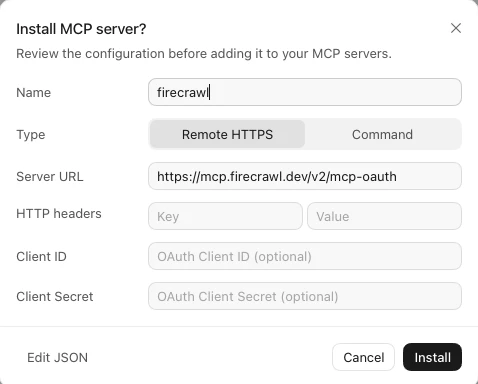
Connect your Firecrawl account
Use the server's sign-in option in Cursor's MCP settings. Firecrawl opens in your browser: sign in, choose a team with Alexandria enabled, and approve access. A green dot next to Firecrawl means it's connected.
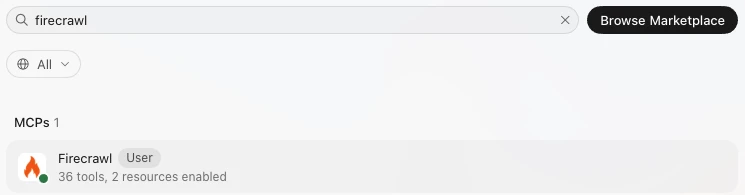
Ask Cursor's agent for the data
In the agent chat, ask in plain language and mention Population allele frequencies and gene constraint (Broad Institute) or Firecrawl Alexandria. The agent finds the Population allele frequencies and gene constraint (Broad Institute) capability that fits and runs it. For example:
Use Firecrawl to answer this: How loss-of-function intolerant is PCSK9 in gnomAD: pLI, LOEUF and observed versus expected pLoF variants?
What can Cursor do with Population allele frequencies and gene constraint (Broad Institute)?
gnomAD, the Genome Aggregation Database of the Broad Institute, through the public GraphQL API behind its browser: how often a variant occurs in 807,162 people (v4.1) by sequencing type (exomes, genomes, both combined) and genetic ancestry group, with homozygote and hemizygote counts, quality filters, the grpmax filtering allele frequency and its consequence on the MANE Select transcript with LOFTEE's loss-of-function call; a gene's constraint (pLI, LOEUF with its confidence interval and percentile, observed and expected pLoF, missense and synonymous variants, z scores); and the variants gnomAD lists in a gene, filtered by consequence, LOFTEE call and allele frequency. Takes gene symbols, Ensembl IDs, gnomAD variant IDs, rsIDs, ClinGen allele IDs and browser URLs, on gnomAD v4.1 and v3.1.2 (GRCh38) or v2.1.1 (GRCh37). Primary data is CC0: every answer carries gnomAD's attribution, citation and terms of use.
Cursor can run any of Population allele frequencies and gene constraint (Broad Institute)'s 3 capabilities through Alexandria. Each call is billed in Firecrawl credits on your Firecrawl team.
- Frequency: One variant's allele frequencies in gnomAD, by gnomAD variant ID (19-44908684-T-C, also chr19:44908684:T:C or 19-44908684-T>C), rsID (rs429358), ClinGen allele ID (CA127512) or gnomAD variant page URL. For each sequencing type (exomes, genomes, and in v4 both combined) it returns allele count, allele number, frequency, homozygote and hemizygote counts, quality filters and flags, the grpmax filtering allele frequency (faf95) with its group, and a row per genetic ancestry group (African/African American, Admixed American, Ashkenazi Jewish, East Asian, European (Finnish), Middle Eastern, European (non-Finnish), Amish, South Asian, Remaining), optionally split into XX and XY. Also the variant's rsIDs, CAID, co-located variants and, per gene, its consequence on the MANE Select (else canonical) transcript with HGVSc, HGVSp and LOFTEE's call. A multi-allelic rsID returns every allele. Variants gnomAD has not seen are not_found; a site where no alternate allele passed quality control is returned with AC 0 and its AC0 filter. Costs 5 Firecrawl credits per call.
- Search: The variants gnomAD lists in a gene, by HGNC symbol, Ensembl gene ID or gnomAD gene page URL, filtered and paged. Each row has the variant ID, rsIDs, the most severe consequence in the gene and its category (lof, missense, inframe, synonymous, splice_region, utr, intron, other), transcript, HGVSc, HGVSp, LOFTEE call and flags, variant flags, and AC, AN, AF, homozygote count and quality filters for exomes, genomes and (v4) both combined. Filter by consequence categories, LOFTEE high-confidence pLoF only, and a minimum and maximum allele frequency (joint in v4, else exomes and genomes summed); sort by position or by frequency, highest first. The whole gene is read in one request (TTN, the largest, has 112,412 variants). total_in_gene and total count the gene's variants and the matches; unknown genes are not_found. Costs 5 Firecrawl credits per call.
- Constraint: gnomAD's constraint metrics for one gene, by HGNC symbol (PCSK9), Ensembl gene ID with or without version (ENSG00000169174.11) or gnomAD gene page URL, on GRCh38 (gnomAD v4.1.2 constraint, the default) or GRCh37 (v2.1.1). Returns the gene's identity (Ensembl ID and version, symbol, name, HGNC, NCBI Gene and OMIM IDs, location, Ensembl canonical and MANE Select transcripts) and its constraint: pLI, LOEUF with its LOEUF percentile, and for pLoF, missense and synonymous variants the observed and expected counts, observed/expected ratio with its 90% confidence interval and z score, plus gnomAD's gene and constraint flags. Genes gnomAD computes no constraint for (most non-coding genes) return constraint null with a no_constraint warning; unknown genes are not_found. Costs 5 Firecrawl credits per call.
What should I ask Cursor?
Name Population allele frequencies and gene constraint (Broad Institute) or Firecrawl Alexandria in the prompt so Cursor reaches for it. Each example opens in Cursor with the prompt filled in.
- Use Firecrawl to answer this: How loss-of-function intolerant is PCSK9 in gnomAD: pLI, LOEUF and observed versus expected pLoF variants?
- Use Firecrawl to answer this: How common is the APOE e4 allele rs429358 in each ancestry group in gnomAD?
- Use Firecrawl to answer this: Which high-confidence loss-of-function variants in TTN have a gnomAD frequency above 0.01%?
- Use Firecrawl to answer this: What is the most common missense variant in PCSK9 in gnomAD, and how does its frequency vary by ancestry?
Troubleshooting
Why can't Cursor find Population allele frequencies and gene constraint (Broad Institute)?
If Firecrawl's tools in Cursor stop at search, scrape and parse, the connection is keyless and doesn't include Alexandria. Finish the sign-in from Cursor's MCP settings, or add an API key from a team with Alexandria enabled.
Firecrawl shows a red dot in Cursor. What should I do?
Open Cursor's MCP settings, sign in to Firecrawl again, and restart the agent chat so it loads the tools.
Use Population allele frequencies and gene constraint (Broad Institute) in other AI apps
The same Firecrawl account reaches Population allele frequencies and gene constraint (Broad Institute) from other AI apps. Pick one for its setup steps:
- Population allele frequencies and gene constraint (Broad Institute) in ChatGPT
- Population allele frequencies and gene constraint (Broad Institute) in Claude
- Population allele frequencies and gene constraint (Broad Institute) in Grok Bot
 Population allele frequencies and gene constraint (Broad Institute) in Muse
Other data providers you can connect to Cursor
Frequently Asked Questions
What is Firecrawl?
Firecrawl is the web data API to search, scrape and interact with the web at scale. It turns websites into clean, LLM-ready data for AI agents and apps. The Firecrawl MCP server brings those tools into Cursor, along with every data provider in Firecrawl Alexandria.
What is Firecrawl Alexandria?
Firecrawl Alexandria is Firecrawl's library of 550+ data providers for AI agents, Population allele frequencies and gene constraint (Broad Institute) among them. Each provider returns structured data through documented capabilities. Cursor finds the capability that fits your question and calls it through the Firecrawl MCP server, so you don't write any integration code. Alexandria needs a Firecrawl account signed in on a team with Alexandria enabled, or an API key from such a team; keyless connections don't include it.
Is there a Population allele frequencies and gene constraint (Broad Institute) MCP server for Cursor?
Cursor reaches Population allele frequencies and gene constraint (Broad Institute) through Firecrawl's hosted MCP server, which serves Population allele frequencies and gene constraint (Broad Institute) and every other Alexandria provider as tools. Add the Firecrawl MCP server once and you don't install or host a separate MCP server for Population allele frequencies and gene constraint (Broad Institute).
What does connecting Population allele frequencies and gene constraint (Broad Institute) to Cursor unlock?
Cursor can run Population allele frequencies and gene constraint (Broad Institute)'s Frequency, Search and Constraint, from any chat, with structured results it can sort, compare and summarize. For example, ask: "Use Firecrawl to answer this: How loss-of-function intolerant is PCSK9 in gnomAD: pLI, LOEUF and observed versus expected pLoF variants?" In the same conversation, Cursor can combine Population allele frequencies and gene constraint (Broad Institute) with Firecrawl's web search and scraping and the other providers in Firecrawl Alexandria.
Do I need my own Population allele frequencies and gene constraint (Broad Institute) account or API key to use it in Cursor?
No. Cursor calls Population allele frequencies and gene constraint (Broad Institute) through Firecrawl Alexandria and each call is billed in Firecrawl credits, so you don't need a separate Population allele frequencies and gene constraint (Broad Institute) account or API key.
How much does it cost to use Population allele frequencies and gene constraint (Broad Institute) in Cursor?
Each Population allele frequencies and gene constraint (Broad Institute) call costs 5 Firecrawl credits. The capability list on this page shows each price and its unit. The credits come from the Firecrawl team you connect to Cursor, and finding the right capability is free.
Can Cursor use other providers besides Population allele frequencies and gene constraint (Broad Institute)?
Yes. The same Firecrawl MCP server reaches every provider in Firecrawl Alexandria, along with Firecrawl's web search and scraping, so you connect once.
Can I use Population allele frequencies and gene constraint (Broad Institute) in other AI apps?
Yes. Connect Firecrawl to ChatGPT, Claude, Grok Bot, Muse signed in on a Firecrawl team with Alexandria enabled, or use the Firecrawl MCP server, CLI or API with an API key from that team, and the same Population allele frequencies and gene constraint (Broad Institute) capabilities are available there. Keyless connections don't include Alexandria.