How to connect USITC Harmonized Tariff Schedule (HTSUS) to Cursor
Add the Firecrawl MCP server to Cursor once and it can call the USITC Harmonized Tariff Schedule (HTSUS) API and every other provider in Firecrawl Alexandria, with no USITC Harmonized Tariff Schedule (HTSUS) integration code.
To connect USITC Harmonized Tariff Schedule (HTSUS) to Cursor, add the Firecrawl MCP server to Cursor, sign in on a Firecrawl team with Alexandria enabled, and ask for USITC Harmonized Tariff Schedule (HTSUS) data in plain language. The connection works in Cursor's agent and chat, and you set it up once.
Cursor uses USITC Harmonized Tariff Schedule (HTSUS) as an MCP tool through Firecrawl's hosted MCP server, so you don't install or host a separate MCP server for USITC Harmonized Tariff Schedule (HTSUS).
Cursor is an AI code editor. Its agent uses MCP servers for outside tools, and the Firecrawl MCP server adds web search, scraping and every data provider in Firecrawl Alexandria.
How do I connect USITC Harmonized Tariff Schedule (HTSUS) to Cursor?
Install the Firecrawl MCP server
Open the install dialog in Cursor, check that the URL is Firecrawl's hosted server, then select Install.
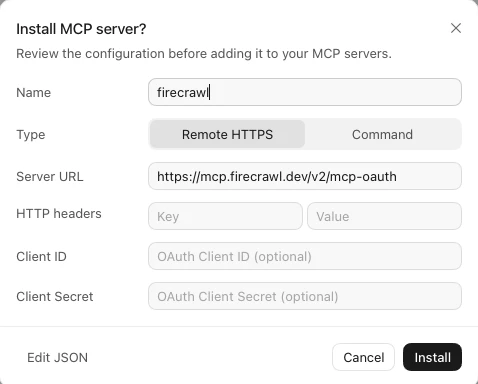
Connect your Firecrawl account
Use the server's sign-in option in Cursor's MCP settings. Firecrawl opens in your browser: sign in, choose a team with Alexandria enabled, and approve access. A green dot next to Firecrawl means it's connected.
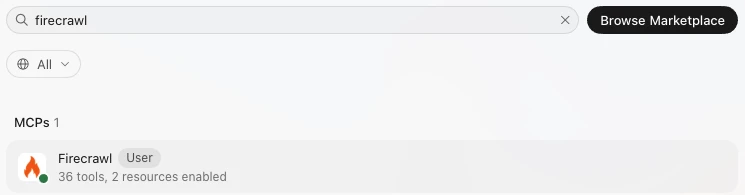
Ask Cursor's agent for the data
In the agent chat, ask in plain language and mention USITC Harmonized Tariff Schedule (HTSUS) or Firecrawl Alexandria. The agent finds the USITC Harmonized Tariff Schedule (HTSUS) capability that fits and runs it. For example:
Use Firecrawl to run USITC Harmonized Tariff Schedule (HTSUS)'s Records get capability. Inspect the Alexandria inputs, ask for any missing required details, and return a small sample with sources.
What can Cursor do with USITC Harmonized Tariff Schedule (HTSUS)?
The Harmonized Tariff Schedule of the United States from the USITC HTS REST API (hts.usitc.gov/reststop): the current revision's identity and dates, every HTS line (4-, 6-, 8- and 10-digit numbers, group headings, descriptions, units, General/Special/Column 2 duty rates, footnotes) one chapter per page, one line by HTS number, and keyword search. Current revision only: the API serves no archived revisions as data.
Cursor can run any of USITC Harmonized Tariff Schedule (HTSUS)'s 4 capabilities through Alexandria. Each call is billed in Firecrawl credits on your Firecrawl team.
- Records get: One HTS line by its number: exports the 4-digit heading's range (`exportList?from=HHHH&to=HHHH.99.99.99`) and returns the matching row in the same shape as `records_list`, with `parent_htsno` computed within the heading. Accepts the dotted form (`8541.43.00.10`) or bare digits (`8541430010`) with 4, 6, 8 or 10 digits, and the `<chapter>:<ordinal>` id that `records_list` gives unnumbered headings (one chapter export). A number the current revision does not carry is `not_found`. Collection contract name: `records/get`. Costs 5 Firecrawl credits per call.
- Records list: Every HTS line of the current revision, segmented by chapter: `exportList?from=CC00&to=CC99&format=JSON&styles=false` for one two-digit chapter per segment, paged by `limit` rows. Before each page the current revision name is re-read (`reststop/currentRelease`) and compared with the one pinned in the cursor; if it moved the call fails with `invalid_input` and issue code `publication_changed` on `/continuation` instead of mixing revisions (the server always serves the current revision; it ignores `release=`). Chapter 77 is reserved and empty; empty chapters are skipped. Rows are mapped per the collection contract: `htsno` as `source_record_id` (unnumbered headings get `<chapter>:<ordinal>` and a `parent_htsno`), derived `hts_level`, `hs6`, `statistical_suffix`, `chapter`. Collection contract name: `records/list`. Costs 5 Firecrawl credits per call.
- Search: Keyword search of the current revision through `reststop/search?keyword=`: substring match on article descriptions and HTS numbers, the server returns every hit (152 for `copper`) and this function keeps the first `limit`. Hits carry the search endpoint's own fields (`statisticalSuffix`, `effectivePeriod`) plus the derived `hts_level`, `hs6` and `chapter`. No hits is a legitimate empty result. Costs 5 Firecrawl credits per call.
- Source status: Cheap version check of the Harmonized Tariff Schedule: the current revision from `reststop/releaseList` (exactly one entry has `status: current`) with its name as `publication_id`, title, publication and effective dates, the previous revision and the publisher's PDF/JSON file URLs. The publisher posts no hash and the API sends no ETag, so `content_hash` and `record_count` are null: `publication_id` is the change key (a new revision every ~2 weeks). Collection contract name: `source/status`. Costs 5 Firecrawl credits per call.
What should I ask Cursor?
Name USITC Harmonized Tariff Schedule (HTSUS) or Firecrawl Alexandria in the prompt so Cursor reaches for it. Each example opens in Cursor with the prompt filled in.
- Use Firecrawl to run USITC Harmonized Tariff Schedule (HTSUS)'s Records get capability. Inspect the Alexandria inputs, ask for any missing required details, and return a small sample with sources.
- Use Firecrawl to run USITC Harmonized Tariff Schedule (HTSUS)'s Records list capability. Inspect the Alexandria inputs, ask for any missing required details, and return a small sample with sources.
- Use Firecrawl to run USITC Harmonized Tariff Schedule (HTSUS)'s Search capability. Inspect the Alexandria inputs, ask for any missing required details, and return a small sample with sources.
- Use Firecrawl to run USITC Harmonized Tariff Schedule (HTSUS)'s Source status capability. Inspect the Alexandria inputs, ask for any missing required details, and return a small sample with sources.
Troubleshooting
Why can't Cursor find USITC Harmonized Tariff Schedule (HTSUS)?
If Firecrawl's tools in Cursor stop at search, scrape and parse, the connection is keyless and doesn't include Alexandria. Finish the sign-in from Cursor's MCP settings, or add an API key from a team with Alexandria enabled.
Firecrawl shows a red dot in Cursor. What should I do?
Open Cursor's MCP settings, sign in to Firecrawl again, and restart the agent chat so it loads the tools.
Use USITC Harmonized Tariff Schedule (HTSUS) in other AI apps
The same Firecrawl account reaches USITC Harmonized Tariff Schedule (HTSUS) from other AI apps. Pick one for its setup steps:
- USITC Harmonized Tariff Schedule (HTSUS) in ChatGPT
- USITC Harmonized Tariff Schedule (HTSUS) in Claude
- USITC Harmonized Tariff Schedule (HTSUS) in Grok Bot
 USITC Harmonized Tariff Schedule (HTSUS) in Muse
Other data providers you can connect to Cursor
Frequently Asked Questions
What is Firecrawl?
Firecrawl is the web data API to search, scrape and interact with the web at scale. It turns websites into clean, LLM-ready data for AI agents and apps. The Firecrawl MCP server brings those tools into Cursor, along with every data provider in Firecrawl Alexandria.
What is Firecrawl Alexandria?
Firecrawl Alexandria is Firecrawl's library of 550+ data providers for AI agents, USITC Harmonized Tariff Schedule (HTSUS) among them. Each provider returns structured data through documented capabilities. Cursor finds the capability that fits your question and calls it through the Firecrawl MCP server, so you don't write any integration code. Alexandria needs a Firecrawl account signed in on a team with Alexandria enabled, or an API key from such a team; keyless connections don't include it.
Is there a USITC Harmonized Tariff Schedule (HTSUS) MCP server for Cursor?
Cursor reaches USITC Harmonized Tariff Schedule (HTSUS) through Firecrawl's hosted MCP server, which serves USITC Harmonized Tariff Schedule (HTSUS) and every other Alexandria provider as tools. Add the Firecrawl MCP server once and you don't install or host a separate MCP server for USITC Harmonized Tariff Schedule (HTSUS).
What does connecting USITC Harmonized Tariff Schedule (HTSUS) to Cursor unlock?
Cursor can run all 4 of USITC Harmonized Tariff Schedule (HTSUS)'s capabilities, including Records get, Records list and Search, from any chat, with structured results it can sort, compare and summarize. In the same conversation, Cursor can combine USITC Harmonized Tariff Schedule (HTSUS) with Firecrawl's web search and scraping and the other providers in Firecrawl Alexandria.
Do I need my own USITC Harmonized Tariff Schedule (HTSUS) account or API key to use it in Cursor?
No. Cursor calls USITC Harmonized Tariff Schedule (HTSUS) through Firecrawl Alexandria and each call is billed in Firecrawl credits, so you don't need a separate USITC Harmonized Tariff Schedule (HTSUS) account or API key.
How much does it cost to use USITC Harmonized Tariff Schedule (HTSUS) in Cursor?
Each USITC Harmonized Tariff Schedule (HTSUS) call costs 5 Firecrawl credits. The capability list on this page shows each price and its unit. The credits come from the Firecrawl team you connect to Cursor, and finding the right capability is free.
Can Cursor use other providers besides USITC Harmonized Tariff Schedule (HTSUS)?
Yes. The same Firecrawl MCP server reaches every provider in Firecrawl Alexandria, along with Firecrawl's web search and scraping, so you connect once.
Can I use USITC Harmonized Tariff Schedule (HTSUS) in other AI apps?
Yes. Connect Firecrawl to ChatGPT, Claude, Grok Bot, Muse signed in on a Firecrawl team with Alexandria enabled, or use the Firecrawl MCP server, CLI or API with an API key from that team, and the same USITC Harmonized Tariff Schedule (HTSUS) capabilities are available there. Keyless connections don't include Alexandria.