How to connect Docker Hub to Cursor
Add the Firecrawl MCP server to Cursor once and it can call the Docker Hub API and every other provider in Firecrawl Alexandria, with no Docker Hub integration code.
To connect Docker Hub to Cursor, add the Firecrawl MCP server to Cursor, sign in on a Firecrawl team with Alexandria enabled, and ask for Docker Hub data in plain language. The connection works in Cursor's agent and chat, and you set it up once.
Cursor uses Docker Hub as an MCP tool through Firecrawl's hosted MCP server, so you don't install or host a separate MCP server for Docker Hub.
Cursor is an AI code editor. Its agent uses MCP servers for outside tools, and the Firecrawl MCP server adds web search, scraping and every data provider in Firecrawl Alexandria.
How do I connect Docker Hub to Cursor?
Install the Firecrawl MCP server
Open the install dialog in Cursor, check that the URL is Firecrawl's hosted server, then select Install.
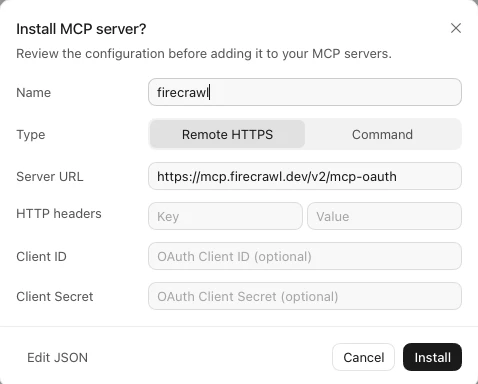
Connect your Firecrawl account
Use the server's sign-in option in Cursor's MCP settings. Firecrawl opens in your browser: sign in, choose a team with Alexandria enabled, and approve access. A green dot next to Firecrawl means it's connected.
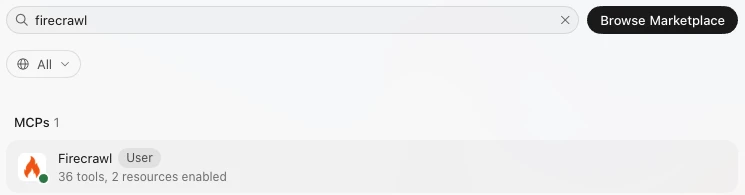
Ask Cursor's agent for the data
In the agent chat, ask in plain language and mention Docker Hub or Firecrawl Alexandria. The agent finds the Docker Hub capability that fits and runs it. For example:
Use Firecrawl to search Docker Hub for nginx and show the first 10 image repositories with descriptions and publisher information.
What can Cursor do with Docker Hub?
Docker Hub, the public container image registry: catalog search with badge, architecture, OS and category filters; repository metadata and README; tag listings and tag detail with per-architecture digests, sizes and push dates; a namespace's repositories and profile; catalog categories; Docker Scout vulnerability summaries by image digest.
Cursor can run any of Docker Hub's 8 capabilities through Alexandria. Each call is billed in Firecrawl credits on your Firecrawl team.
- Get image vulnerability summary: Docker Scout's public vulnerability summary for image digests of a Docker Hub repository (`api.scout.docker.com/v1/graphql`, query `imageSummariesByDigest`): per digest the SBOM indexing state and the count of critical, high, medium, low and unspecified CVEs. Digests come from `list_tags`/`get_tag` (`images[].digest`). Digests Scout has not indexed are listed in `missing_digests`; when none of the requested digests is known the call is `not_found`. Costs 5 Firecrawl credits per call.
- Get namespace: Public profile of a Docker Hub namespace from `/v2/orgs/{namespace}/` (which also answers for individual users): type (Organization or User), display name, company, location, profile link, join date, avatar and, for organizations, the verified-publisher badge and active flag. Costs 5 Firecrawl credits per call.
- Get repository: One public repository from Docker Hub's `/v2/repositories/{namespace}/{repository}/`: description and full Markdown description, pull and star counts, last push/update and registration timestamps, categories, manifest media types and content types, storage size, registry region and immutable-tag setting. Official images live in the `library` namespace (`library/nginx`). Accepts a pasted `https://hub.docker.com/_/{repo}` or `/r/{namespace}/{repo}` URL instead of the name pair. Costs 5 Firecrawl credits per call.
- Get tag: One tag of a repository from Docker Hub's `/v2/repositories/{namespace}/{repository}/tags/{tag}`: manifest digest, size, media and content type, status, last push/pull/update timestamps, last updater and the per-platform images (architecture, variant, OS, digest, size, status, last pushed/pulled). Costs 5 Firecrawl credits per call.
- List categories: The fixed list of Docker Hub catalog categories from `/v2/categories/` (name and slug, e.g. `Databases & storage` / `databases-and-storage`); slugs feed `search_images.categories`. Costs 5 Firecrawl credits per call.
- List namespace repositories: Public repositories of one namespace (organization or user) from Docker Hub's `/v2/repositories/{namespace}/`: name, description, pull and star counts, last push and registration timestamps, categories, media and content types, storage size and registry region. `library` lists the Docker Official Images. Pages of `page_size` repositories; `cursor` is the next page number. An unknown namespace is `not_found`. Costs 5 Firecrawl credits per call.
- List tags: Tags of one repository from Docker Hub's `/v2/repositories/{namespace}/{repository}/tags`: each tag with its manifest digest, size, media type, status, last push/pull/update timestamps, the account that last pushed it and one entry per platform (architecture, variant, OS, digest, size, last pushed/pulled). Optional substring filter on the tag name and ordering by last update (newest first by default, `-last_updated` oldest first) or by name. Pages of `page_size` tags; `cursor` is the next page number. Costs 5 Firecrawl credits per call.
- Search images: Search Docker Hub's public catalog (`/api/search/v4`): images, Docker Hardened Images and Desktop extensions matching a query, with badge (official, verified publisher, open source, hardened), architecture, operating system and category filters, sorted by relevance, pull count or update time. Each hit carries the exact and the rounded pull count, star count, supported architectures and operating systems, categories, publisher, created/updated timestamps and its public URL; image hits also carry `namespace`/`repository` for `get_repository` and `list_tags`. Offset pages of `page_size` hits; `cursor` is the offset of the next page. Costs 5 Firecrawl credits per call.
What should I ask Cursor?
Name Docker Hub or Firecrawl Alexandria in the prompt so Cursor reaches for it. Each example opens in Cursor with the prompt filled in.
- Use Firecrawl to search Docker Hub for nginx and show the first 10 image repositories with descriptions and publisher information.
- Use Firecrawl to show the latest 10 tags of the official nginx Docker image with update times and supported architectures.
- Use Firecrawl to read the official nginx latest tag, then show Docker Scout’s reported critical, high, medium and low CVE counts for its platform digests, identifying any unindexed digests.
- Use Firecrawl to list the first 10 public repositories in Docker Hub’s grafana namespace with descriptions and pull counts.
Troubleshooting
Why can't Cursor find Docker Hub?
If Firecrawl's tools in Cursor stop at search, scrape and parse, the connection is keyless and doesn't include Alexandria. Finish the sign-in from Cursor's MCP settings, or add an API key from a team with Alexandria enabled.
Firecrawl shows a red dot in Cursor. What should I do?
Open Cursor's MCP settings, sign in to Firecrawl again, and restart the agent chat so it loads the tools.
Use Docker Hub in other AI apps
The same Firecrawl account reaches Docker Hub from other AI apps. Pick one for its setup steps:

Other data providers you can connect to Cursor
Frequently Asked Questions
What is Firecrawl?
Firecrawl is the web data API to search, scrape and interact with the web at scale. It turns websites into clean, LLM-ready data for AI agents and apps. The Firecrawl MCP server brings those tools into Cursor, along with every data provider in Firecrawl Alexandria.
What is Firecrawl Alexandria?
Firecrawl Alexandria is Firecrawl's library of 550+ data providers for AI agents, Docker Hub among them. Each provider returns structured data through documented capabilities. Cursor finds the capability that fits your question and calls it through the Firecrawl MCP server, so you don't write any integration code. Alexandria needs a Firecrawl account signed in on a team with Alexandria enabled, or an API key from such a team; keyless connections don't include it.
Is there a Docker Hub MCP server for Cursor?
Cursor reaches Docker Hub through Firecrawl's hosted MCP server, which serves Docker Hub and every other Alexandria provider as tools. Add the Firecrawl MCP server once and you don't install or host a separate MCP server for Docker Hub.
What does connecting Docker Hub to Cursor unlock?
Cursor can run all 8 of Docker Hub's capabilities, including Get image vulnerability summary, Get namespace and Get repository, from any chat, with structured results it can sort, compare and summarize. For example, ask: "Use Firecrawl to search Docker Hub for nginx and show the first 10 image repositories with descriptions and publisher information." In the same conversation, Cursor can combine Docker Hub with Firecrawl's web search and scraping and the other providers in Firecrawl Alexandria.
Do I need my own Docker Hub account or API key to use it in Cursor?
No. Cursor calls Docker Hub through Firecrawl Alexandria and each call is billed in Firecrawl credits, so you don't need a separate Docker Hub account or API key.
How much does it cost to use Docker Hub in Cursor?
Each Docker Hub call costs 5 Firecrawl credits. The capability list on this page shows each price and its unit. The credits come from the Firecrawl team you connect to Cursor, and finding the right capability is free.
Can Cursor use other providers besides Docker Hub?
Yes. The same Firecrawl MCP server reaches every provider in Firecrawl Alexandria, along with Firecrawl's web search and scraping, so you connect once.
Can I use Docker Hub in other AI apps?
Yes. Connect Firecrawl to ChatGPT, Claude, Grok Bot, Muse signed in on a Firecrawl team with Alexandria enabled, or use the Firecrawl MCP server, CLI or API with an API key from that team, and the same Docker Hub capabilities are available there. Keyless connections don't include Alexandria.