How to connect Orphanet (Orphadata): rare disease prevalence, codes and genes to Cursor
Add the Firecrawl MCP server to Cursor once and it can call the Orphanet (Orphadata): rare disease prevalence, codes and genes API and every other provider in Firecrawl Alexandria, with no Orphanet (Orphadata): rare disease prevalence, codes and genes integration code.
To connect Orphanet (Orphadata): rare disease prevalence, codes and genes to Cursor, add the Firecrawl MCP server to Cursor, sign in on a Firecrawl team with Alexandria enabled, and ask for Orphanet (Orphadata): rare disease prevalence, codes and genes data in plain language. The connection works in Cursor's agent and chat, and you set it up once.
Cursor uses Orphanet (Orphadata): rare disease prevalence, codes and genes as an MCP tool through Firecrawl's hosted MCP server, so you don't install or host a separate MCP server for Orphanet (Orphadata): rare disease prevalence, codes and genes.
Cursor is an AI code editor. Its agent uses MCP servers for outside tools, and the Firecrawl MCP server adds web search, scraping and every data provider in Firecrawl Alexandria.
How do I connect Orphanet (Orphadata): rare disease prevalence, codes and genes to Cursor?
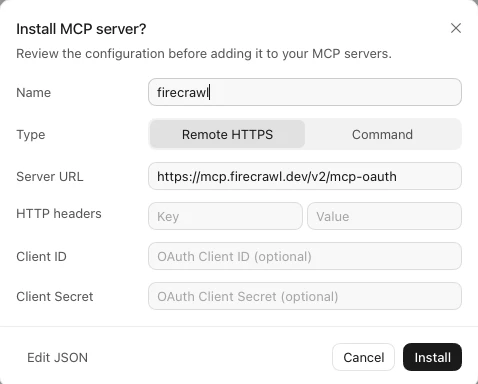
Install the Firecrawl MCP server
Open the install dialog in Cursor, check that the URL is Firecrawl's hosted server, then select Install.
Connect your Firecrawl account
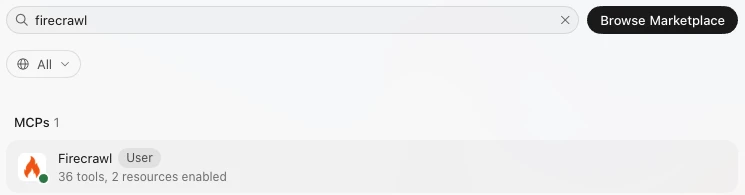
Use the server's sign-in option in Cursor's MCP settings. Firecrawl opens in your browser: sign in, choose a team with Alexandria enabled, and approve access. A green dot next to Firecrawl means it's connected.
Ask Cursor's agent for the data
In the agent chat, ask in plain language and mention Orphanet (Orphadata): rare disease prevalence, codes and genes or Firecrawl Alexandria. The agent finds the Orphanet (Orphadata): rare disease prevalence, codes and genes capability that fits and runs it. For example:
Use Firecrawl to answer this: What is the prevalence of cystic fibrosis in Europe and in France, with sources?
What can Cursor do with Orphanet (Orphadata): rare disease prevalence, codes and genes?
Orphanet, the INSERM rare disease knowledge base, through its Orphadata Science API (CC BY 4.0). Finds rare diseases by name, synonym or abbreviation ("Pompe disease", "ALS"), ORPHAcode, orpha.net page, OMIM number or ICD-10/ICD-11 code, with definition, synonyms and Orphanet's mappings to ICD-10, ICD-11, OMIM, MONDO, MeSH, UMLS, MedDRA and GARD. Gives each disease's prevalence, birth prevalence, lifetime prevalence, annual incidence and case counts by area (worldwide, Europe and other regions, 130 countries) with Orphanet's prevalence class, mean value per 100,000, validation status and source PMIDs, plus inheritance and age of onset; and its gene associations with association type, HGNC, Ensembl, UniProt and OMIM identifiers. About 11,600 entities; 6,700 have prevalence data, 4,200 have genes. Orphadata releases twice a year; every answer carries its data version, Orphadata's citation and its AI-use notice.
Cursor can run any of Orphanet (Orphadata): rare disease prevalence, codes and genes's 3 capabilities through Alexandria. Each call is billed in Firecrawl credits on your Firecrawl team.
- Epidemiology: Orphanet's epidemiology for one rare disease: every prevalence, birth prevalence, lifetime prevalence, annual incidence and case-count record by area (worldwide, regions, countries), each with Orphanet's prevalence class, the mean value per 100,000 when published, validation status, and its sources as PubMed IDs, Orphanet estimates, expert opinion or registries; plus modes of inheritance and age of onset. Filter by area (ISO country codes or Orphanet region names), record type and validation. Costs 5 Firecrawl credits per call.
- Genes: Genes Orphanet associates with one rare disease: symbol, name, type and locus; the association (disease-causing germline or somatic mutation, loss or gain of function, susceptibility factor, fusion gene, phenotype modifier, candidate or biomarker) and whether it was assessed; HGNC, Ensembl, UniProt and OMIM gene identifiers; and the PubMed IDs behind it. When a disorder has no genes of its own, the genes of its subtypes, each naming the subtype. Costs 5 Firecrawl credits per call.
- Search: Find rare diseases in Orphanet by name, synonym or abbreviation, ORPHAcode, orpha.net page URL, OMIM number, or ICD-10 / ICD-11 code. Returns each disease's ORPHAcode, preferred name, status (inactive entities say where Orphanet moved them), level and type, definition, synonyms, and its mappings to ICD-10, ICD-11, OMIM, MONDO, MeSH, UMLS, MedDRA and GARD, each with how closely it maps. Name searches match preferred names and synonyms word by word, best match first, and fall back to Orphanet's approximate search for misspellings. Costs 5 Firecrawl credits per call.
What should I ask Cursor?
Name Orphanet (Orphadata): rare disease prevalence, codes and genes or Firecrawl Alexandria in the prompt so Cursor reaches for it. Each example opens in Cursor with the prompt filled in.
- Use Firecrawl to answer this: What is the prevalence of cystic fibrosis in Europe and in France, with sources?
- Use Firecrawl to answer this: Which genes cause Marfan syndrome, with their HGNC and Ensembl IDs?
- Use Firecrawl to answer this: Which Orphanet disease is OMIM 154700, and what are its ICD-10 and MONDO codes?
- Use Firecrawl to run Orphanet (Orphadata): rare disease prevalence, codes and genes' Epidemiology capability. Inspect the Alexandria inputs, ask for any missing required details, and return a small sample with sources.
Troubleshooting
Why can't Cursor find Orphanet (Orphadata): rare disease prevalence, codes and genes?
If Firecrawl's tools in Cursor stop at search, scrape and parse, the connection is keyless and doesn't include Alexandria. Finish the sign-in from Cursor's MCP settings, or add an API key from a team with Alexandria enabled.
Firecrawl shows a red dot in Cursor. What should I do?
Open Cursor's MCP settings, sign in to Firecrawl again, and restart the agent chat so it loads the tools.
Use Orphanet (Orphadata): rare disease prevalence, codes and genes in other AI apps
The same Firecrawl account reaches Orphanet (Orphadata): rare disease prevalence, codes and genes from other AI apps. Pick one for its setup steps:
- Orphanet (Orphadata): rare disease prevalence, codes and genes in ChatGPT
- Orphanet (Orphadata): rare disease prevalence, codes and genes in Claude
- Orphanet (Orphadata): rare disease prevalence, codes and genes in Grok Bot
 Orphanet (Orphadata): rare disease prevalence, codes and genes in Muse
Other data providers you can connect to Cursor
Frequently Asked Questions
What is Firecrawl?
Firecrawl is the web data API to search, scrape and interact with the web at scale. It turns websites into clean, LLM-ready data for AI agents and apps. The Firecrawl MCP server brings those tools into Cursor, along with every data provider in Firecrawl Alexandria.
What is Firecrawl Alexandria?
Firecrawl Alexandria is Firecrawl's library of 550+ data providers for AI agents, Orphanet (Orphadata): rare disease prevalence, codes and genes among them. Each provider returns structured data through documented capabilities. Cursor finds the capability that fits your question and calls it through the Firecrawl MCP server, so you don't write any integration code. Alexandria needs a Firecrawl account signed in on a team with Alexandria enabled, or an API key from such a team; keyless connections don't include it.
Is there a Orphanet (Orphadata): rare disease prevalence, codes and genes MCP server for Cursor?
Cursor reaches Orphanet (Orphadata): rare disease prevalence, codes and genes through Firecrawl's hosted MCP server, which serves Orphanet (Orphadata): rare disease prevalence, codes and genes and every other Alexandria provider as tools. Add the Firecrawl MCP server once and you don't install or host a separate MCP server for Orphanet (Orphadata): rare disease prevalence, codes and genes.
What does connecting Orphanet (Orphadata): rare disease prevalence, codes and genes to Cursor unlock?
Cursor can run Orphanet (Orphadata): rare disease prevalence, codes and genes's Epidemiology, Genes and Search, from any chat, with structured results it can sort, compare and summarize. For example, ask: "Use Firecrawl to answer this: What is the prevalence of cystic fibrosis in Europe and in France, with sources?" In the same conversation, Cursor can combine Orphanet (Orphadata): rare disease prevalence, codes and genes with Firecrawl's web search and scraping and the other providers in Firecrawl Alexandria.
Do I need my own Orphanet (Orphadata): rare disease prevalence, codes and genes account or API key to use it in Cursor?
No. Cursor calls Orphanet (Orphadata): rare disease prevalence, codes and genes through Firecrawl Alexandria and each call is billed in Firecrawl credits, so you don't need a separate Orphanet (Orphadata): rare disease prevalence, codes and genes account or API key.
How much does it cost to use Orphanet (Orphadata): rare disease prevalence, codes and genes in Cursor?
Each Orphanet (Orphadata): rare disease prevalence, codes and genes call costs 5 Firecrawl credits. The capability list on this page shows each price and its unit. The credits come from the Firecrawl team you connect to Cursor, and finding the right capability is free.
Can Cursor use other providers besides Orphanet (Orphadata): rare disease prevalence, codes and genes?
Yes. The same Firecrawl MCP server reaches every provider in Firecrawl Alexandria, along with Firecrawl's web search and scraping, so you connect once.
Can I use Orphanet (Orphadata): rare disease prevalence, codes and genes in other AI apps?
Yes. Connect Firecrawl to ChatGPT, Claude, Grok Bot, Muse signed in on a Firecrawl team with Alexandria enabled, or use the Firecrawl MCP server, CLI or API with an API key from that team, and the same Orphanet (Orphadata): rare disease prevalence, codes and genes capabilities are available there. Keyless connections don't include Alexandria.