How to connect PGS Catalog: polygenic scores and biobank performance to Claude
Add the Firecrawl connector to Claude once and it can call the PGS Catalog: polygenic scores and biobank performance API and every other provider in Firecrawl Alexandria, with no PGS Catalog: polygenic scores and biobank performance integration code.
To connect PGS Catalog: polygenic scores and biobank performance to Claude, add the Firecrawl connector to Claude, sign in on a Firecrawl team with Alexandria enabled, and ask for PGS Catalog: polygenic scores and biobank performance data in plain language. The connection works in Claude on the web, Claude Desktop and Cowork, and you set it up once.
Claude uses PGS Catalog: polygenic scores and biobank performance as an MCP tool through Firecrawl's hosted MCP server, so you don't install or host a separate MCP server for PGS Catalog: polygenic scores and biobank performance.
Claude is Anthropic's AI assistant. Connectors give it tools from other services, and the Firecrawl connector adds web search, scraping and every data provider in Firecrawl Alexandria.
How do I connect PGS Catalog: polygenic scores and biobank performance to Claude?
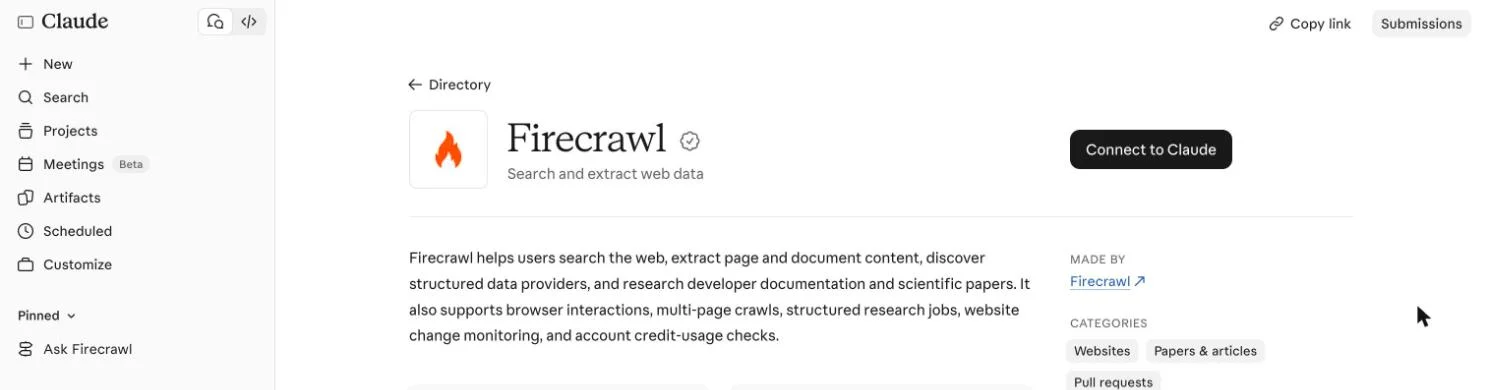
Add the Firecrawl connector
Open the Firecrawl connector in Claude's connector directory and select Connect to Claude. In Claude Desktop you can also go to Customize, then Connectors, and search for Firecrawl.
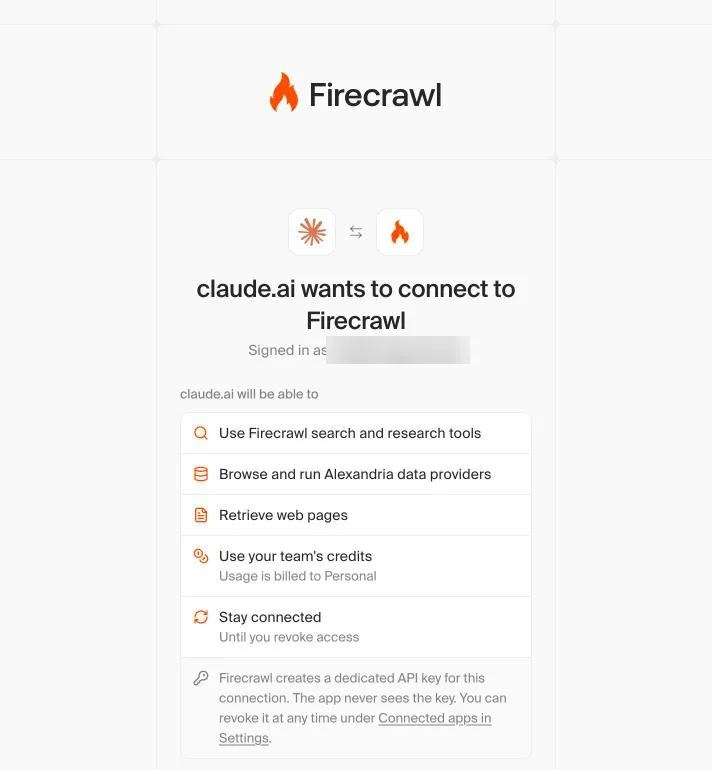
Connect your Firecrawl account
Claude opens Firecrawl in your browser. Sign in, choose a team with Alexandria enabled, and approve access. No account yet? You can create one for free in the same flow.
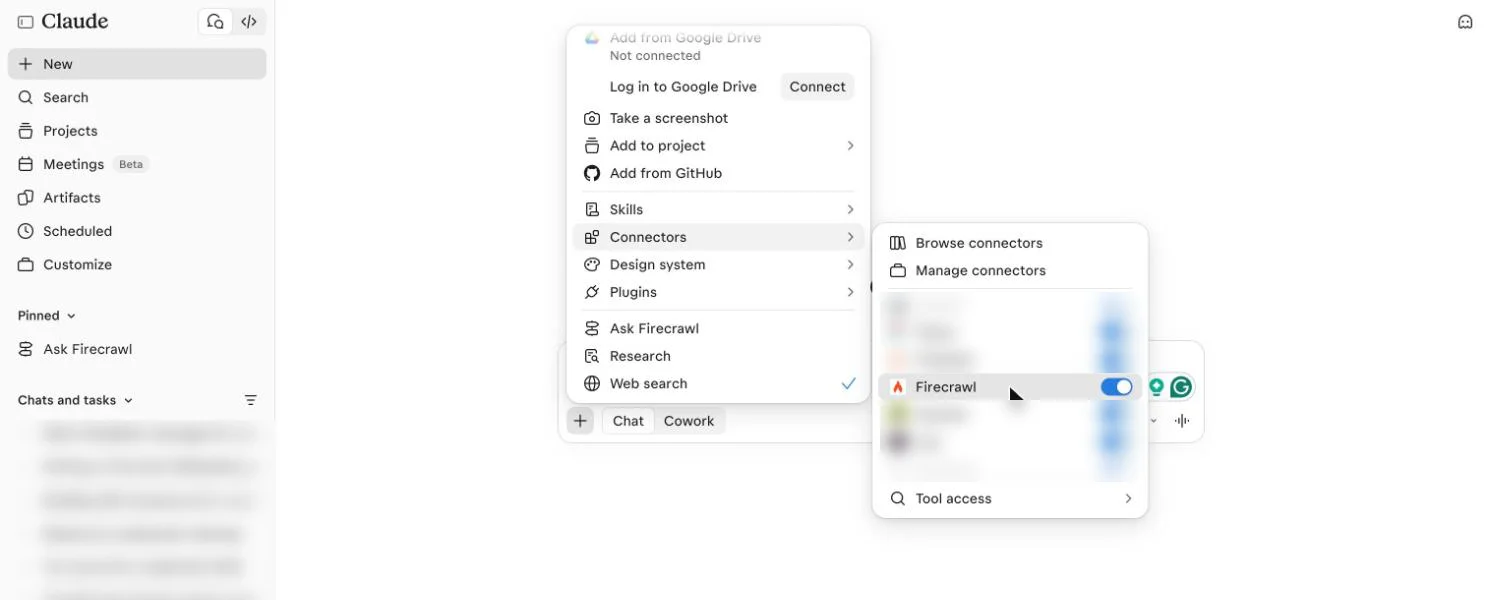
Turn on Firecrawl in a chat
In a new conversation, open the + menu, go to Connectors and switch on Firecrawl.
Ask Claude for the data
Ask in plain language and mention PGS Catalog: polygenic scores and biobank performance or Firecrawl Alexandria. Claude finds the PGS Catalog: polygenic scores and biobank performance capability that fits, checks its inputs and runs it. For example:
Use Firecrawl to answer this: Which published polygenic scores exist for insomnia, and which were evaluated in UK Biobank?
What can Claude do with PGS Catalog: polygenic scores and biobank performance?
The PGS Catalog (EMBL-EBI) through its keyless REST API: an open database of published polygenic scores (PGS) and the performance metrics papers report for them. Find scores by trait (name or EFO, MONDO, HP or OBA ID, with child traits), by publication (PGP or PubMed ID) or by the cohort or biobank that developed or evaluated them (UK Biobank, FinnGen, BioBank Japan, Million Veteran Program, Estonian Biobank, All of Us and about 1,500 more); read one score's metadata (method, variant count, genome build, source GWAS, development samples with ancestry, its own licence and the address of its scoring file); and read reported performance (odds and hazard ratios, AUROC, C-index, R², with confidence intervals) with each evaluation sample's size, ancestry and cohorts. Curated metadata from published papers only: no individual-level data and no PheWAS; scoring-file weights are never downloaded or returned, only their URL, and each score row carries the licence its authors set for that file. Outputs carry the catalog release and the PGS Catalog citation and terms.
Claude can run any of PGS Catalog: polygenic scores and biobank performance's 3 capabilities through Alexandria. Each call is billed in Firecrawl credits on your Firecrawl team.
- Get score: One polygenic score from the PGS Catalog by PGS ID (PGS000908, any case) or score page URL. Returns its name, reported trait and mapped ontology traits (EFO, MONDO, HP or OBA IDs with descriptions), development method and parameters, weight type, variant and interaction counts, genome build, ancestry distribution of the GWAS, development and evaluation samples, every source-GWAS and training sample (size, cases and controls, percent male, age, ancestry, country, cohorts, GWAS Catalog study and PubMed ID), the source publication, release date, the licence its authors set for the scoring file, and the URLs of the scoring file and its GRCh37 and GRCh38 harmonized versions. It never downloads or returns the variant weights; fetching the file is the caller's choice under the licence on the record. Outputs carry the catalog release and the PGS Catalog citation and terms. Costs 5 Firecrawl credits per call.
- Search scores: Find published polygenic scores (PGS) in the PGS Catalog by trait, publication or cohort; filters given together must all hold. trait is a trait name (insomnia, short sleep, sleep duration, coronary artery disease) matched by the catalog's trait search over labels, synonyms and mapped ontology terms, or an ontology ID (MONDO_0013600, EFO_0004611, OBA_2040171) or trait page URL; include_child_traits (default true) adds the scores of more specific child traits. publication is a PGP ID (PGP000238) or PubMed ID. cohort is a PGS Catalog cohort symbol (UKB, FinnGen, BBJ, MVP, EB, AllofUs, HUNT, CKB, TWB) or the name of those biobanks (UK Biobank, BioBank Japan, Million Veteran Program, Estonian Biobank, All of Us); cohort_role picks scores the cohort helped develop (GWAS or training samples), evaluated, or either. Returns the traits matched, the publication or cohort resolved, the total and one page of scores in catalog order: PGS ID, name, reported and mapped traits, variant count, method, genome build, ancestry distribution of the GWAS, development and evaluation samples, development cohorts, source publication (DOI, PMID), release date, the licence the score's authors set, and the URL of its scoring file. Scoring files are never downloaded; each row's licence governs that file. Outputs carry the catalog release and the PGS Catalog citation and terms. Costs 5 Firecrawl credits per call.
- Score performance: Performance metrics reported for polygenic scores in the PGS Catalog: one row per evaluation (PPM ID) with the score, the phenotype evaluated, each metric (effect sizes such as OR, HR or beta; classification metrics such as AUROC or C-index; others such as R²) with estimate, confidence interval and standard error, the evaluation sample set (size, cases and controls, percent male, age, ancestry, country, cohorts), covariates, comments and the publication that reported it. Give exactly one subject: pgs_id (that score's evaluations), publication (PGP or PubMed ID: the evaluations that paper reported) or trait (name or ontology ID as in search_scores: evaluations of every score for the trait, child traits included by default). cohort keeps evaluations that used that cohort or biobank (UKB, FinnGen, BBJ, MVP, EB, AllofUs or their names); with trait it reads only the scores the catalog lists as evaluated there. ancestry keeps evaluations with a sample of that broad ancestry (code EUR, EAS, AFR, SAS, AMR, GME, or a name such as East Asian; other text is matched against each sample's ancestry and country). Rows come in catalog order with counts per cohort; next_cursor continues when a call reaches its limit, or its budget of pages, first. Summary results as published; no individual-level data. Costs 5 Firecrawl credits per call.
What should I ask Claude?
Name PGS Catalog: polygenic scores and biobank performance or Firecrawl Alexandria in the prompt so Claude reaches for it. Each example opens in Claude with the prompt filled in.
- Use Firecrawl to answer this: Which published polygenic scores exist for insomnia, and which were evaluated in UK Biobank?
- Use Firecrawl to answer this: How well does the insomnia score PGS000908 predict outcomes, and in which cohorts and ancestries was it tested?
- Use Firecrawl to answer this: Which coronary artery disease polygenic scores were evaluated in FinnGen, and what hazard ratios or AUROC did they report?
- Use Firecrawl to answer this: Which LDL cholesterol polygenic scores were tested in the Million Veteran Program?
Troubleshooting
Why doesn't Claude use PGS Catalog: polygenic scores and biobank performance?
The connector has to be on in each conversation. Open the + menu, go to Connectors and check that Firecrawl is switched on, then ask again and name PGS Catalog: polygenic scores and biobank performance or Firecrawl Alexandria in the prompt.
Claude says it can't reach the Firecrawl server. What should I do?
Open Customize, then Connectors, disconnect Firecrawl and connect it again. On a Team or Enterprise plan, an owner has to allow the connector before members can add it.
Why does Claude say PGS Catalog: polygenic scores and biobank performance isn't available?
Alexandria needs a Firecrawl team with Alexandria enabled. Reconnect Firecrawl and pick that team on the consent screen.
Use PGS Catalog: polygenic scores and biobank performance in other AI apps
The same Firecrawl account reaches PGS Catalog: polygenic scores and biobank performance from other AI apps. Pick one for its setup steps:
- PGS Catalog: polygenic scores and biobank performance in ChatGPT
- PGS Catalog: polygenic scores and biobank performance in Cursor
- PGS Catalog: polygenic scores and biobank performance in Grok Bot
 PGS Catalog: polygenic scores and biobank performance in Muse
Other data providers you can connect to Claude
Frequently Asked Questions
What is Firecrawl?
Firecrawl is the web data API to search, scrape and interact with the web at scale. It turns websites into clean, LLM-ready data for AI agents and apps. The Firecrawl connector brings those tools into Claude, along with every data provider in Firecrawl Alexandria.
What is Firecrawl Alexandria?
Firecrawl Alexandria is Firecrawl's library of 550+ data providers for AI agents, PGS Catalog: polygenic scores and biobank performance among them. Each provider returns structured data through documented capabilities. Claude finds the capability that fits your question and calls it through the Firecrawl connector, so you don't write any integration code. Alexandria needs a Firecrawl account signed in on a team with Alexandria enabled, or an API key from such a team; keyless connections don't include it.
Is there a PGS Catalog: polygenic scores and biobank performance MCP server for Claude?
Claude reaches PGS Catalog: polygenic scores and biobank performance through Firecrawl's hosted MCP server, which serves PGS Catalog: polygenic scores and biobank performance and every other Alexandria provider as tools. Add the Firecrawl connector once and you don't install or host a separate MCP server for PGS Catalog: polygenic scores and biobank performance.
What does connecting PGS Catalog: polygenic scores and biobank performance to Claude unlock?
Claude can run PGS Catalog: polygenic scores and biobank performance's Get score, Search scores and Score performance, from any chat, with structured results it can sort, compare and summarize. For example, ask: "Use Firecrawl to answer this: Which published polygenic scores exist for insomnia, and which were evaluated in UK Biobank?" In the same conversation, Claude can combine PGS Catalog: polygenic scores and biobank performance with Firecrawl's web search and scraping and the other providers in Firecrawl Alexandria.
Do I need my own PGS Catalog: polygenic scores and biobank performance account or API key to use it in Claude?
No. Claude calls PGS Catalog: polygenic scores and biobank performance through Firecrawl Alexandria and each call is billed in Firecrawl credits, so you don't need a separate PGS Catalog: polygenic scores and biobank performance account or API key.
How much does it cost to use PGS Catalog: polygenic scores and biobank performance in Claude?
Each PGS Catalog: polygenic scores and biobank performance call costs 5 Firecrawl credits. The capability list on this page shows each price and its unit. The credits come from the Firecrawl team you connect to Claude, and finding the right capability is free.
Can Claude use other providers besides PGS Catalog: polygenic scores and biobank performance?
Yes. The same Firecrawl connector reaches every provider in Firecrawl Alexandria, along with Firecrawl's web search and scraping, so you connect once.
Can I use PGS Catalog: polygenic scores and biobank performance in other AI apps?
Yes. Connect Firecrawl to ChatGPT, Cursor, Grok Bot, Muse signed in on a Firecrawl team with Alexandria enabled, or use the Firecrawl MCP server, CLI or API with an API key from that team, and the same PGS Catalog: polygenic scores and biobank performance capabilities are available there. Keyless connections don't include Alexandria.