How to connect Open Targets Platform to Cursor
Add the Firecrawl MCP server to Cursor once and it can call the Open Targets Platform API and every other provider in Firecrawl Alexandria, with no Open Targets Platform integration code.
To connect Open Targets Platform to Cursor, add the Firecrawl MCP server to Cursor, sign in on a Firecrawl team with Alexandria enabled, and ask for Open Targets Platform data in plain language. The connection works in Cursor's agent and chat, and you set it up once.
Cursor uses Open Targets Platform as an MCP tool through Firecrawl's hosted MCP server, so you don't install or host a separate MCP server for Open Targets Platform.
Cursor is an AI code editor. Its agent uses MCP servers for outside tools, and the Firecrawl MCP server adds web search, scraping and every data provider in Firecrawl Alexandria.
How do I connect Open Targets Platform to Cursor?
Install the Firecrawl MCP server
Open the install dialog in Cursor, check that the URL is Firecrawl's hosted server, then select Install.
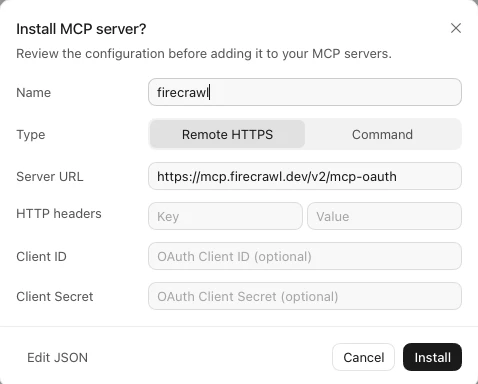
Connect your Firecrawl account
Use the server's sign-in option in Cursor's MCP settings. Firecrawl opens in your browser: sign in, choose a team with Alexandria enabled, and approve access. A green dot next to Firecrawl means it's connected.
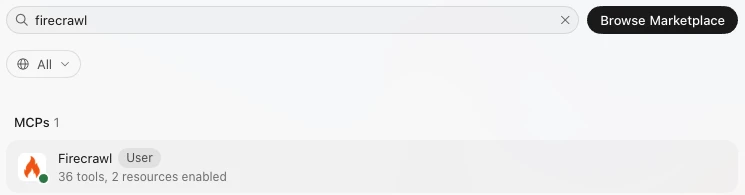
Ask Cursor's agent for the data
In the agent chat, ask in plain language and mention Open Targets Platform or Firecrawl Alexandria. The agent finds the Open Targets Platform capability that fits and runs it. For example:
Use Firecrawl to answer this: Is BRAF tractable with small molecules or antibodies, and what safety liabilities are known?
What can Cursor do with Open Targets Platform?
Drug-target and human genetics evidence from the Open Targets Platform (EMBL-EBI, Wellcome Sanger Institute and partners; data CC0): target profiles with tractability, safety liabilities and cross-references; diseases and phenotypes across EFO, MONDO, HP and Orphanet with synonyms and vocabulary mappings; target-disease association scores broken down by evidence type and datasource; the evidence records behind them (GWAS credible sets, rare-variant and gene burden results, somatic drivers, clinical precedence, literature); and known drugs and clinical candidates with mechanisms, clinical stage and trial or regulatory references. Biobank genetics: a variant PheWAS across fine-mapped GWAS credible sets from FinnGen R12 and the GWAS Catalog (UK Biobank, BioBank Japan, Million Veteran Program and other biobank and consortium studies), optionally with eQTL Catalogue (GTEx and others) and UKB-PPP molecular QTLs, each with p-value, posterior probability and locus-to-gene (L2G) genes; the loci of any one study; and GWAS study search by disease or trait with cohorts, ancestry, sample size, case and control counts and publication. Gene burden evidence includes UK Biobank exome PheWAS results (AstraZeneca PheWAS Portal, Genebass, Regeneron) and Genes & Health. Summary-level results and study metadata only: individual-level biobank data needs an application to each biobank and is not here. Targets resolve from symbols, synonyms and UniProt accessions, diseases from names and IDs including retired EFO IDs, variants from rsIDs and GRCh38 IDs. Uses the keyless Open Targets GraphQL API.
Cursor can run any of Open Targets Platform's 7 capabilities through Alexandria. Each call is billed in Firecrawl credits on your Firecrawl team.
- List associations: Target-disease associations scored by Open Targets (0 to 1) with the score broken down by evidence type (genetic association, somatic mutation, known drug/clinical, pathways, RNA expression, literature, animal models) and by datasource. Give a target for its diseases (optionally within one therapeutic area), a disease for its targets, or both for one pair. Order by the overall score or one evidence type; `min_score` stops at a threshold. Costs 5 Firecrawl credits per call.
- Get target: One drug target (human gene) from Open Targets: approved symbol and name, Ensembl ID, biotype, synonyms and previous symbols, UniProt function text, genomic location, ChEMBL target class, tractability by modality (small molecule, antibody, PROTAC, other), subcellular locations, safety liabilities with effects, tissues and sources, chemical probes, gnomAD loss-of-function constraint, core essentiality, and UniProt, HGNC, ChEMBL and PDB cross-references. Accepts a symbol, Ensembl ID, UniProt accession, synonym or target page URL; `matched_on` says how the input matched. Costs 5 Firecrawl credits per call.
- List credible sets: Variant PheWAS: every fine-mapped GWAS credible set in Open Targets that contains a variant, most significant first, across FinnGen R12 and GWAS Catalog studies (UK Biobank, BioBank Japan, Million Veteran Program and other biobank and consortium GWAS), optionally adding molecular QTLs from the eQTL Catalogue (GTEx and others) and UKB-PPP. Each row has the trait and mapped diseases, study, project and cohorts, sample size and case counts, lead variant and p-value, beta, fine-mapping method, the variant's posterior probability and LD with the lead, and the top locus-to-gene (L2G) genes. Or give a study ID to list that study's loci. Also returns the variant's consequence, consequence genes and closest protein-coding gene. Summary-level results only. Costs 5 Firecrawl credits per call.
- List drugs: Known drugs and clinical candidates from Open Targets clinical reports (ClinicalTrials.gov, FDA, EMA, PMDA, DailyMed, ChEMBL, TTD): for a target, the drugs acting on it with their indications; for a disease, the drugs developed for it; for both, the drugs for that disease that act on that target. Each row has the ChEMBL ID, name, type, highest harmonised clinical stage, mechanisms of action with their targets, and up to 5 supporting reports with IDs, status and links. Highest stage first; `min_stage` filters. Costs 5 Firecrawl credits per call.
- List evidence: The evidence records behind one Open Targets target-disease association, highest score first: datasource and evidence type, score, the disease as the source named it, PubMed and PMC IDs, variant and rsID, GWAS study, drug and clinical stage, direction of effect on target and trait, ClinVar significance, p-value, odds ratio, beta, sample size and source links. Genetic evidence includes GWAS credible sets from FinnGen and GWAS Catalog biobank studies, and gene burden results from UK Biobank exome PheWAS (AstraZeneca PheWAS Portal, Genebass, Regeneron) and Genes & Health. Filter to chosen datasources. Costs 5 Firecrawl credits per call.
- Search diseases: Search Open Targets diseases and phenotypes (EFO, MONDO, HP, Orphanet terms) by free text, or read one by ontology ID or disease page URL. Each result has its ID, name, description, therapeutic areas, exact synonyms, cross-references to other vocabularies (MeSH, DOID, ICD10, OMIM, UMLS) and the retired IDs it replaces. Retired EFO IDs (e.g. EFO_0000270) are followed to the current record through EBI OLS. Costs 5 Firecrawl credits per call.
- Search studies: GWAS studies Open Targets holds for a disease or trait, largest first: FinnGen R12 endpoints and GWAS Catalog studies, including UK Biobank, BioBank Japan, Million Veteran Program and other biobank and consortium GWAS. Each has the reported trait and mapped diseases, project and cohorts, named biobanks, discovery ancestry and sample sizes, case and control counts, publication (PubMed ID, author, date, journal, title), whether full summary statistics exist, and how many fine-mapped credible sets (loci) it has. Filter by biobank or summary statistics, or read one study by ID. Metadata only; summary statistics files and individual-level data are not returned. Costs 5 Firecrawl credits per call.
What should I ask Cursor?
Name Open Targets Platform or Firecrawl Alexandria in the prompt so Cursor reaches for it. Each example opens in Cursor with the prompt filled in.
- Use Firecrawl to answer this: Is BRAF tractable with small molecules or antibodies, and what safety liabilities are known?
- Use Firecrawl to answer this: Which targets have the strongest genetic evidence for asthma?
- Use Firecrawl to answer this: How strong is the evidence linking PCSK9 to familial hypercholesterolemia, and which studies support it?
- Use Firecrawl to answer this: What approved drugs act on PCSK9, and what are they approved for?
Troubleshooting
Why can't Cursor find Open Targets Platform?
If Firecrawl's tools in Cursor stop at search, scrape and parse, the connection is keyless and doesn't include Alexandria. Finish the sign-in from Cursor's MCP settings, or add an API key from a team with Alexandria enabled.
Firecrawl shows a red dot in Cursor. What should I do?
Open Cursor's MCP settings, sign in to Firecrawl again, and restart the agent chat so it loads the tools.
Use Open Targets Platform in other AI apps
The same Firecrawl account reaches Open Targets Platform from other AI apps. Pick one for its setup steps:
- Open Targets Platform in ChatGPT
- Open Targets Platform in Claude
- Open Targets Platform in Grok Bot
 Open Targets Platform in Muse
Other data providers you can connect to Cursor
Frequently Asked Questions
What is Firecrawl?
Firecrawl is the web data API to search, scrape and interact with the web at scale. It turns websites into clean, LLM-ready data for AI agents and apps. The Firecrawl MCP server brings those tools into Cursor, along with every data provider in Firecrawl Alexandria.
What is Firecrawl Alexandria?
Firecrawl Alexandria is Firecrawl's library of 550+ data providers for AI agents, Open Targets Platform among them. Each provider returns structured data through documented capabilities. Cursor finds the capability that fits your question and calls it through the Firecrawl MCP server, so you don't write any integration code. Alexandria needs a Firecrawl account signed in on a team with Alexandria enabled, or an API key from such a team; keyless connections don't include it.
Is there a Open Targets Platform MCP server for Cursor?
Cursor reaches Open Targets Platform through Firecrawl's hosted MCP server, which serves Open Targets Platform and every other Alexandria provider as tools. Add the Firecrawl MCP server once and you don't install or host a separate MCP server for Open Targets Platform.
What does connecting Open Targets Platform to Cursor unlock?
Cursor can run all 7 of Open Targets Platform's capabilities, including List associations, Get target and List credible sets, from any chat, with structured results it can sort, compare and summarize. For example, ask: "Use Firecrawl to answer this: Is BRAF tractable with small molecules or antibodies, and what safety liabilities are known?" In the same conversation, Cursor can combine Open Targets Platform with Firecrawl's web search and scraping and the other providers in Firecrawl Alexandria.
Do I need my own Open Targets Platform account or API key to use it in Cursor?
No. Cursor calls Open Targets Platform through Firecrawl Alexandria and each call is billed in Firecrawl credits, so you don't need a separate Open Targets Platform account or API key.
How much does it cost to use Open Targets Platform in Cursor?
Each Open Targets Platform call costs 5 Firecrawl credits. The capability list on this page shows each price and its unit. The credits come from the Firecrawl team you connect to Cursor, and finding the right capability is free.
Can Cursor use other providers besides Open Targets Platform?
Yes. The same Firecrawl MCP server reaches every provider in Firecrawl Alexandria, along with Firecrawl's web search and scraping, so you connect once.
Can I use Open Targets Platform in other AI apps?
Yes. Connect Firecrawl to ChatGPT, Claude, Grok Bot, Muse signed in on a Firecrawl team with Alexandria enabled, or use the Firecrawl MCP server, CLI or API with an API key from that team, and the same Open Targets Platform capabilities are available there. Keyless connections don't include Alexandria.