How to connect PubMed and PMC to ChatGPT
Add the Firecrawl plugin to ChatGPT once and it can call the PubMed and PMC API and every other provider in Firecrawl Alexandria, with no PubMed and PMC integration code.
To connect PubMed and PMC to ChatGPT, add the Firecrawl plugin to ChatGPT, sign in on a Firecrawl team with Alexandria enabled, and ask for PubMed and PMC data in plain language. The connection works in ChatGPT and Codex, and you set it up once.
ChatGPT uses PubMed and PMC as an MCP tool through Firecrawl's hosted MCP server, so you don't install or host a separate MCP server for PubMed and PMC.
ChatGPT is OpenAI's AI assistant. Plugins add tools from other services, and the Firecrawl plugin adds web search, scraping and every data provider in Firecrawl Alexandria.
How do I connect PubMed and PMC to ChatGPT?
Install the Firecrawl plugin
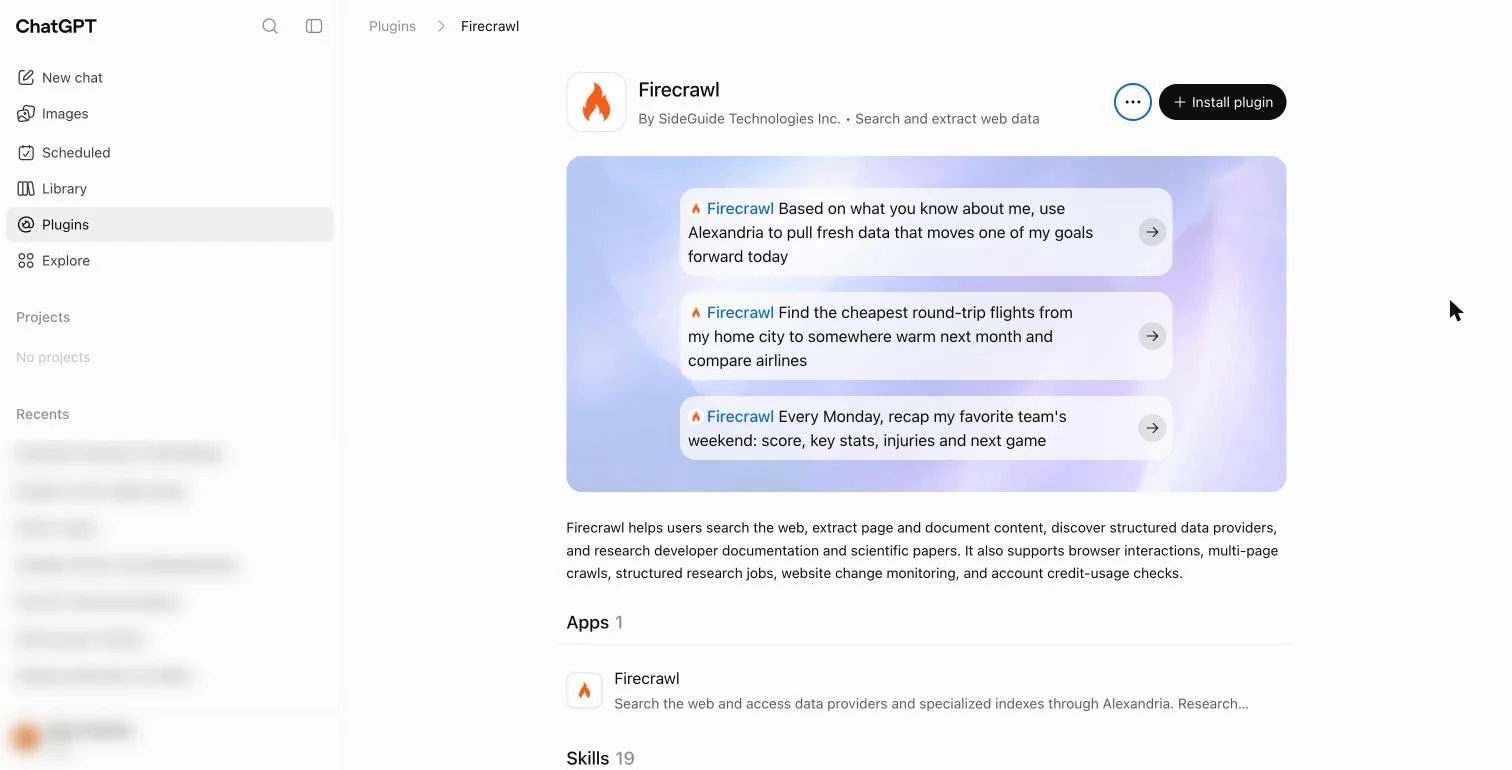
Open the Firecrawl listing in ChatGPT's plugin directory and select Install plugin. You can also open Plugins in ChatGPT or Codex and search for Firecrawl.
Connect your Firecrawl account
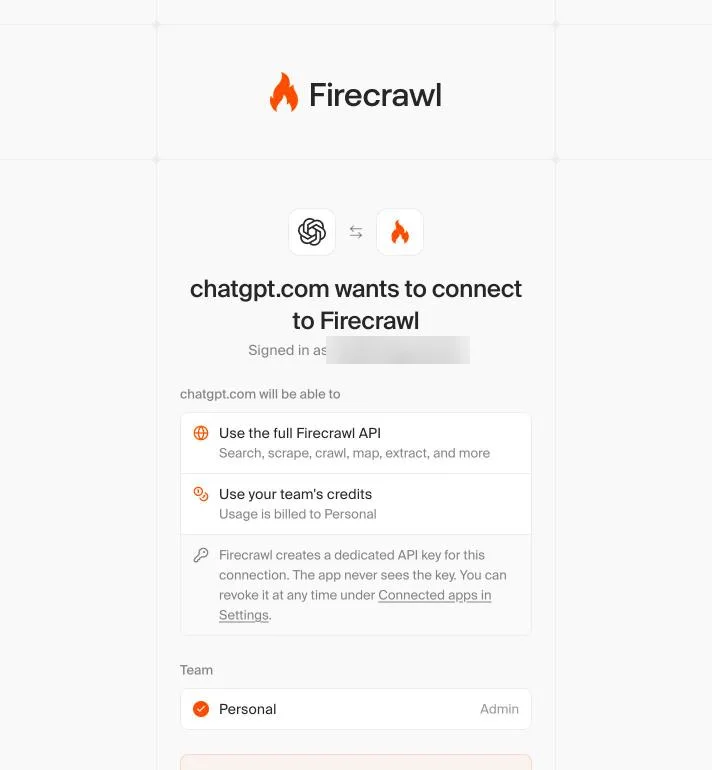
ChatGPT opens Firecrawl in your browser. Sign in, choose a team with Alexandria enabled, and approve access. No account yet? You can create one for free in the same flow.
Attach Firecrawl to a chat
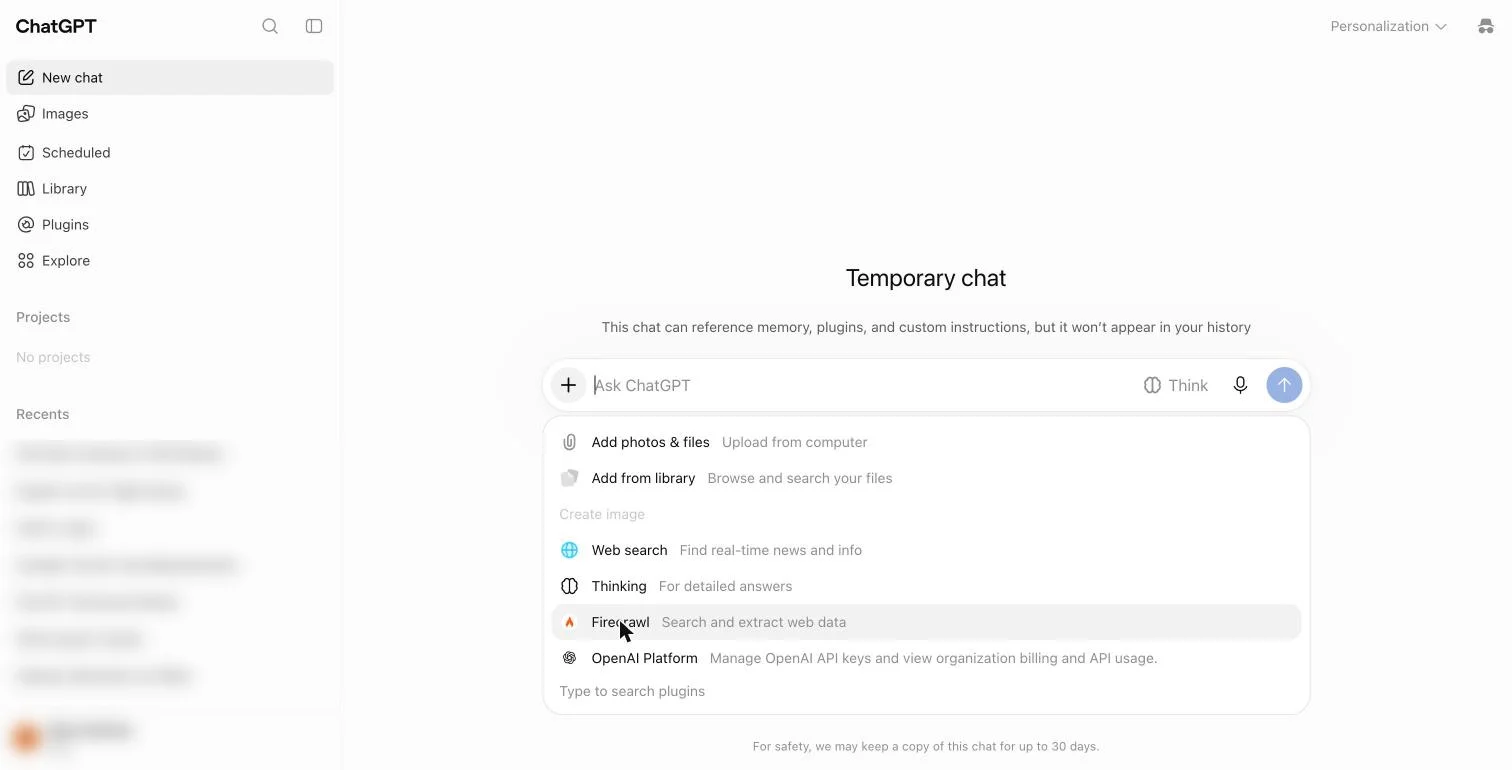
Start a new chat so it loads the plugin, open the + menu and choose Firecrawl. You can also ask ChatGPT to use Firecrawl by name.
Ask ChatGPT for the data
Ask in plain language and mention PubMed and PMC or Firecrawl Alexandria. ChatGPT finds the PubMed and PMC capability that fits and runs it. For example:
Use Firecrawl to find 10 PubMed papers with CRISPR in the title published in 2024, newest first, with titles, journals and identifiers.
What can ChatGPT do with PubMed and PMC?
Biomedical literature from PubMed and PubMed Central (NIH National Library of Medicine): search with PubMed query syntax, document summaries, full article records with abstracts and MeSH indexing, PMID/PMCID/DOI resolution, similar and citing articles, and open-access full text. Uses NCBI's anonymous programmatic services (E-utilities, PMC ID Converter, BioC) only; the PubMed and PMC websites themselves sit behind a proof-of-work challenge and are not scraped.
ChatGPT can run any of PubMed and PMC's 6 capabilities through Alexandria. Each call is billed in Firecrawl credits on your Firecrawl team.
- Article: One PubMed record in full from NCBI E-utilities efetch XML (ep-19): title, abstract (plain text plus labelled sections for structured abstracts), authors with affiliations and ORCID, journal and issue, publication date and history, language, publication types, MeSH headings with qualifiers and major-topic flags, keywords, chemicals, grants, conflict-of-interest statement, identifiers (PMID, DOI, PMCID, PII) and the reference list with PMIDs where PubMed has them. NCBI Bookshelf records (GeneReviews, StatPearls, LiverTox, LactMed chapters and whole books) return the same shape with the journal fields null plus a `book` object (book title, NBK accession, publisher, editors). Accepts a PMID (`id` is an alias, and a number is accepted) or a `pubmed.ncbi.nlm.nih.gov/{pmid}/` URL. An unknown PMID is `not_found`. Unknown options are rejected by name. Costs 5 Firecrawl credits per call.
- Full text: Full text of a PubMed Central article from the NCBI BioC RESTful service (ep-31, `pmcoa.cgi`), which serves the PMC Open Access subset: title, license, article ids, authors, year and every passage (abstract, section headings, paragraphs, table and figure captions) with its section type, in reading order. `availability` is `full_text` when body passages are present, `abstract_only` when the OA record has only front matter (typical for preprints), and `not_in_open_access_subset` when PMC knows the article but does not license its text for the service (then `sections` is empty and ids come from the PMC ID Converter, ep-25). Accepts a PMCID or a `pmc.ncbi.nlm.nih.gov/articles/PMC.../` URL; an unknown PMCID is `not_found`. `max_chars` truncates the concatenated text. Costs 5 Firecrawl credits per call.
- Related: Articles linked to one PMID through NCBI E-utilities elink (ep-21): `similar` (PubMed's computed similar-articles list, `pubmed_pubmed`, the article itself removed), `cited_in` (PubMed articles citing it, `pubmed_pubmed_citedin`) or `references` (its references that are in PubMed, `pubmed_pubmed_refs`). Returns every linked PMID count, the first `limit` ids and, unless disabled, their document summaries via esummary (ep-18). An unknown PMID is `not_found`; a known article with no links of that kind is a valid empty list. Costs 5 Firecrawl credits per call.
- Resolve ids: Convert between PMIDs, PMCIDs, DOIs and NIHMS manuscript ids with the PMC ID Converter API (ep-25), up to 200 ids per call of one type. `idtype` is inferred when omitted (`PMC...` = pmcid, `10.x/...` = doi, digits = pmid). Each record carries every id PMC knows plus the PubMed and PMC page URLs; ids PMC does not know appear with `status: error` and in `unmatched`. When nothing resolves the result is `not_found`. Note the converter only knows articles that are in PMC: a valid PMID for an article without a PMC copy is reported as unmatched. Costs 5 Firecrawl credits per call.
- Search: Search PubMed or PMC with the full PubMed query syntax (`crispr[Title] AND 2024[dp]`, MeSH terms, field tags) through NCBI E-utilities esearch (ep-17), then fetch document summaries for the page through esummary (ep-18): title, authors, journal, dates, volume/issue/pages, publication types and PMID/PMCID/DOI. Offset-paginated (`offset`, `next_offset`); `total_count` is the full hit count and `query_translation` shows how PubMed expanded the query. Empty results are a valid empty page. `term` and `q` are aliases of `query`; `retmax` is an alias of `limit`. A `limit` above 50 is clamped to 50 and noted in `messages`. Unknown options are rejected by name. Costs 5 Firecrawl credits per call.
- Summaries: Document summaries for up to 50 PMIDs (or PMCIDs with `db=pmc`) in one NCBI E-utilities esummary call (ep-18): title, authors, journal, publication and e-publication dates, volume/issue/pages, publication types, languages, PMID/PMCID/DOI, PMC cited-by count and record status. Ids PubMed does not know are listed in `missing`; when none resolve the result is `not_found`. Costs 5 Firecrawl credits per call.
What should I ask ChatGPT?
Name PubMed and PMC or Firecrawl Alexandria in the prompt so ChatGPT reaches for it. Each example opens in ChatGPT with the prompt filled in.
- Use Firecrawl to find 10 PubMed papers with CRISPR in the title published in 2024, newest first, with titles, journals and identifiers.
- Use Firecrawl to read PubMed article 37742320 and show its abstract, authors, MeSH headings and DOI.
- Use Firecrawl to help with this: Retrieve up to 10,000 characters of open-access full text for PMC3531190 and include the license and availability status.
- Use Firecrawl to find five articles PubMed considers similar to PMID 37742320, with their citation summaries.
Troubleshooting
Why doesn't ChatGPT use PubMed and PMC?
Start a new chat after installing so ChatGPT loads the plugin, then attach Firecrawl from the + menu and name PubMed and PMC or Firecrawl Alexandria in the prompt.
How do I switch the Firecrawl team ChatGPT uses?
Open the Firecrawl plugin page in ChatGPT, uninstall it from the menu next to Settings, then install it again and choose the other team on Firecrawl's consent screen.
Why does ChatGPT say PubMed and PMC isn't available?
Alexandria needs a Firecrawl team with Alexandria enabled. Reinstall the plugin and pick that team when you approve access.
Use PubMed and PMC in other AI apps
The same Firecrawl account reaches PubMed and PMC from other AI apps. Pick one for its setup steps:

Other data providers you can connect to ChatGPT
Frequently Asked Questions
What is Firecrawl?
Firecrawl is the web data API to search, scrape and interact with the web at scale. It turns websites into clean, LLM-ready data for AI agents and apps. The Firecrawl plugin brings those tools into ChatGPT, along with every data provider in Firecrawl Alexandria.
What is Firecrawl Alexandria?
Firecrawl Alexandria is Firecrawl's library of 550+ data providers for AI agents, PubMed and PMC among them. Each provider returns structured data through documented capabilities. ChatGPT finds the capability that fits your question and calls it through the Firecrawl plugin, so you don't write any integration code. Alexandria needs a Firecrawl account signed in on a team with Alexandria enabled, or an API key from such a team; keyless connections don't include it.
Is there a PubMed and PMC MCP server for ChatGPT?
ChatGPT reaches PubMed and PMC through Firecrawl's hosted MCP server, which serves PubMed and PMC and every other Alexandria provider as tools. Add the Firecrawl plugin once and you don't install or host a separate MCP server for PubMed and PMC.
What does connecting PubMed and PMC to ChatGPT unlock?
ChatGPT can run all 6 of PubMed and PMC's capabilities, including Article, Full text and Related, from any chat, with structured results it can sort, compare and summarize. For example, ask: "Use Firecrawl to find 10 PubMed papers with CRISPR in the title published in 2024, newest first, with titles, journals and identifiers." In the same conversation, ChatGPT can combine PubMed and PMC with Firecrawl's web search and scraping and the other providers in Firecrawl Alexandria.
Do I need my own PubMed and PMC account or API key to use it in ChatGPT?
No. ChatGPT calls PubMed and PMC through Firecrawl Alexandria and each call is billed in Firecrawl credits, so you don't need a separate PubMed and PMC account or API key.
How much does it cost to use PubMed and PMC in ChatGPT?
Each PubMed and PMC call costs 5 Firecrawl credits. The capability list on this page shows each price and its unit. The credits come from the Firecrawl team you connect to ChatGPT, and finding the right capability is free.
Can ChatGPT use other providers besides PubMed and PMC?
Yes. The same Firecrawl plugin reaches every provider in Firecrawl Alexandria, along with Firecrawl's web search and scraping, so you connect once.
Can I use PubMed and PMC in other AI apps?
Yes. Connect Firecrawl to Claude, Cursor, Grok Bot, Muse signed in on a Firecrawl team with Alexandria enabled, or use the Firecrawl MCP server, CLI or API with an API key from that team, and the same PubMed and PMC capabilities are available there. Keyless connections don't include Alexandria.