How to connect UN Security Council Consolidated Sanctions List to Claude
Add the Firecrawl connector to Claude once and it can call the UN Security Council Consolidated Sanctions List API and every other provider in Firecrawl Alexandria, with no UN Security Council Consolidated Sanctions List integration code.
To connect UN Security Council Consolidated Sanctions List to Claude, add the Firecrawl connector to Claude, sign in on a Firecrawl team with Alexandria enabled, and ask for UN Security Council Consolidated Sanctions List data in plain language. The connection works in Claude on the web, Claude Desktop and Cowork, and you set it up once.
Claude uses UN Security Council Consolidated Sanctions List as an MCP tool through Firecrawl's hosted MCP server, so you don't install or host a separate MCP server for UN Security Council Consolidated Sanctions List.
Claude is Anthropic's AI assistant. Connectors give it tools from other services, and the Firecrawl connector adds web search, scraping and every data provider in Firecrawl Alexandria.
How do I connect UN Security Council Consolidated Sanctions List to Claude?
Add the Firecrawl connector
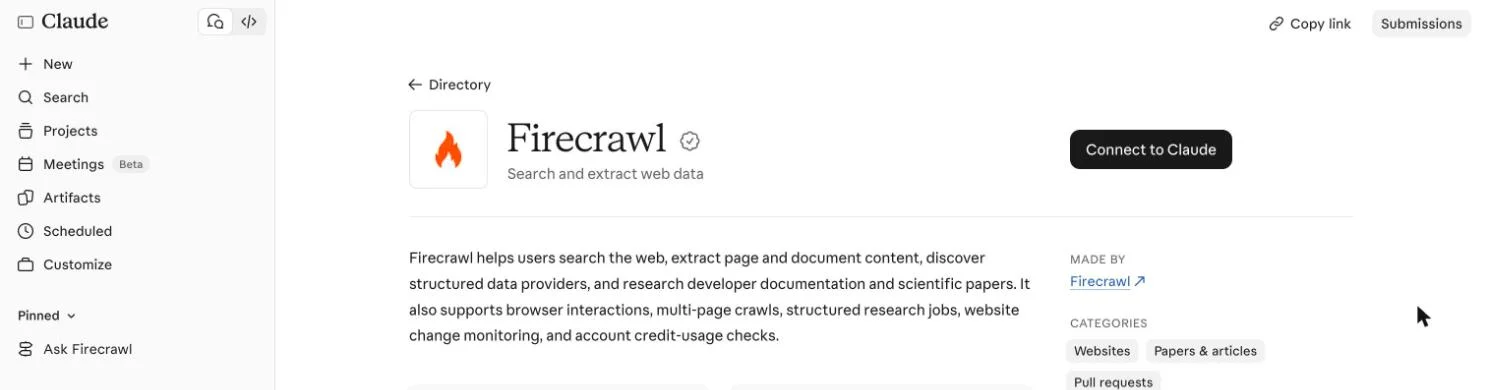
Open the Firecrawl connector in Claude's connector directory and select Connect to Claude. In Claude Desktop you can also go to Customize, then Connectors, and search for Firecrawl.
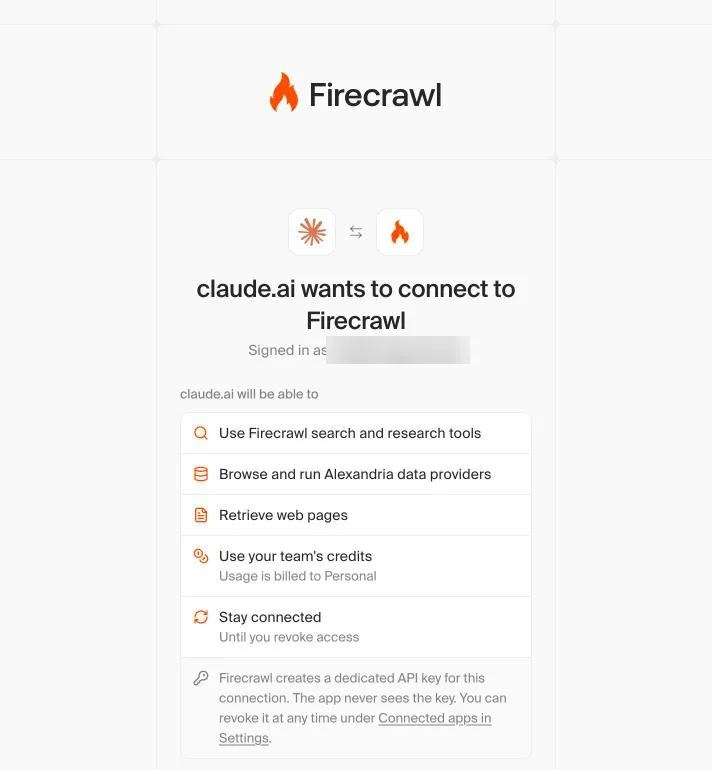
Connect your Firecrawl account
Claude opens Firecrawl in your browser. Sign in, choose a team with Alexandria enabled, and approve access. No account yet? You can create one for free in the same flow.
Turn on Firecrawl in a chat
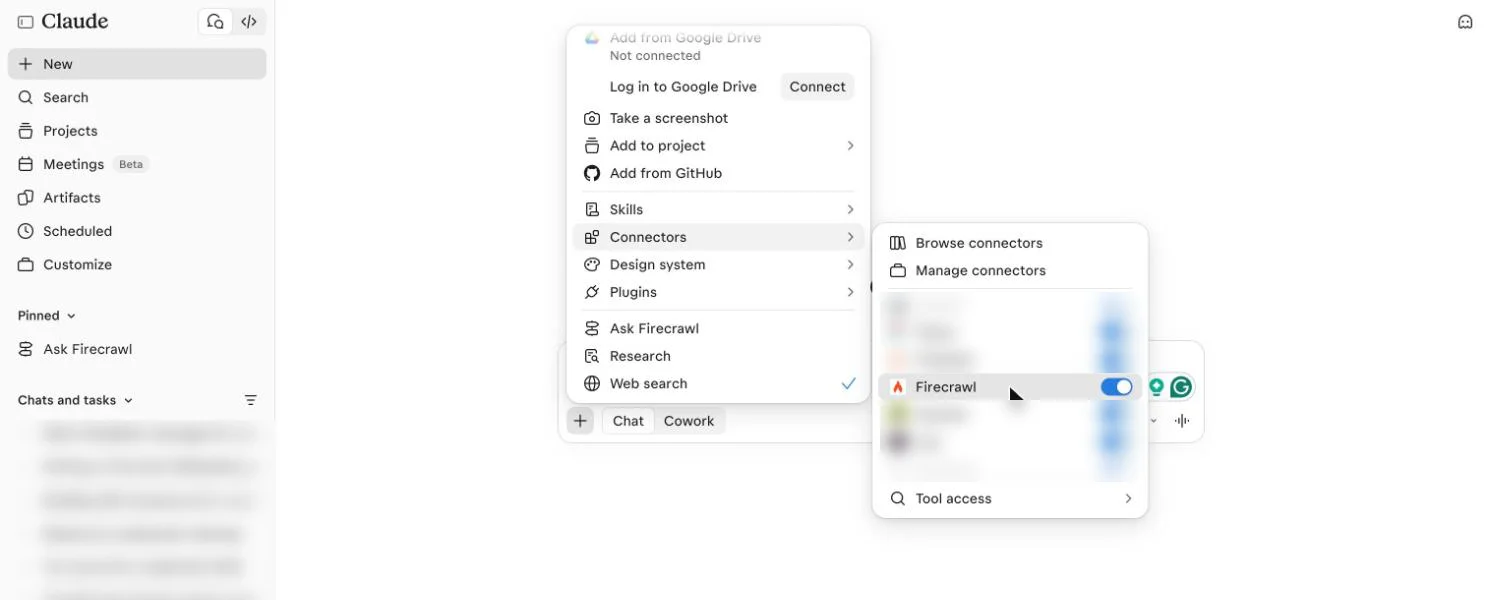
In a new conversation, open the + menu, go to Connectors and switch on Firecrawl.
Ask Claude for the data
Ask in plain language and mention UN Security Council Consolidated Sanctions List or Firecrawl Alexandria. Claude finds the UN Security Council Consolidated Sanctions List capability that fits, checks its inputs and runs it. For example:
Use Firecrawl to run UN Security Council Consolidated Sanctions List's Records get capability. Inspect the Alexandria inputs, ask for any missing required details, and return a small sample with sources.
What can Claude do with UN Security Council Consolidated Sanctions List?
The United Nations Security Council Consolidated List (scsanctions.un.org): every individual and entity subject to Security Council sanctions measures, published as one XML file per language edition and regenerated nightly. Publication status (dateGenerated, Content-MD5, Last-Modified, canonical record hash, counts per regime), the full record list paginated with a cursor pinned to one publication, one record by permanent reference number or DATAID, and an in-memory name search. Measures and legal basis are derived from a regime table and marked as such; the file carries no delta feed, so there is no records_changes function. Anonymous, read-only. The UN declares no open licence for this data (https://www.un.org/en/about-us/terms-of-use); a match or an absence is not a compliance determination.
Claude can run any of UN Security Council Consolidated Sanctions List's 4 capabilities through Alexandria. Each call is billed in Firecrawl credits on your Firecrawl team.
- Records get: One record by the source's own id: `reference_number` (the permanent reference number, QDi.001 / KPe.001 / IRi.043 ..., case-insensitive) or `dataid` (the numeric DATAID), exactly one of them. The file is fetched and the record selected in memory (no per-record page exists upstream); an id not in the current publication is not_found. The answer carries the publication fields so the record can be tied to a snapshot. Costs 5 Firecrawl credits per call.
- Records list: The full current list of one language edition, paginated in file order (INDIVIDUALS then ENTITIES, each by permanent reference number) and optionally filtered by regime (UN_LIST_TYPE or slug) and entity_type. Every page re-fetches the file (the runner keeps no state) and pins its canonical publication_id in the cursor; when the publisher has moved on, the next page fails with invalid_input and issue code `publication_changed` on /continuation instead of mixing publications: restart from the first page. A continuation overrides the filters (passing different ones is `cursor_mismatch`). A regime with no records of the requested type (e.g. GB organizations) is a legitimate empty page with total 0. Each record carries source_record_id (un:<REFERENCE_NUMBER>), source_url, publication_id and retrieved_at; measures and legal_basis are derived from the regime table (`derived` names them). Costs 5 Firecrawl credits per call.
- Search: Name search over one language edition, in memory (the site has no search): case-insensitive substring match on the primary name, the original-script name and every alias, plus exact match on the reference number or DATAID; optional regime and entity_type filters. `total` counts every match, `records` holds the first `limit` (default 20, max 100) in file order; a query matching nothing is a successful empty result (total 0). Use `lang: ar` (or fr, ru, sp, ch) to match names in that edition's script. Not a compliance determination. Costs 5 Firecrawl credits per call.
- Source status: Cheap version check of one language edition: GET the consolidated XML through its 302 (the signed Azure blob is followed at call time, never returned) and report the file's dateGenerated (published_at), the blob's Last-Modified, ETag and publisher-posted Content-MD5, the file URL and size, the canonical publication_id (SHA-256 over the records, stable across nightly regenerations that change nothing), record counts (total, individuals, entities) and per-regime counts. `changes_feed` is always false: the UN publishes no deltas. The whole 2.2 MB file is read because record counts and the canonical hash need it. Costs 5 Firecrawl credits per call.
What should I ask Claude?
Name UN Security Council Consolidated Sanctions List or Firecrawl Alexandria in the prompt so Claude reaches for it. Each example opens in Claude with the prompt filled in.
- Use Firecrawl to run UN Security Council Consolidated Sanctions List's Records get capability. Inspect the Alexandria inputs, ask for any missing required details, and return a small sample with sources.
- Use Firecrawl to run UN Security Council Consolidated Sanctions List's Records list capability. Inspect the Alexandria inputs, ask for any missing required details, and return a small sample with sources.
- Use Firecrawl to run UN Security Council Consolidated Sanctions List's Search capability. Inspect the Alexandria inputs, ask for any missing required details, and return a small sample with sources.
- Use Firecrawl to run UN Security Council Consolidated Sanctions List's Source status capability. Inspect the Alexandria inputs, ask for any missing required details, and return a small sample with sources.
Troubleshooting
Why doesn't Claude use UN Security Council Consolidated Sanctions List?
The connector has to be on in each conversation. Open the + menu, go to Connectors and check that Firecrawl is switched on, then ask again and name UN Security Council Consolidated Sanctions List or Firecrawl Alexandria in the prompt.
Claude says it can't reach the Firecrawl server. What should I do?
Open Customize, then Connectors, disconnect Firecrawl and connect it again. On a Team or Enterprise plan, an owner has to allow the connector before members can add it.
Why does Claude say UN Security Council Consolidated Sanctions List isn't available?
Alexandria needs a Firecrawl team with Alexandria enabled. Reconnect Firecrawl and pick that team on the consent screen.
Use UN Security Council Consolidated Sanctions List in other AI apps
The same Firecrawl account reaches UN Security Council Consolidated Sanctions List from other AI apps. Pick one for its setup steps:
- UN Security Council Consolidated Sanctions List in ChatGPT
- UN Security Council Consolidated Sanctions List in Cursor
- UN Security Council Consolidated Sanctions List in Grok Bot
 UN Security Council Consolidated Sanctions List in Muse
Other data providers you can connect to Claude
Frequently Asked Questions
What is Firecrawl?
Firecrawl is the web data API to search, scrape and interact with the web at scale. It turns websites into clean, LLM-ready data for AI agents and apps. The Firecrawl connector brings those tools into Claude, along with every data provider in Firecrawl Alexandria.
What is Firecrawl Alexandria?
Firecrawl Alexandria is Firecrawl's library of 550+ data providers for AI agents, UN Security Council Consolidated Sanctions List among them. Each provider returns structured data through documented capabilities. Claude finds the capability that fits your question and calls it through the Firecrawl connector, so you don't write any integration code. Alexandria needs a Firecrawl account signed in on a team with Alexandria enabled, or an API key from such a team; keyless connections don't include it.
Is there a UN Security Council Consolidated Sanctions List MCP server for Claude?
Claude reaches UN Security Council Consolidated Sanctions List through Firecrawl's hosted MCP server, which serves UN Security Council Consolidated Sanctions List and every other Alexandria provider as tools. Add the Firecrawl connector once and you don't install or host a separate MCP server for UN Security Council Consolidated Sanctions List.
What does connecting UN Security Council Consolidated Sanctions List to Claude unlock?
Claude can run all 4 of UN Security Council Consolidated Sanctions List's capabilities, including Records get, Records list and Search, from any chat, with structured results it can sort, compare and summarize. In the same conversation, Claude can combine UN Security Council Consolidated Sanctions List with Firecrawl's web search and scraping and the other providers in Firecrawl Alexandria.
Do I need my own UN Security Council Consolidated Sanctions List account or API key to use it in Claude?
No. Claude calls UN Security Council Consolidated Sanctions List through Firecrawl Alexandria and each call is billed in Firecrawl credits, so you don't need a separate UN Security Council Consolidated Sanctions List account or API key.
How much does it cost to use UN Security Council Consolidated Sanctions List in Claude?
Each UN Security Council Consolidated Sanctions List call costs 5 Firecrawl credits. The capability list on this page shows each price and its unit. The credits come from the Firecrawl team you connect to Claude, and finding the right capability is free.
Can Claude use other providers besides UN Security Council Consolidated Sanctions List?
Yes. The same Firecrawl connector reaches every provider in Firecrawl Alexandria, along with Firecrawl's web search and scraping, so you connect once.
Can I use UN Security Council Consolidated Sanctions List in other AI apps?
Yes. Connect Firecrawl to ChatGPT, Cursor, Grok Bot, Muse signed in on a Firecrawl team with Alexandria enabled, or use the Firecrawl MCP server, CLI or API with an API key from that team, and the same UN Security Council Consolidated Sanctions List capabilities are available there. Keyless connections don't include Alexandria.