How to connect OECD Data Explorer SDMX API to Grok Bot
Add the Firecrawl plugin to Grok Bot once and it can call the OECD Data Explorer SDMX API API and every other provider in Firecrawl Alexandria, with no OECD Data Explorer SDMX API integration code.
To connect OECD Data Explorer SDMX API to Grok Bot, add the Firecrawl plugin to Grok Bot, sign in on a Firecrawl team with Alexandria enabled, and ask for OECD Data Explorer SDMX API data in plain language. The connection works in every Bot in your Grok Bot account, and you set it up once.
Grok Bot uses OECD Data Explorer SDMX API as an MCP tool through Firecrawl's hosted MCP server, so you don't install or host a separate MCP server for OECD Data Explorer SDMX API.
Grok Bot is xAI's agent app. Plugins give your Bots outside tools, and the Firecrawl plugin adds web search, scraping and every data provider in Firecrawl Alexandria.
How do I connect OECD Data Explorer SDMX API to Grok Bot?
Add the Firecrawl plugin
In Grok Bot, open Connect apps from the sidebar, find Firecrawl and select Connect. You can also open Firecrawl's plugin listing and select Add to Grok Bot, which opens the desktop app to finish the install.
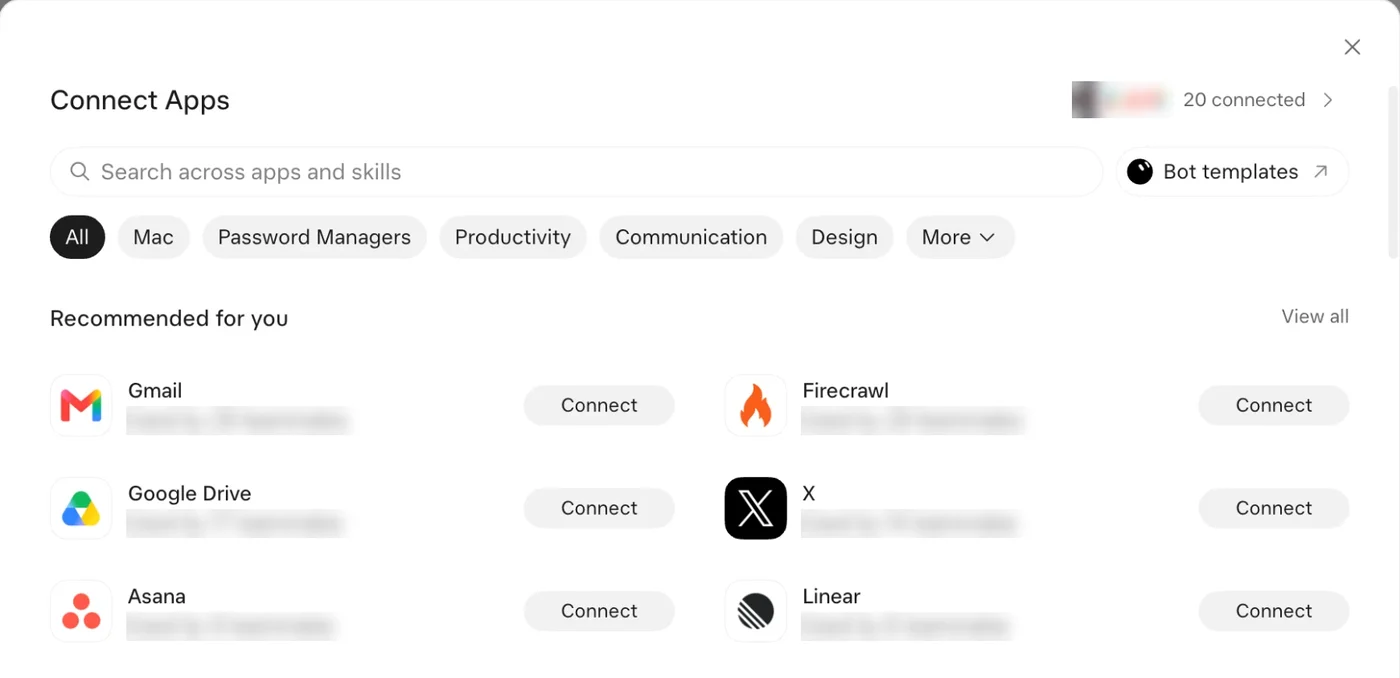
Connect your Firecrawl account
Grok Bot opens Firecrawl in your browser. Sign in, choose a team with Alexandria enabled, and select Authorize. The screen names Cursor, because the plugin is published on the Cursor Marketplace. No account yet? You can create one for free in the same flow.
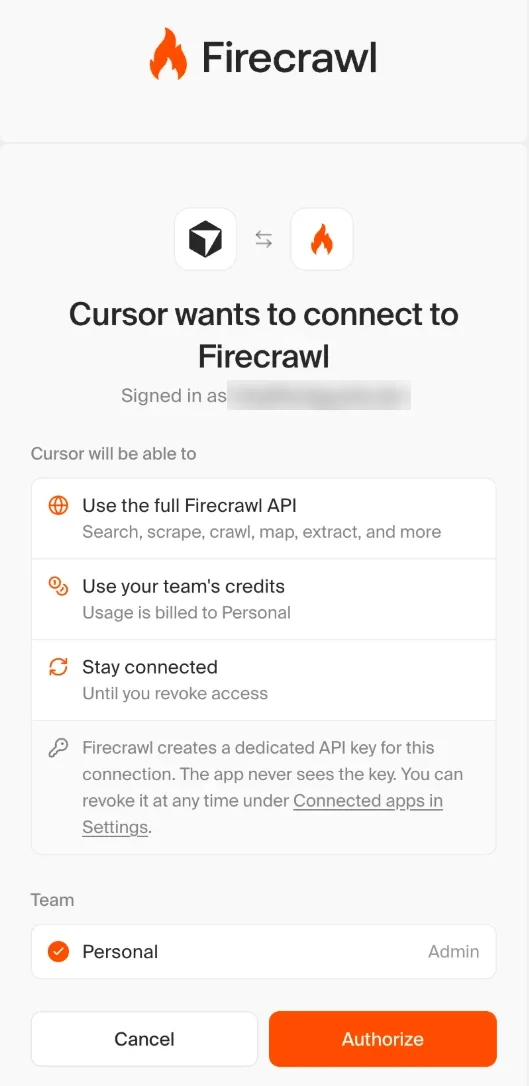
Ask your Bot for the data
In a chat, ask in plain language and mention OECD Data Explorer SDMX API or Firecrawl Alexandria. To make sure the Bot uses Firecrawl, type @ and choose Firecrawl first. For example:
Use Firecrawl to run OECD Data Explorer SDMX API's Codelist get capability. Inspect the Alexandria inputs, ask for any missing required details, and return a small sample with sources.
What can Grok Bot do with OECD Data Explorer SDMX API?
OECD Data Explorer SDMX 2.1 REST API (sdmx.oecd.org/public/rest): any public OECD dataflow by country and period, including G20 international merchandise trade and balance-of-payments services trade (quarterly), Revenue Statistics (tax revenue by type, % of GDP), Social Expenditure (SOCX) and quarterly/annual sector accounts, plus financial market indicators. Dataflow catalogue, structures (dimensions and codes with data), codelists and observations as records. Select observations with `filters` (dimension id to code(s), e.g. REF_AREA USA) and start_period/end_period; the program places the codes in key order. Anonymous, no key.
Grok Bot can run any of OECD Data Explorer SDMX API's 6 capabilities through Alexandria. Each call is billed in Firecrawl credits on your Firecrawl team.
- Codelist get: Codes and labels of one SDMX codelist from GET codelist/{agency}/{id}/{version}: code, English name and parent code. Codelist references come from `structure_get` (dimensions[].codelist, attributes[].codelist). Paginated client-side. Costs 5 Firecrawl credits per call.
- Dataflows list: Find OECD dataflows by keyword: id, agency, version, name and the `dataflow_ref` every other function takes, from GET dataflow/{agency}/all/latest?detail=allstubs (about 1,500 public dataflows with `agency` = all). `q` filters by a case-insensitive substring of the name or id (e.g. `revenue statistics`, `social expenditure`, `sector accounts`, `merchandise trade`). Common dataflows: G20/OECD merchandise trade OECD.SDD.TPS:DSD_IMTS@DF_IMTS (REF_AREA incl. G20, G7, OECD; TRADE_FLOW X exports, M imports, TB balance; FREQ Q/M/A; UNIT_MEASURE USD_EXC); quarterly trade in services and goods from balance of payments OECD.SDD.TPS:DSD_BOP@DF_BOP (MEASURE S services, G goods; ACCOUNTING_ENTRY C credit (exports), D debit (imports), B balance; FREQ Q); annual services by partner and category OECD.SDD.TPS:DSD_BOP@DF_TIS; Revenue Statistics OECD.CTP.TPS:DSD_REV_COMP_OECD@DF_RSOECD (STANDARD_REVENUE _T total tax, T_1000 income, T_1100 personal income, T_1200 corporate, T_2000 social security, T_4000 property, T_5000 goods and services; UNIT_MEASURE PT_B1GQ % of GDP; SECTOR S13 general government); Social expenditure (SOCX) OECD.ELS.SPD:DSD_SOCX_AGG@DF_SOCX_AGG (EXPEND_SOURCE ES10 public, ES20 mandatory private; PROGRAMME_TYPE _T total, TP11 old age...; UNIT_MEASURE PT_B1GQ % of GDP); quarterly sector accounts OECD.SDD.NAD:DSD_NASEC1@DF_QSA (SECTOR S1 total economy, S11 non-financial corporations, S13 government, S14 households, S1M households and NPISH; TRANSACTION B6G disposable income, B8G saving, B9 net lending...); annual sector accounts OECD.SDD.NAD:DSD_NASEC10@DF_TABLE14. Countries are ISO3 codes in REF_AREA; periods are 2024, 2024-Q3, 2024-07. Costs 5 Firecrawl credits per call.
- Records get: One observation by its source identity: dataflow, full series key (no wildcards, no `+`) and TIME_PERIOD, from GET data/{flow}/{series key}?startPeriod=P&endPeriod=P as SDMX-CSV. not_found when OECD has no observation for that series and period. Costs 5 Firecrawl credits per call.
- Records list: Observations of one dataflow selected by country, other dimension codes and period, as records. Give `filters` (dimension id to code(s); REF_AREA is the country) or a raw `key`, plus optional start_period/end_period. Unknown dimensions or codes without data fail with invalid_input listing the valid ones; a combination with no data is not_found. Selections above 50,000 observations are rejected: add filters or a period range. One data download per page (OECD allows about 60 per hour); rows are sorted canonically and the cursor pins the dataflow version and segment hash, so a publication change fails with upstream_error `publication_changed` instead of mixing data. Each record carries every dimension and attribute code, obs_value, time_period, series_key, source_record_id and source_url; Revenue Statistics and financial market rows also get a typed `mapped` view. Common dataflows: merchandise trade incl. G20 aggregate OECD.SDD.TPS:DSD_IMTS@DF_IMTS, quarterly services/goods trade (balance of payments) OECD.SDD.TPS:DSD_BOP@DF_BOP, Revenue Statistics OECD.CTP.TPS:DSD_REV_COMP_OECD@DF_RSOECD, SOCX OECD.ELS.SPD:DSD_SOCX_AGG@DF_SOCX_AGG, quarterly sector accounts OECD.SDD.NAD:DSD_NASEC1@DF_QSA; structure_get and dataflows_list list their key codes. Costs 5 Firecrawl credits per call.
- Source status: Cheap check of one selection (`filters` or `key`) of a dataflow from GET availableconstraint/{flow}/{key}?mode=exact (cached 2 h upstream): resolved dataflow version, obs_count, time range and the codes present per dimension, plus the segment's data file URL. With `include_hash` the SDMX-CSV segment is downloaded once and hashed canonically (the same hash records_list pins in its cursor). Useful to see which codes and periods exist for a country before collecting. Costs 5 Firecrawl credits per call.
- Structure get: Describe one dataflow: dimension ids in key order, the codelist of each, the codes that actually carry data per dimension, attributes, total obs_count and time range (stub, data structure definition and whole-flow availability). Use it to choose `filters` for records_list; code labels come from codelist_get. Common dataflows: G20/OECD merchandise trade OECD.SDD.TPS:DSD_IMTS@DF_IMTS (REF_AREA incl. G20, G7, OECD; TRADE_FLOW X exports, M imports, TB balance; FREQ Q/M/A; UNIT_MEASURE USD_EXC); quarterly trade in services and goods from balance of payments OECD.SDD.TPS:DSD_BOP@DF_BOP (MEASURE S services, G goods; ACCOUNTING_ENTRY C credit (exports), D debit (imports), B balance; FREQ Q); annual services by partner and category OECD.SDD.TPS:DSD_BOP@DF_TIS; Revenue Statistics OECD.CTP.TPS:DSD_REV_COMP_OECD@DF_RSOECD (STANDARD_REVENUE _T total tax, T_1000 income, T_1100 personal income, T_1200 corporate, T_2000 social security, T_4000 property, T_5000 goods and services; UNIT_MEASURE PT_B1GQ % of GDP; SECTOR S13 general government); Social expenditure (SOCX) OECD.ELS.SPD:DSD_SOCX_AGG@DF_SOCX_AGG (EXPEND_SOURCE ES10 public, ES20 mandatory private; PROGRAMME_TYPE _T total, TP11 old age...; UNIT_MEASURE PT_B1GQ % of GDP); quarterly sector accounts OECD.SDD.NAD:DSD_NASEC1@DF_QSA (SECTOR S1 total economy, S11 non-financial corporations, S13 government, S14 households, S1M households and NPISH; TRANSACTION B6G disposable income, B8G saving, B9 net lending...); annual sector accounts OECD.SDD.NAD:DSD_NASEC10@DF_TABLE14. Countries are ISO3 codes in REF_AREA; periods are 2024, 2024-Q3, 2024-07. Costs 5 Firecrawl credits per call.
What should I ask Grok Bot?
Name OECD Data Explorer SDMX API or Firecrawl Alexandria in the prompt so Grok Bot reaches for it.
- Use Firecrawl to run OECD Data Explorer SDMX API's Codelist get capability. Inspect the Alexandria inputs, ask for any missing required details, and return a small sample with sources.
- Use Firecrawl to run OECD Data Explorer SDMX API's Dataflows list capability. Inspect the Alexandria inputs, ask for any missing required details, and return a small sample with sources.
- Use Firecrawl to run OECD Data Explorer SDMX API's Records get capability. Inspect the Alexandria inputs, ask for any missing required details, and return a small sample with sources.
- Use Firecrawl to run OECD Data Explorer SDMX API's Records list capability. Inspect the Alexandria inputs, ask for any missing required details, and return a small sample with sources.
Troubleshooting
Why doesn't my Bot use OECD Data Explorer SDMX API?
Attach Firecrawl to the chat with @ before you ask, and name OECD Data Explorer SDMX API or Firecrawl Alexandria in the prompt.
Add to Grok Bot doesn't open the app. What should I do?
Install the Grok Bot desktop app first, or open Connect apps in Grok Bot and search for Firecrawl.
Use OECD Data Explorer SDMX API in other AI apps
The same Firecrawl account reaches OECD Data Explorer SDMX API from other AI apps. Pick one for its setup steps:
- OECD Data Explorer SDMX API in ChatGPT
- OECD Data Explorer SDMX API in Claude
- OECD Data Explorer SDMX API in Cursor
 OECD Data Explorer SDMX API in Muse
Other data providers you can connect to Grok Bot
Frequently Asked Questions
What is Firecrawl?
Firecrawl is the web data API to search, scrape and interact with the web at scale. It turns websites into clean, LLM-ready data for AI agents and apps. The Firecrawl plugin brings those tools into Grok Bot, along with every data provider in Firecrawl Alexandria.
What is Firecrawl Alexandria?
Firecrawl Alexandria is Firecrawl's library of 550+ data providers for AI agents, OECD Data Explorer SDMX API among them. Each provider returns structured data through documented capabilities. Grok Bot finds the capability that fits your question and calls it through the Firecrawl plugin, so you don't write any integration code. Alexandria needs a Firecrawl account signed in on a team with Alexandria enabled, or an API key from such a team; keyless connections don't include it.
Is there a OECD Data Explorer SDMX API MCP server for Grok Bot?
Grok Bot reaches OECD Data Explorer SDMX API through Firecrawl's hosted MCP server, which serves OECD Data Explorer SDMX API and every other Alexandria provider as tools. Add the Firecrawl plugin once and you don't install or host a separate MCP server for OECD Data Explorer SDMX API.
What does connecting OECD Data Explorer SDMX API to Grok Bot unlock?
Grok Bot can run all 6 of OECD Data Explorer SDMX API's capabilities, including Codelist get, Dataflows list and Records get, from any chat, with structured results it can sort, compare and summarize. In the same conversation, Grok Bot can combine OECD Data Explorer SDMX API with Firecrawl's web search and scraping and the other providers in Firecrawl Alexandria.
Do I need my own OECD Data Explorer SDMX API account or API key to use it in Grok Bot?
No. Grok Bot calls OECD Data Explorer SDMX API through Firecrawl Alexandria and each call is billed in Firecrawl credits, so you don't need a separate OECD Data Explorer SDMX API account or API key.
How much does it cost to use OECD Data Explorer SDMX API in Grok Bot?
Each OECD Data Explorer SDMX API call costs 5 Firecrawl credits. The capability list on this page shows each price and its unit. The credits come from the Firecrawl team you connect to Grok Bot, and finding the right capability is free.
Can Grok Bot use other providers besides OECD Data Explorer SDMX API?
Yes. The same Firecrawl plugin reaches every provider in Firecrawl Alexandria, along with Firecrawl's web search and scraping, so you connect once.
Can I use OECD Data Explorer SDMX API in other AI apps?
Yes. Connect Firecrawl to ChatGPT, Claude, Cursor, Muse signed in on a Firecrawl team with Alexandria enabled, or use the Firecrawl MCP server, CLI or API with an API key from that team, and the same OECD Data Explorer SDMX API capabilities are available there. Keyless connections don't include Alexandria.