How to connect STRING: protein interactions and functional enrichment to Cursor
Add the Firecrawl MCP server to Cursor once and it can call the STRING: protein interactions and functional enrichment API and every other provider in Firecrawl Alexandria, with no STRING: protein interactions and functional enrichment integration code.
To connect STRING: protein interactions and functional enrichment to Cursor, add the Firecrawl MCP server to Cursor, sign in on a Firecrawl team with Alexandria enabled, and ask for STRING: protein interactions and functional enrichment data in plain language. The connection works in Cursor's agent and chat, and you set it up once.
Cursor uses STRING: protein interactions and functional enrichment as an MCP tool through Firecrawl's hosted MCP server, so you don't install or host a separate MCP server for STRING: protein interactions and functional enrichment.
Cursor is an AI code editor. Its agent uses MCP servers for outside tools, and the Firecrawl MCP server adds web search, scraping and every data provider in Firecrawl Alexandria.
How do I connect STRING: protein interactions and functional enrichment to Cursor?
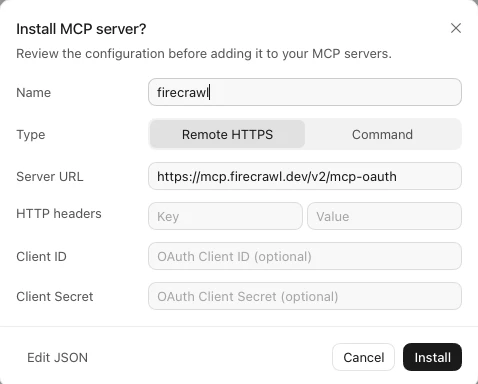
Install the Firecrawl MCP server
Open the install dialog in Cursor, check that the URL is Firecrawl's hosted server, then select Install.
Connect your Firecrawl account
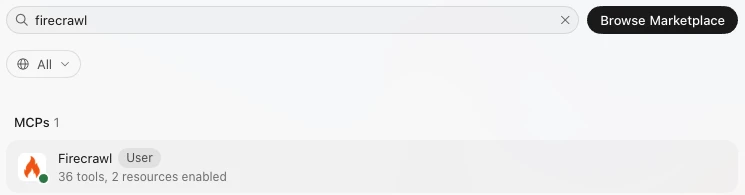
Use the server's sign-in option in Cursor's MCP settings. Firecrawl opens in your browser: sign in, choose a team with Alexandria enabled, and approve access. A green dot next to Firecrawl means it's connected.
Ask Cursor's agent for the data
In the agent chat, ask in plain language and mention STRING: protein interactions and functional enrichment or Firecrawl Alexandria. The agent finds the STRING: protein interactions and functional enrichment capability that fits and runs it. For example:
Use Firecrawl to answer this: Which proteins does STRING say interact with PCSK9 with confidence above 0.7, and which evidence channel supports each?
What can Cursor do with STRING: protein interactions and functional enrichment?
STRING (string-db.org, version 12.5; SIB, Novo Nordisk Foundation CPR and EMBL), the database of known and predicted protein-protein associations, through its public REST API (CC BY 4.0). Gives one protein's interaction partners or the network among a gene list in any of about 12,500 species, with STRING's combined confidence score and its seven evidence channels (neighborhood, gene fusion, co-occurrence, co-expression, experiments, curated databases, text mining), physical-only or functional associations, and the network's PPI enrichment p-value against chance. Runs functional enrichment of a gene list (Gene Ontology, Reactome, WikiPathways, UniProt keywords, Hallmark, COMPARTMENTS, TISSUES, DISEASES, InterPro, Pfam, PubMed, mammalian phenotypes) with FDR and the matched genes, limited to categories whose source licence permits commercial redistribution: KEGG, SMART and HPO terms are left out and counted. Names are mapped first (gene symbol, UniProt accession, Ensembl protein ID, STRING ID) and every answer names the STRING version, its licence and attribution.
Cursor can run any of STRING: protein interactions and functional enrichment's 3 capabilities through Alexandria. Each call is billed in Firecrawl credits on your Firecrawl team.
- Network: The interaction network among a list of 2 to 100 proteins in one species. Required option: proteins (an array of 2 to 100 gene symbols, UniProt accessions, Ensembl protein IDs or STRING IDs, one per item; STRING's own API parameter name identifiers is not an option here); optional species, min_score, network_type. Gives every pair STRING scores at or above min_score, with the combined confidence score and the seven evidence channel scores, plus STRING's network statistics (nodes, edges against the number expected for random proteins, average node degree, clustering coefficient and the PPI enrichment p-value that says whether the list is more connected than chance). Each input is mapped first (gene symbol, UniProt accession, Ensembl protein ID or STRING ID); proteins shows how each mapped and inputs that matched nothing come back in unmapped with a warning. preferred_name is the gene symbol (join to genenames-org or gene-ncbi-nlm-nih-gov); the STRING ID embeds the Ensembl protein ID for human and most vertebrates (protein_id; join to uniprot-org proteins/map_ids). No proteins are added to the network. Also the STRING version, a link to the network on string-db.org and the CC BY 4.0 licence with attribution. Costs 5 Firecrawl credits per call.
- Partners: One protein's interaction partners in STRING for a species. Required option: protein (one gene symbol, UniProt accession, Ensembl protein ID or STRING ID; STRING's own API parameter name identifiers is not an option here); optional species, min_score, limit, network_type. Gives each partner's gene symbol and STRING ID with the combined confidence score (0 to 1) and the seven evidence channel scores (neighborhood, gene_fusion, cooccurrence, coexpression, experiments, databases, text_mining), highest first. protein is mapped first; the answer shows how it mapped (STRING ID, preferred_name, annotation, species) and warns when STRING matched an alias or a similar name. preferred_name is the gene symbol (join to genenames-org or gene-ncbi-nlm-nih-gov by it); the STRING ID is the NCBI taxon plus a dot plus protein_id, the Ensembl protein ID for human and most vertebrates (join to uniprot-org proteins/map_ids). min_score takes STRING's bands (0.4 medium, 0.7 high, 0.9 highest); network_type physical keeps only binding and complex evidence. Also the STRING version, a link to the network on string-db.org and the CC BY 4.0 licence with the attribution STRING asks for. Costs 5 Firecrawl credits per call.
- Enrichment: Functional enrichment of a list of 2 to 200 proteins in one species against the whole genome, as STRING computes it. Required option: proteins (an array of 2 to 200 gene symbols, UniProt accessions, Ensembl protein IDs or STRING IDs, one per item; STRING's own API parameter name identifiers is not an option here); optional species, categories, fdr, limit. Gives the terms the list is over-represented for, with the term's category, source database and licence, ID, name, how many of your proteins and how many genome proteins have it, p-value, FDR and which of your genes carry it. Categories are Gene Ontology (Process, Function, Component), UniProt Keywords, Reactome (RCTM), WikiPathways, MSigDB Hallmark, COMPARTMENTS, TISSUES, DISEASES, InterPro, Pfam, PubMed papers (PMID), STRING network clusters (NetworkNeighborAL) and Mammalian Phenotype (MPO). Categories whose source licence does not permit commercial redistribution (KEGG, SMART, the Human Phenotype Ontology) or is unverified are left out, and excluded_categories counts what was dropped and why; no term data from them is returned. Inputs are mapped first (gene symbol, UniProt accession, Ensembl protein ID or STRING ID; unmapped ones warn); genes lists preferred names, the gene symbols to join to genenames-org or gene-ncbi-nlm-nih-gov, and the STRING ID embeds the Ensembl protein ID (protein_id; join to uniprot-org proteins/map_ids). Also the STRING version, the licence of STRING (CC BY 4.0) and of every source database present. Costs 5 Firecrawl credits per call.
What should I ask Cursor?
Name STRING: protein interactions and functional enrichment or Firecrawl Alexandria in the prompt so Cursor reaches for it. Each example opens in Cursor with the prompt filled in.
- Use Firecrawl to answer this: Which proteins does STRING say interact with PCSK9 with confidence above 0.7, and which evidence channel supports each?
- Use Firecrawl to answer this: Are LDLR, PCSK9, APOB, APOE, LPL, ABCA1, LCAT, CETP, NPC1L1 and HMGCR more connected in STRING than chance, and which pairs have the strongest evidence?
- Use Firecrawl to answer this: For LDLR, PCSK9, APOB, APOE, LPL, ABCA1, LCAT, CETP, NPC1L1 and HMGCR, which GO processes and pathways are over-represented, and which enrichment categories were left out for licence reasons?
- Use Firecrawl to run STRING: protein interactions and functional enrichment's Network capability. Inspect the Alexandria inputs, ask for any missing required details, and return a small sample with sources.
Troubleshooting
Why can't Cursor find STRING: protein interactions and functional enrichment?
If Firecrawl's tools in Cursor stop at search, scrape and parse, the connection is keyless and doesn't include Alexandria. Finish the sign-in from Cursor's MCP settings, or add an API key from a team with Alexandria enabled.
Firecrawl shows a red dot in Cursor. What should I do?
Open Cursor's MCP settings, sign in to Firecrawl again, and restart the agent chat so it loads the tools.
Use STRING: protein interactions and functional enrichment in other AI apps
The same Firecrawl account reaches STRING: protein interactions and functional enrichment from other AI apps. Pick one for its setup steps:
- STRING: protein interactions and functional enrichment in ChatGPT
- STRING: protein interactions and functional enrichment in Claude
- STRING: protein interactions and functional enrichment in Grok Bot
 STRING: protein interactions and functional enrichment in Muse
Other data providers you can connect to Cursor
Frequently Asked Questions
What is Firecrawl?
Firecrawl is the web data API to search, scrape and interact with the web at scale. It turns websites into clean, LLM-ready data for AI agents and apps. The Firecrawl MCP server brings those tools into Cursor, along with every data provider in Firecrawl Alexandria.
What is Firecrawl Alexandria?
Firecrawl Alexandria is Firecrawl's library of 550+ data providers for AI agents, STRING: protein interactions and functional enrichment among them. Each provider returns structured data through documented capabilities. Cursor finds the capability that fits your question and calls it through the Firecrawl MCP server, so you don't write any integration code. Alexandria needs a Firecrawl account signed in on a team with Alexandria enabled, or an API key from such a team; keyless connections don't include it.
Is there a STRING: protein interactions and functional enrichment MCP server for Cursor?
Cursor reaches STRING: protein interactions and functional enrichment through Firecrawl's hosted MCP server, which serves STRING: protein interactions and functional enrichment and every other Alexandria provider as tools. Add the Firecrawl MCP server once and you don't install or host a separate MCP server for STRING: protein interactions and functional enrichment.
What does connecting STRING: protein interactions and functional enrichment to Cursor unlock?
Cursor can run STRING: protein interactions and functional enrichment's Network, Partners and Enrichment, from any chat, with structured results it can sort, compare and summarize. For example, ask: "Use Firecrawl to answer this: Which proteins does STRING say interact with PCSK9 with confidence above 0.7, and which evidence channel supports each?" In the same conversation, Cursor can combine STRING: protein interactions and functional enrichment with Firecrawl's web search and scraping and the other providers in Firecrawl Alexandria.
Do I need my own STRING: protein interactions and functional enrichment account or API key to use it in Cursor?
No. Cursor calls STRING: protein interactions and functional enrichment through Firecrawl Alexandria and each call is billed in Firecrawl credits, so you don't need a separate STRING: protein interactions and functional enrichment account or API key.
How much does it cost to use STRING: protein interactions and functional enrichment in Cursor?
Each STRING: protein interactions and functional enrichment call costs 5 Firecrawl credits. The capability list on this page shows each price and its unit. The credits come from the Firecrawl team you connect to Cursor, and finding the right capability is free.
Can Cursor use other providers besides STRING: protein interactions and functional enrichment?
Yes. The same Firecrawl MCP server reaches every provider in Firecrawl Alexandria, along with Firecrawl's web search and scraping, so you connect once.
Can I use STRING: protein interactions and functional enrichment in other AI apps?
Yes. Connect Firecrawl to ChatGPT, Claude, Grok Bot, Muse signed in on a Firecrawl team with Alexandria enabled, or use the Firecrawl MCP server, CLI or API with an API key from that team, and the same STRING: protein interactions and functional enrichment capabilities are available there. Keyless connections don't include Alexandria.