How to connect U.S. Cancer Statistics (CDC and NCI) to Cursor
Add the Firecrawl MCP server to Cursor once and it can call the U.S. Cancer Statistics (CDC and NCI) API and every other provider in Firecrawl Alexandria, with no U.S. Cancer Statistics (CDC and NCI) integration code.
To connect U.S. Cancer Statistics (CDC and NCI) to Cursor, add the Firecrawl MCP server to Cursor, sign in on a Firecrawl team with Alexandria enabled, and ask for U.S. Cancer Statistics (CDC and NCI) data in plain language. The connection works in Cursor's agent and chat, and you set it up once.
Cursor uses U.S. Cancer Statistics (CDC and NCI) as an MCP tool through Firecrawl's hosted MCP server, so you don't install or host a separate MCP server for U.S. Cancer Statistics (CDC and NCI).
Cursor is an AI code editor. Its agent uses MCP servers for outside tools, and the Firecrawl MCP server adds web search, scraping and every data provider in Firecrawl Alexandria.
How do I connect U.S. Cancer Statistics (CDC and NCI) to Cursor?
Install the Firecrawl MCP server
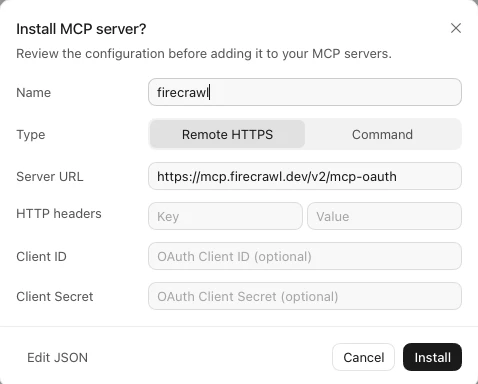
Open the install dialog in Cursor, check that the URL is Firecrawl's hosted server, then select Install.
Connect your Firecrawl account
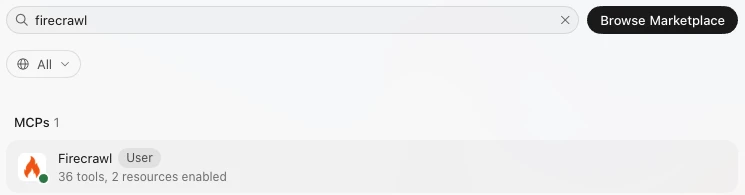
Use the server's sign-in option in Cursor's MCP settings. Firecrawl opens in your browser: sign in, choose a team with Alexandria enabled, and approve access. A green dot next to Firecrawl means it's connected.
Ask Cursor's agent for the data
In the agent chat, ask in plain language and mention U.S. Cancer Statistics (CDC and NCI) or Firecrawl Alexandria. The agent finds the U.S. Cancer Statistics (CDC and NCI) capability that fits and runs it. For example:
Use Firecrawl to answer this: What is the pancreatic cancer incidence rate in each U.S. state?
What can Cursor do with U.S. Cancer Statistics (CDC and NCI)?
U.S. Cancer Statistics (USCS), the official federal cancer statistics that CDC's National Program of Cancer Registries and NCI's SEER Program publish: registry counts and rates of new cancer cases (incidence) and of cancer deaths (mortality) by state, county, age group and cancer site, from the delimited ASCII data tables of the newest release on the USCS data-tables page (now 1999-2023: new cases diagnosed 1999-2023, deaths 1999-2024, from the November 2025 data submission). Rates are per 100,000, age-adjusted to the 2000 U.S. standard population except the age table's age-specific rates; counts below 16 are suppressed, and every suppressed or missing value is marked with its reason instead of a number. These are new cases and deaths, not prevalence. Public domain U.S. Government data; every result carries the USCS citation and CDC's terms.
Cursor can run U.S. Cancer Statistics (CDC and NCI)'s capability through Alexandria. Each call is billed in Firecrawl credits on your Firecrawl team.
- Search: Cancer incidence (new cases) or mortality (deaths) counts and rates from one USCS table: by state and year (`state`), by county for the latest 5-year period (`county`), by age group for the U.S. (`age`), or for the U.S. by detailed site (`national`), filtered by site, sex, race and ethnicity, states and year or year range, optionally sorted. Each row has the area (state code, county name and FIPS, or age group), year, site, sex, race, count, population, rate per 100,000 (age-adjusted to the 2000 U.S. standard population, or age-specific in the age table) with its 95% confidence interval, and a status for the count and the rate: `suppressed_under_16` (fewer than 16 cases or deaths), `suppressed_state_request`, `suppressed_complementary` (withheld because the other sex's count is suppressed) or `not_available`, never a 0 in their place. Defaults: all sites combined, incidence, both sexes, all races, the latest year. No matching row is an empty result with a warning. Costs 5 Firecrawl credits per call.
What should I ask Cursor?
Name U.S. Cancer Statistics (CDC and NCI) or Firecrawl Alexandria in the prompt so Cursor reaches for it. Each example opens in Cursor with the prompt filled in.
- Use Firecrawl to answer this: What is the pancreatic cancer incidence rate in each U.S. state?
- Use Firecrawl to answer this: Which Texas counties have the highest pancreatic cancer incidence?
- Use Firecrawl to answer this: How has the female breast cancer death rate in California changed since 1999?
- Use Firecrawl to run U.S. Cancer Statistics (CDC and NCI)'s Search capability. Inspect the Alexandria inputs, ask for any missing required details, and return a small sample with sources.
Troubleshooting
Why can't Cursor find U.S. Cancer Statistics (CDC and NCI)?
If Firecrawl's tools in Cursor stop at search, scrape and parse, the connection is keyless and doesn't include Alexandria. Finish the sign-in from Cursor's MCP settings, or add an API key from a team with Alexandria enabled.
Firecrawl shows a red dot in Cursor. What should I do?
Open Cursor's MCP settings, sign in to Firecrawl again, and restart the agent chat so it loads the tools.
Use U.S. Cancer Statistics (CDC and NCI) in other AI apps
The same Firecrawl account reaches U.S. Cancer Statistics (CDC and NCI) from other AI apps. Pick one for its setup steps:
- U.S. Cancer Statistics (CDC and NCI) in ChatGPT
- U.S. Cancer Statistics (CDC and NCI) in Claude
- U.S. Cancer Statistics (CDC and NCI) in Grok Bot
 U.S. Cancer Statistics (CDC and NCI) in Muse
Other data providers you can connect to Cursor
Frequently Asked Questions
What is Firecrawl?
Firecrawl is the web data API to search, scrape and interact with the web at scale. It turns websites into clean, LLM-ready data for AI agents and apps. The Firecrawl MCP server brings those tools into Cursor, along with every data provider in Firecrawl Alexandria.
What is Firecrawl Alexandria?
Firecrawl Alexandria is Firecrawl's library of 550+ data providers for AI agents, U.S. Cancer Statistics (CDC and NCI) among them. Each provider returns structured data through documented capabilities. Cursor finds the capability that fits your question and calls it through the Firecrawl MCP server, so you don't write any integration code. Alexandria needs a Firecrawl account signed in on a team with Alexandria enabled, or an API key from such a team; keyless connections don't include it.
Is there a U.S. Cancer Statistics (CDC and NCI) MCP server for Cursor?
Cursor reaches U.S. Cancer Statistics (CDC and NCI) through Firecrawl's hosted MCP server, which serves U.S. Cancer Statistics (CDC and NCI) and every other Alexandria provider as tools. Add the Firecrawl MCP server once and you don't install or host a separate MCP server for U.S. Cancer Statistics (CDC and NCI).
What does connecting U.S. Cancer Statistics (CDC and NCI) to Cursor unlock?
Cursor can run U.S. Cancer Statistics (CDC and NCI)'s Search capability from any chat, with structured results it can sort, compare and summarize. For example, ask: "Use Firecrawl to answer this: What is the pancreatic cancer incidence rate in each U.S. state?" In the same conversation, Cursor can combine U.S. Cancer Statistics (CDC and NCI) with Firecrawl's web search and scraping and the other providers in Firecrawl Alexandria.
Do I need my own U.S. Cancer Statistics (CDC and NCI) account or API key to use it in Cursor?
No. Cursor calls U.S. Cancer Statistics (CDC and NCI) through Firecrawl Alexandria and each call is billed in Firecrawl credits, so you don't need a separate U.S. Cancer Statistics (CDC and NCI) account or API key.
How much does it cost to use U.S. Cancer Statistics (CDC and NCI) in Cursor?
Each U.S. Cancer Statistics (CDC and NCI) call costs 5 Firecrawl credits. The capability list on this page shows each price and its unit. The credits come from the Firecrawl team you connect to Cursor, and finding the right capability is free.
Can Cursor use other providers besides U.S. Cancer Statistics (CDC and NCI)?
Yes. The same Firecrawl MCP server reaches every provider in Firecrawl Alexandria, along with Firecrawl's web search and scraping, so you connect once.
Can I use U.S. Cancer Statistics (CDC and NCI) in other AI apps?
Yes. Connect Firecrawl to ChatGPT, Claude, Grok Bot, Muse signed in on a Firecrawl team with Alexandria enabled, or use the Firecrawl MCP server, CLI or API with an API key from that team, and the same U.S. Cancer Statistics (CDC and NCI) capabilities are available there. Keyless connections don't include Alexandria.