How to connect EU Financial Sanctions Files (consolidated list) to Grok Bot
Add the Firecrawl plugin to Grok Bot once and it can call the EU Financial Sanctions Files (consolidated list) API and every other provider in Firecrawl Alexandria, with no EU Financial Sanctions Files (consolidated list) integration code.
To connect EU Financial Sanctions Files (consolidated list) to Grok Bot, add the Firecrawl plugin to Grok Bot, sign in on a Firecrawl team with Alexandria enabled, and ask for EU Financial Sanctions Files (consolidated list) data in plain language. The connection works in every Bot in your Grok Bot account, and you set it up once.
Grok Bot uses EU Financial Sanctions Files (consolidated list) as an MCP tool through Firecrawl's hosted MCP server, so you don't install or host a separate MCP server for EU Financial Sanctions Files (consolidated list).
Grok Bot is xAI's agent app. Plugins give your Bots outside tools, and the Firecrawl plugin adds web search, scraping and every data provider in Firecrawl Alexandria.
How do I connect EU Financial Sanctions Files (consolidated list) to Grok Bot?
Add the Firecrawl plugin
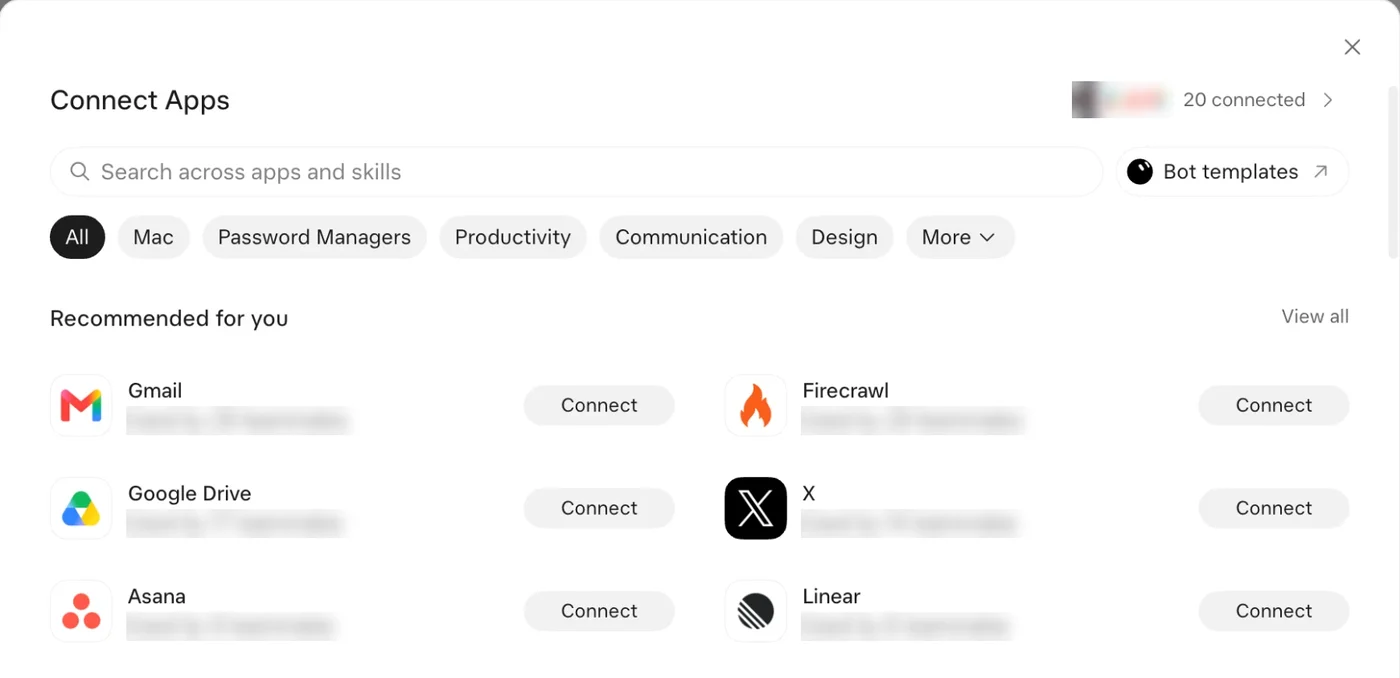
In Grok Bot, open Connect apps from the sidebar, find Firecrawl and select Connect. You can also open Firecrawl's plugin listing and select Add to Grok Bot, which opens the desktop app to finish the install.
Connect your Firecrawl account
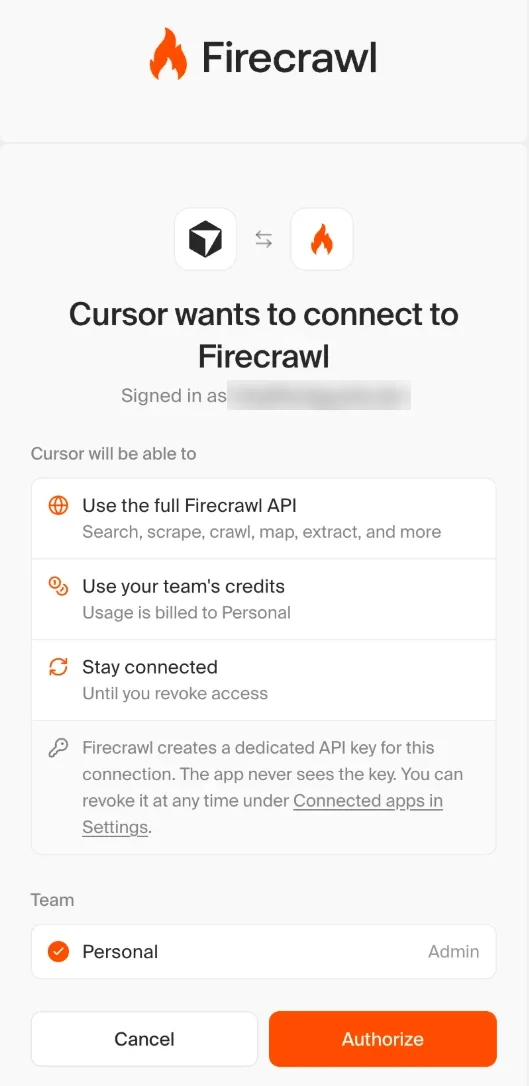
Grok Bot opens Firecrawl in your browser. Sign in, choose a team with Alexandria enabled, and select Authorize. The screen names Cursor, because the plugin is published on the Cursor Marketplace. No account yet? You can create one for free in the same flow.
Ask your Bot for the data
In a chat, ask in plain language and mention EU Financial Sanctions Files (consolidated list) or Firecrawl Alexandria. To make sure the Bot uses Firecrawl, type @ and choose Firecrawl first. For example:
Use Firecrawl to run EU Financial Sanctions Files (consolidated list)'s Records get capability. Inspect the Alexandria inputs, ask for any missing required details, and return a small sample with sources.
What can Grok Bot do with EU Financial Sanctions Files (consolidated list)?
The European Commission's consolidated list of persons, groups and entities subject to EU financial sanctions (Financial Sanctions Files, webgate.ec.europa.eu/fsd/fsf), read from the public XML 1.1 file and its RSS version feed: a cheap version check (publication id, date, size, publisher's SHA-1), the full list paginated with a cursor pinned to one publication, one entity by logicalId or EU reference number with every name (all languages and scripts), identifier, address, nationality, birth date and place, programme, legal basis and remark, and a name search. Primary source, anonymous, asset-freeze measure only; no change feed exists upstream (the feed only announces new full files), so records_changes is not offered. Reuse under Commission Decision 2011/833/EU. A match or an absence is not a compliance determination.
Grok Bot can run any of EU Financial Sanctions Files (consolidated list)'s 4 capabilities through Alexandria. Each call is billed in Firecrawl credits on your Firecrawl team.
- Records get: One entity of the consolidated list by its own identifier: `eu:<logicalId>` (the source_record_id), a bare logicalId, or the EU reference number (EU.n.n). Returns the full record (names in every language and script with their amendment reference, identifiers, addresses with contact details, nationalities, birth dates and places kept as partial or approximate as the file states them, programme, measures, legal basis with EUR-Lex links, designation date or its fallback, UN reference, designation details, remarks) plus the publication it was read from. There is no per-entity endpoint upstream: the call reads the feed and the current XML 1.1 file and stops at the matching entity. Fails with not_found when no entity in the current file carries the identifier. Costs 5 Firecrawl credits per call.
- Records list: One page of the full consolidated list (XML 1.1), in file order (ascending logicalId), optionally filtered by programme code (UKR, IRN, SYR, ... 34 codes in the current file) and entity type (person, organization). The cursor is pinned to the publication (the file's SHA-1): every page re-reads the feed and the file, and when the publication has moved on the call fails with invalid_input, issue code `publication_changed`, instead of mixing two versions; restart without a cursor. Each record carries source_record_id (eu:<logicalId>), entity_type, primary_name, names (all languages and scripts), identifiers, addresses, nationalities, birth_dates (partial and approximate kept as given), birth_places, programs, measures (always asset_freeze), legal_basis, listed_on (designationDate, or the earliest amendment date when the file omits it), un_reference, remarks, and the provenance fields source_url, publication_id, retrieved_at. `total` counts the entities matching the filter in the whole file; `publication.record_count` is the file's entity count. Every page costs one feed request and one gzip-compressed download of the 25 MB file (about 2.5 MB on the wire), so prefer large pages (up to 500). Costs 5 Firecrawl credits per call.
- Search: Name search over the current consolidated list: every whitespace-separated term of `q` must occur (case-insensitive substring) in one of an entity's names, in any language or script (nameAlias wholeName). Optional programme and entity_type filters. Returns compact hits in file order (source_record_id, EU reference number, entity type, primary name, the names that matched, programmes, listing date, UN reference); records_get has the full record. `total` counts every matching entity; when it exceeds `limit` the result is marked partial. An empty result is a legitimate answer (no name contains the terms), not an error. A match or an absence is not a compliance determination. Costs 5 Firecrawl credits per call.
- Source status: Cheap version check from the RSS feed (one 4 KB request, no file download): the current XML 1.1 publication's id (the publisher's SHA-1 checksum of the file, from the feed's guid), publication date, file resource URL (without the public access query parameter the feed prints; see file_url), size in bytes and content hash, plus the same for every published file (PDF 1.0, CSV 1.0, CSV 1.1, XML 1.1, XML 1.0). The record count is not returned here because it needs the 25 MB file; records_list returns it. Use the publication_id to decide whether a held snapshot is stale. Costs 5 Firecrawl credits per call.
What should I ask Grok Bot?
Name EU Financial Sanctions Files (consolidated list) or Firecrawl Alexandria in the prompt so Grok Bot reaches for it.
- Use Firecrawl to run EU Financial Sanctions Files (consolidated list)'s Records get capability. Inspect the Alexandria inputs, ask for any missing required details, and return a small sample with sources.
- Use Firecrawl to run EU Financial Sanctions Files (consolidated list)'s Records list capability. Inspect the Alexandria inputs, ask for any missing required details, and return a small sample with sources.
- Use Firecrawl to run EU Financial Sanctions Files (consolidated list)'s Search capability. Inspect the Alexandria inputs, ask for any missing required details, and return a small sample with sources.
- Use Firecrawl to run EU Financial Sanctions Files (consolidated list)'s Source status capability. Inspect the Alexandria inputs, ask for any missing required details, and return a small sample with sources.
Troubleshooting
Why doesn't my Bot use EU Financial Sanctions Files (consolidated list)?
Attach Firecrawl to the chat with @ before you ask, and name EU Financial Sanctions Files (consolidated list) or Firecrawl Alexandria in the prompt.
Add to Grok Bot doesn't open the app. What should I do?
Install the Grok Bot desktop app first, or open Connect apps in Grok Bot and search for Firecrawl.
Use EU Financial Sanctions Files (consolidated list) in other AI apps
The same Firecrawl account reaches EU Financial Sanctions Files (consolidated list) from other AI apps. Pick one for its setup steps:
- EU Financial Sanctions Files (consolidated list) in ChatGPT
- EU Financial Sanctions Files (consolidated list) in Claude
- EU Financial Sanctions Files (consolidated list) in Cursor
 EU Financial Sanctions Files (consolidated list) in Muse
Other data providers you can connect to Grok Bot
Frequently Asked Questions
What is Firecrawl?
Firecrawl is the web data API to search, scrape and interact with the web at scale. It turns websites into clean, LLM-ready data for AI agents and apps. The Firecrawl plugin brings those tools into Grok Bot, along with every data provider in Firecrawl Alexandria.
What is Firecrawl Alexandria?
Firecrawl Alexandria is Firecrawl's library of 550+ data providers for AI agents, EU Financial Sanctions Files (consolidated list) among them. Each provider returns structured data through documented capabilities. Grok Bot finds the capability that fits your question and calls it through the Firecrawl plugin, so you don't write any integration code. Alexandria needs a Firecrawl account signed in on a team with Alexandria enabled, or an API key from such a team; keyless connections don't include it.
Is there a EU Financial Sanctions Files (consolidated list) MCP server for Grok Bot?
Grok Bot reaches EU Financial Sanctions Files (consolidated list) through Firecrawl's hosted MCP server, which serves EU Financial Sanctions Files (consolidated list) and every other Alexandria provider as tools. Add the Firecrawl plugin once and you don't install or host a separate MCP server for EU Financial Sanctions Files (consolidated list).
What does connecting EU Financial Sanctions Files (consolidated list) to Grok Bot unlock?
Grok Bot can run all 4 of EU Financial Sanctions Files (consolidated list)'s capabilities, including Records get, Records list and Search, from any chat, with structured results it can sort, compare and summarize. In the same conversation, Grok Bot can combine EU Financial Sanctions Files (consolidated list) with Firecrawl's web search and scraping and the other providers in Firecrawl Alexandria.
Do I need my own EU Financial Sanctions Files (consolidated list) account or API key to use it in Grok Bot?
No. Grok Bot calls EU Financial Sanctions Files (consolidated list) through Firecrawl Alexandria and each call is billed in Firecrawl credits, so you don't need a separate EU Financial Sanctions Files (consolidated list) account or API key.
How much does it cost to use EU Financial Sanctions Files (consolidated list) in Grok Bot?
Each EU Financial Sanctions Files (consolidated list) call costs 5 Firecrawl credits. The capability list on this page shows each price and its unit. The credits come from the Firecrawl team you connect to Grok Bot, and finding the right capability is free.
Can Grok Bot use other providers besides EU Financial Sanctions Files (consolidated list)?
Yes. The same Firecrawl plugin reaches every provider in Firecrawl Alexandria, along with Firecrawl's web search and scraping, so you connect once.
Can I use EU Financial Sanctions Files (consolidated list) in other AI apps?
Yes. Connect Firecrawl to ChatGPT, Claude, Cursor, Muse signed in on a Firecrawl team with Alexandria enabled, or use the Firecrawl MCP server, CLI or API with an API key from that team, and the same EU Financial Sanctions Files (consolidated list) capabilities are available there. Keyless connections don't include Alexandria.