How to connect National Weather Service API (api.weather.gov) to Claude
Add the Firecrawl connector to Claude once and it can call the National Weather Service API (api.weather.gov) API and every other provider in Firecrawl Alexandria, with no National Weather Service API (api.weather.gov) integration code.
To connect National Weather Service API (api.weather.gov) to Claude, add the Firecrawl connector to Claude, sign in on a Firecrawl team with Alexandria enabled, and ask for National Weather Service API (api.weather.gov) data in plain language. The connection works in Claude on the web, Claude Desktop and Cowork, and you set it up once.
Claude uses National Weather Service API (api.weather.gov) as an MCP tool through Firecrawl's hosted MCP server, so you don't install or host a separate MCP server for National Weather Service API (api.weather.gov).
Claude is Anthropic's AI assistant. Connectors give it tools from other services, and the Firecrawl connector adds web search, scraping and every data provider in Firecrawl Alexandria.
How do I connect National Weather Service API (api.weather.gov) to Claude?
Add the Firecrawl connector
Open the Firecrawl connector in Claude's connector directory and select Connect to Claude. In Claude Desktop you can also go to Customize, then Connectors, and search for Firecrawl.
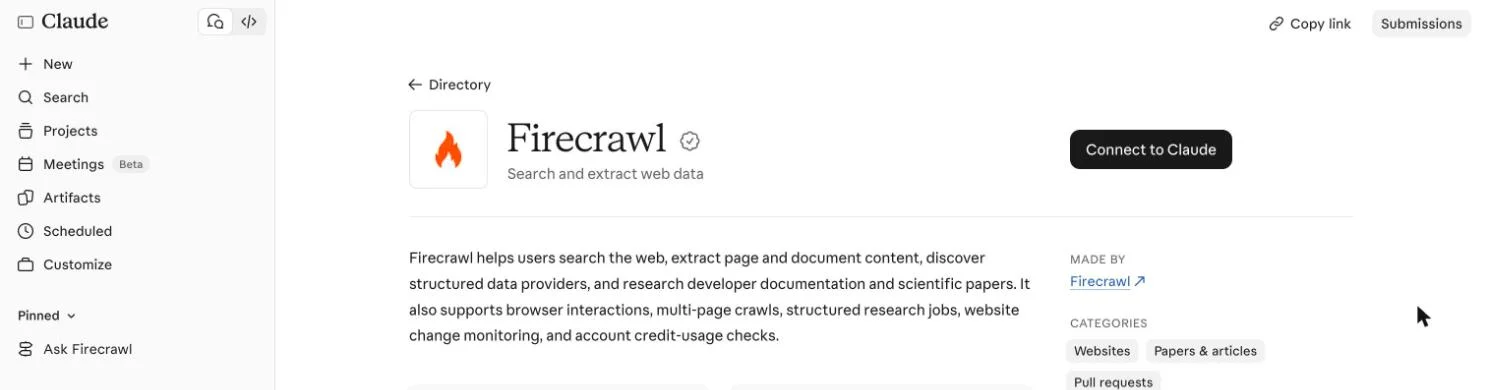
Connect your Firecrawl account
Claude opens Firecrawl in your browser. Sign in, choose a team with Alexandria enabled, and approve access. No account yet? You can create one for free in the same flow.
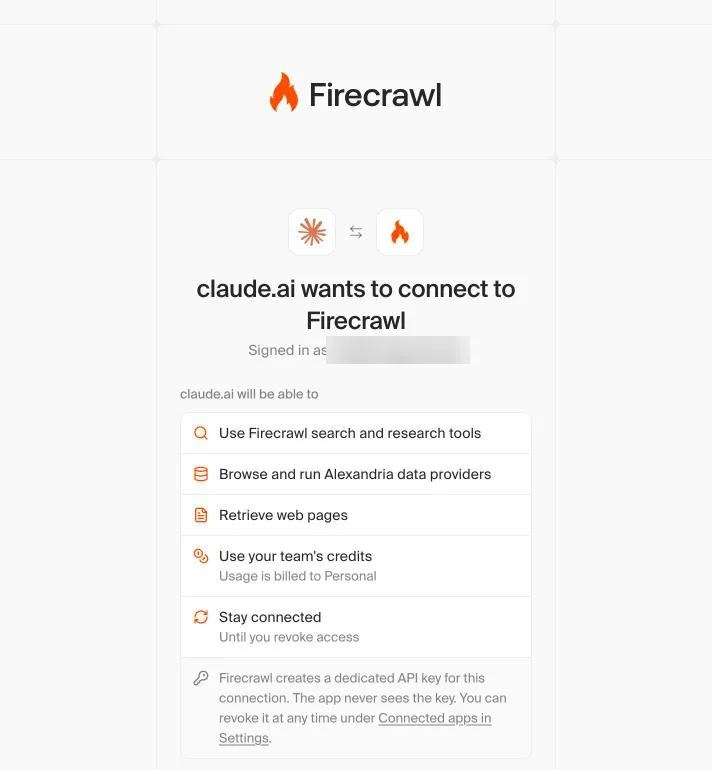
Turn on Firecrawl in a chat
In a new conversation, open the + menu, go to Connectors and switch on Firecrawl.
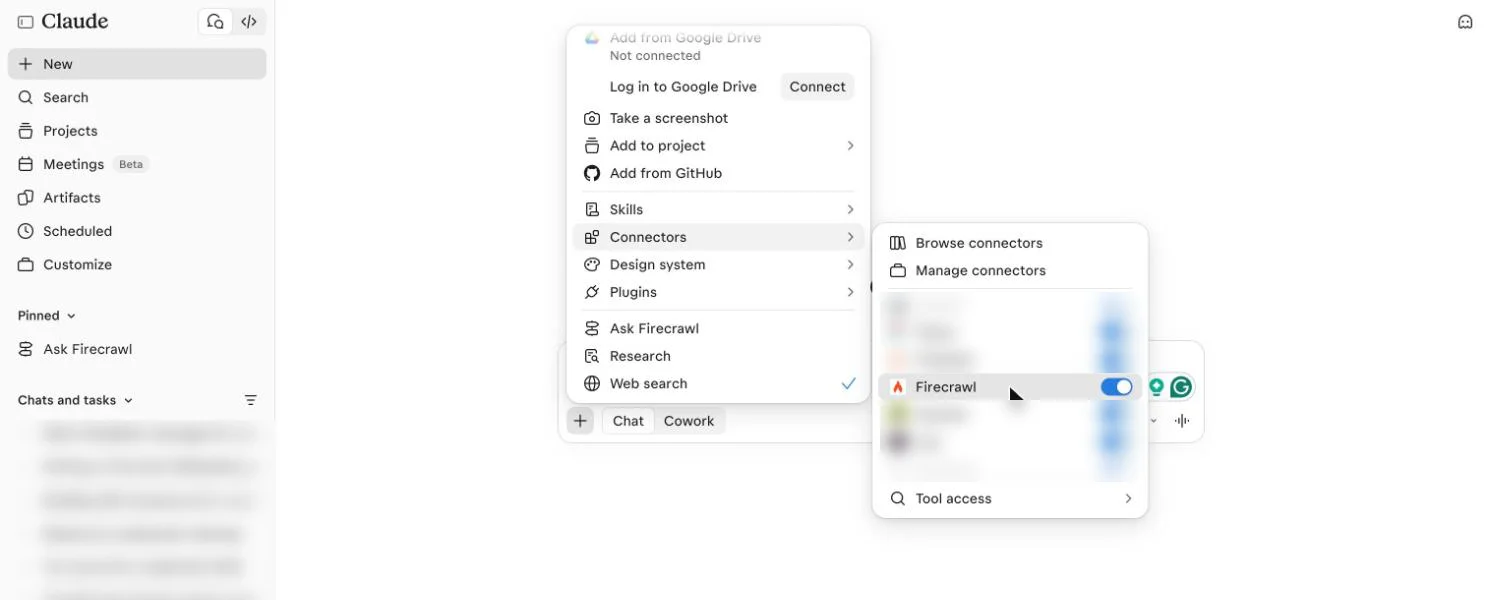
Ask Claude for the data
Ask in plain language and mention National Weather Service API (api.weather.gov) or Firecrawl Alexandria. Claude finds the National Weather Service API (api.weather.gov) capability that fits, checks its inputs and runs it. For example:
Use Firecrawl to get the next five days of NWS forecasts for the GeoJSON Point [-86.93, 35.853], with temperatures in Celsius, precipitation in millimeters and wind in km/h.
What can Claude do with National Weather Service API (api.weather.gov)?
NWS watches, warnings and advisories (active and last ~7 days), daily/hourly forecasts and current conditions / recent observations from the nearest observation stations for a GeoJSON geometry in the United States: the land contract shared with the other land programs (geometry in; spatial_precision, sources, missing and a location echo out). Station-keyed functions (observations_latest, observations, stations) also accept an NWS station id.
Claude can run any of National Weather Service API (api.weather.gov)'s 8 capabilities through Alexandria. Each call is billed in Firecrawl credits on your Firecrawl team.
- Alert: One NWS alert by CAP id from /alerts/{id}: full description and instruction, geocodes, affected zones and the storm polygon when the alert has one. Costs 5 Firecrawl credits per call.
- Alerts active: Active NWS watches, warnings and advisories (status actual) for a GeoJSON geometry. Samples the centroid and ring vertices, resolves their county, forecast and fire zones with /zones?point=, reads /alerts/active?zone=... and keeps zone-based alerts (match zone, precision county) plus storm-based alerts whose polygon intersects the geometry or lies within buffer_km of it (match polygon, precision polygon). Costs 5 Firecrawl credits per call.
- Alerts history: NWS alerts (status actual) whose zones or polygon covered a GeoJSON geometry within a date window, from /alerts?zone=...&start=...&end=.... The API keeps about seven days of alerts; a window older than that is reported in `missing`, not guessed. Pages with `continuation` (the API's opaque cursor). Costs 5 Firecrawl credits per call.
- Forecast daily: Per-local-day quantitative forecast for the NWS 2.5 km grid cell containing the geometry's centroid, aggregated from the raw gridpoint series (/gridpoints/{wfo}/{x},{y}): precipitation (mm), max/min temperature (C), min relative humidity, max wind and gust (km/h), max probability of precipitation, plus the day and night text from the 12-hour forecast, which also supplies the local UTC offset. Costs 5 Firecrawl credits per call.
- Forecast hourly: Hourly forecast periods for the NWS grid cell containing the geometry's centroid, from /gridpoints/{wfo}/{x},{y}/forecast/hourly: temperature (as the source states it, F), dewpoint (C), relative humidity, probability of precipitation, wind and short forecast text, with local-offset timestamps. Costs 5 Firecrawl credits per call.
- Observations: Recent observations of one NWS station, newest first, from /stations/{id}/observations with an optional start/end window (ISO 8601 with offset) and a page size (limit, 1..500). The API keeps roughly seven days; an older window is reported in `missing`, not guessed. Pages with `continuation` (the API's opaque cursor; the window and limit are re-applied on each page because the API's own next link drops them). Station metadata comes from /stations/{id}, which also makes an unknown id a not_found. Costs 5 Firecrawl credits per call.
- Observations latest: Current conditions: the latest observation from the nearest NWS station that reports data. With a geometry: /points/{lat},{lon} for the centroid's grid cell, /gridpoints/{wfo}/{x},{y}/stations (nearest first), then /stations/{id}/observations/latest station by station until one answers 200 with data (max_stations bounds the walk; stations that 404 or report every value null are skipped and listed in stations_tried). With a station_id: /stations/{id} and its /observations/latest. When /observations/latest answers with every value null, the newest record with data among the station's last 3 /observations is returned instead, with a latest_fallback warning. Temperature, dewpoint, humidity, wind, pressure, visibility, precipitation, present weather and cloud layers in fixed SI units, each null when the station did not report it, with the API's quality-control flags. Costs 5 Firecrawl credits per call.
- Stations: NWS observation stations, one of three ways: for a geometry, the stations the API lists for the centroid's forecast grid cell (/points then /gridpoints/{wfo}/{x},{y}/stations), nearest first with the API's grid-cell distance and bearing plus the great-circle distance from the centroid; for a two-letter state code, /stations?state=XX with cursor pagination; for a list of station ids, /stations?id=A,B (not_found when none exists). Each station carries name, provider network, time zone, elevation, coordinates and its forecast, county and fire-weather zone ids. Costs 5 Firecrawl credits per call.
What should I ask Claude?
Name National Weather Service API (api.weather.gov) or Firecrawl Alexandria in the prompt so Claude reaches for it. Each example opens in Claude with the prompt filled in.
- Use Firecrawl to get the next five days of NWS forecasts for the GeoJSON Point [-86.93, 35.853], with temperatures in Celsius, precipitation in millimeters and wind in km/h.
- Use Firecrawl to show the next 12 hours of NWS temperature, precipitation probability and wind forecasts at GeoJSON Point [-86.93, 35.853].
- Use Firecrawl to list active NWS warnings and advisories covering GeoJSON Point [-97.12, 32.58], with severity, expiry and instructions.
- Use Firecrawl to show NWS alerts covering GeoJSON Point [-97.12, 32.58] during the last three days, limited to 20 alerts, and report any missing history.
Troubleshooting
Why doesn't Claude use National Weather Service API (api.weather.gov)?
The connector has to be on in each conversation. Open the + menu, go to Connectors and check that Firecrawl is switched on, then ask again and name National Weather Service API (api.weather.gov) or Firecrawl Alexandria in the prompt.
Claude says it can't reach the Firecrawl server. What should I do?
Open Customize, then Connectors, disconnect Firecrawl and connect it again. On a Team or Enterprise plan, an owner has to allow the connector before members can add it.
Why does Claude say National Weather Service API (api.weather.gov) isn't available?
Alexandria needs a Firecrawl team with Alexandria enabled. Reconnect Firecrawl and pick that team on the consent screen.
Use National Weather Service API (api.weather.gov) in other AI apps
The same Firecrawl account reaches National Weather Service API (api.weather.gov) from other AI apps. Pick one for its setup steps:
- National Weather Service API (api.weather.gov) in ChatGPT
- National Weather Service API (api.weather.gov) in Cursor
- National Weather Service API (api.weather.gov) in Grok Bot
 National Weather Service API (api.weather.gov) in Muse
Other data providers you can connect to Claude
Frequently Asked Questions
What is Firecrawl?
Firecrawl is the web data API to search, scrape and interact with the web at scale. It turns websites into clean, LLM-ready data for AI agents and apps. The Firecrawl connector brings those tools into Claude, along with every data provider in Firecrawl Alexandria.
What is Firecrawl Alexandria?
Firecrawl Alexandria is Firecrawl's library of 550+ data providers for AI agents, National Weather Service API (api.weather.gov) among them. Each provider returns structured data through documented capabilities. Claude finds the capability that fits your question and calls it through the Firecrawl connector, so you don't write any integration code. Alexandria needs a Firecrawl account signed in on a team with Alexandria enabled, or an API key from such a team; keyless connections don't include it.
Is there a National Weather Service API (api.weather.gov) MCP server for Claude?
Claude reaches National Weather Service API (api.weather.gov) through Firecrawl's hosted MCP server, which serves National Weather Service API (api.weather.gov) and every other Alexandria provider as tools. Add the Firecrawl connector once and you don't install or host a separate MCP server for National Weather Service API (api.weather.gov).
What does connecting National Weather Service API (api.weather.gov) to Claude unlock?
Claude can run all 8 of National Weather Service API (api.weather.gov)'s capabilities, including Alert, Alerts active and Alerts history, from any chat, with structured results it can sort, compare and summarize. For example, ask: "Use Firecrawl to get the next five days of NWS forecasts for the GeoJSON Point [-86.93, 35.853], with temperatures in Celsius, precipitation in millimeters and wind in km/h." In the same conversation, Claude can combine National Weather Service API (api.weather.gov) with Firecrawl's web search and scraping and the other providers in Firecrawl Alexandria.
Do I need my own National Weather Service API (api.weather.gov) account or API key to use it in Claude?
No. Claude calls National Weather Service API (api.weather.gov) through Firecrawl Alexandria and each call is billed in Firecrawl credits, so you don't need a separate National Weather Service API (api.weather.gov) account or API key.
How much does it cost to use National Weather Service API (api.weather.gov) in Claude?
Each National Weather Service API (api.weather.gov) call costs 5 Firecrawl credits. The capability list on this page shows each price and its unit. The credits come from the Firecrawl team you connect to Claude, and finding the right capability is free.
Can Claude use other providers besides National Weather Service API (api.weather.gov)?
Yes. The same Firecrawl connector reaches every provider in Firecrawl Alexandria, along with Firecrawl's web search and scraping, so you connect once.
Can I use National Weather Service API (api.weather.gov) in other AI apps?
Yes. Connect Firecrawl to ChatGPT, Cursor, Grok Bot, Muse signed in on a Firecrawl team with Alexandria enabled, or use the Firecrawl MCP server, CLI or API with an API key from that team, and the same National Weather Service API (api.weather.gov) capabilities are available there. Keyless connections don't include Alexandria.