How to connect National Weather Service API (api.weather.gov) to Grok Bot
Add the Firecrawl plugin to Grok Bot once and it can call the National Weather Service API (api.weather.gov) API and every other provider in Firecrawl Alexandria, with no National Weather Service API (api.weather.gov) integration code.
To connect National Weather Service API (api.weather.gov) to Grok Bot, add the Firecrawl plugin to Grok Bot, sign in on a Firecrawl team with Alexandria enabled, and ask for National Weather Service API (api.weather.gov) data in plain language. The connection works in every Bot in your Grok Bot account, and you set it up once.
Grok Bot uses National Weather Service API (api.weather.gov) as an MCP tool through Firecrawl's hosted MCP server, so you don't install or host a separate MCP server for National Weather Service API (api.weather.gov).
Grok Bot is xAI's agent app. Plugins give your Bots outside tools, and the Firecrawl plugin adds web search, scraping and every data provider in Firecrawl Alexandria.
How do I connect National Weather Service API (api.weather.gov) to Grok Bot?
Add the Firecrawl plugin
In Grok Bot, open Connect apps from the sidebar, find Firecrawl and select Connect. You can also open Firecrawl's plugin listing and select Add to Grok Bot, which opens the desktop app to finish the install.
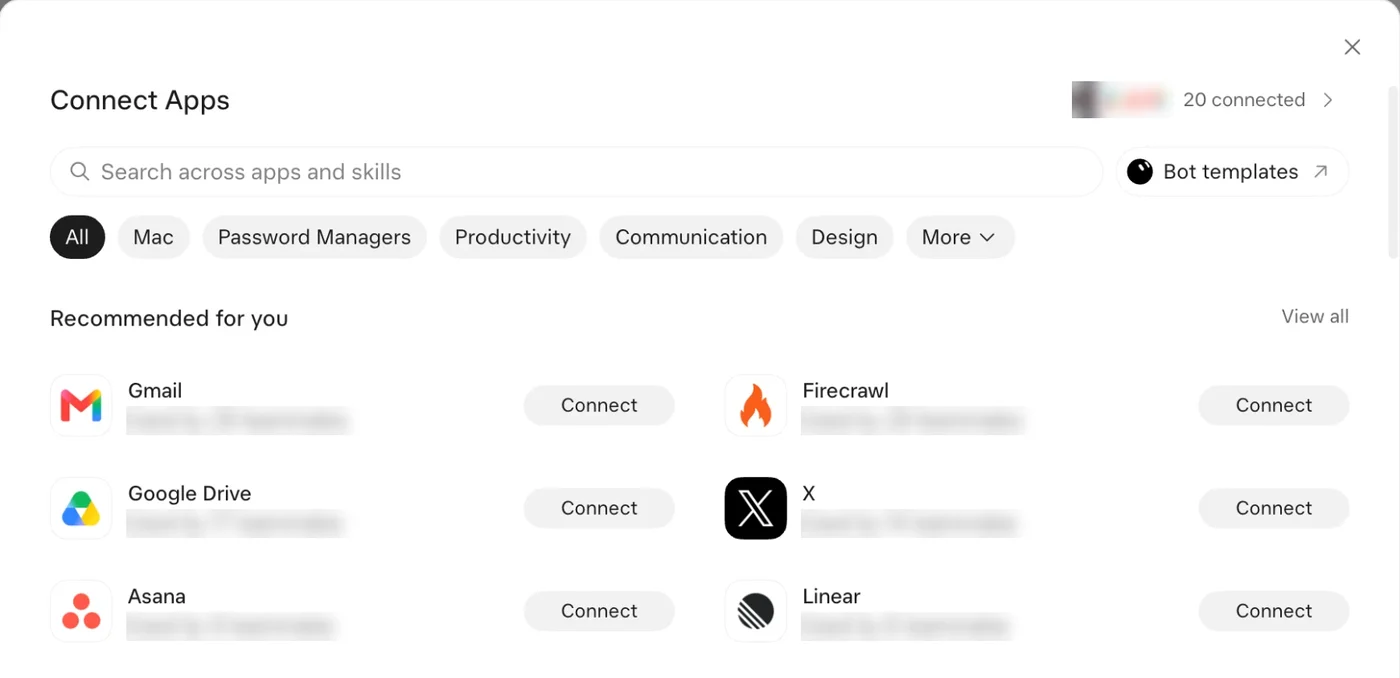
Connect your Firecrawl account
Grok Bot opens Firecrawl in your browser. Sign in, choose a team with Alexandria enabled, and select Authorize. The screen names Cursor, because the plugin is published on the Cursor Marketplace. No account yet? You can create one for free in the same flow.
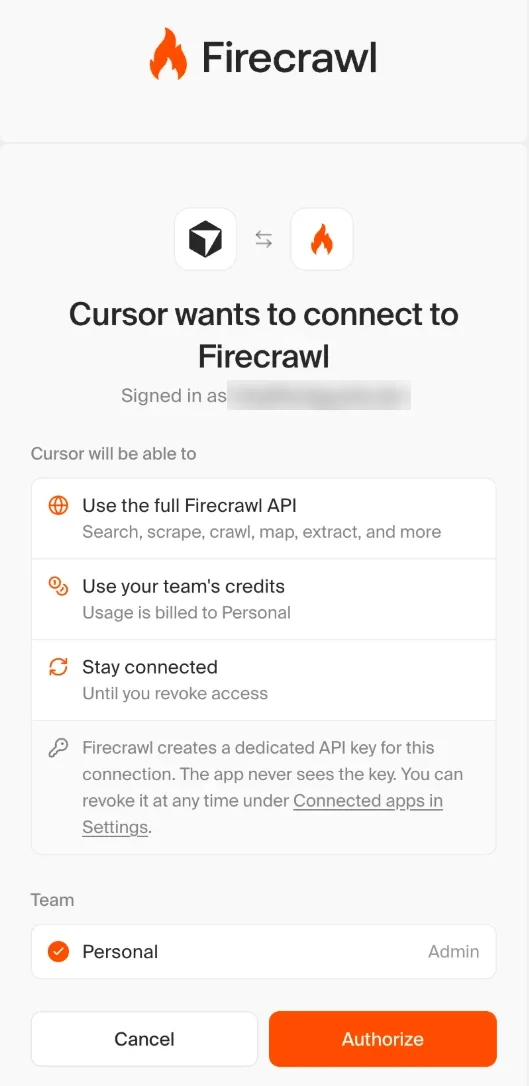
Ask your Bot for the data
In a chat, ask in plain language and mention National Weather Service API (api.weather.gov) or Firecrawl Alexandria. To make sure the Bot uses Firecrawl, type @ and choose Firecrawl first. For example:
Use Firecrawl to get the next five days of NWS forecasts for the GeoJSON Point [-86.93, 35.853], with temperatures in Celsius, precipitation in millimeters and wind in km/h.
What can Grok Bot do with National Weather Service API (api.weather.gov)?
NWS watches, warnings and advisories (active and last ~7 days), daily/hourly forecasts and current conditions / recent observations from the nearest observation stations for a GeoJSON geometry in the United States: the land contract shared with the other land programs (geometry in; spatial_precision, sources, missing and a location echo out). Station-keyed functions (observations_latest, observations, stations) also accept an NWS station id.
Grok Bot can run any of National Weather Service API (api.weather.gov)'s 8 capabilities through Alexandria. Each call is billed in Firecrawl credits on your Firecrawl team.
- Alert: One NWS alert by CAP id from /alerts/{id}: full description and instruction, geocodes, affected zones and the storm polygon when the alert has one. Costs 5 Firecrawl credits per call.
- Alerts active: Active NWS watches, warnings and advisories (status actual) for a GeoJSON geometry. Samples the centroid and ring vertices, resolves their county, forecast and fire zones with /zones?point=, reads /alerts/active?zone=... and keeps zone-based alerts (match zone, precision county) plus storm-based alerts whose polygon intersects the geometry or lies within buffer_km of it (match polygon, precision polygon). Costs 5 Firecrawl credits per call.
- Alerts history: NWS alerts (status actual) whose zones or polygon covered a GeoJSON geometry within a date window, from /alerts?zone=...&start=...&end=.... The API keeps about seven days of alerts; a window older than that is reported in `missing`, not guessed. Pages with `continuation` (the API's opaque cursor). Costs 5 Firecrawl credits per call.
- Forecast daily: Per-local-day quantitative forecast for the NWS 2.5 km grid cell containing the geometry's centroid, aggregated from the raw gridpoint series (/gridpoints/{wfo}/{x},{y}): precipitation (mm), max/min temperature (C), min relative humidity, max wind and gust (km/h), max probability of precipitation, plus the day and night text from the 12-hour forecast, which also supplies the local UTC offset. Costs 5 Firecrawl credits per call.
- Forecast hourly: Hourly forecast periods for the NWS grid cell containing the geometry's centroid, from /gridpoints/{wfo}/{x},{y}/forecast/hourly: temperature (as the source states it, F), dewpoint (C), relative humidity, probability of precipitation, wind and short forecast text, with local-offset timestamps. Costs 5 Firecrawl credits per call.
- Observations: Recent observations of one NWS station, newest first, from /stations/{id}/observations with an optional start/end window (ISO 8601 with offset) and a page size (limit, 1..500). The API keeps roughly seven days; an older window is reported in `missing`, not guessed. Pages with `continuation` (the API's opaque cursor; the window and limit are re-applied on each page because the API's own next link drops them). Station metadata comes from /stations/{id}, which also makes an unknown id a not_found. Costs 5 Firecrawl credits per call.
- Observations latest: Current conditions: the latest observation from the nearest NWS station that reports data. With a geometry: /points/{lat},{lon} for the centroid's grid cell, /gridpoints/{wfo}/{x},{y}/stations (nearest first), then /stations/{id}/observations/latest station by station until one answers 200 with data (max_stations bounds the walk; stations that 404 or report every value null are skipped and listed in stations_tried). With a station_id: /stations/{id} and its /observations/latest. When /observations/latest answers with every value null, the newest record with data among the station's last 3 /observations is returned instead, with a latest_fallback warning. Temperature, dewpoint, humidity, wind, pressure, visibility, precipitation, present weather and cloud layers in fixed SI units, each null when the station did not report it, with the API's quality-control flags. Costs 5 Firecrawl credits per call.
- Stations: NWS observation stations, one of three ways: for a geometry, the stations the API lists for the centroid's forecast grid cell (/points then /gridpoints/{wfo}/{x},{y}/stations), nearest first with the API's grid-cell distance and bearing plus the great-circle distance from the centroid; for a two-letter state code, /stations?state=XX with cursor pagination; for a list of station ids, /stations?id=A,B (not_found when none exists). Each station carries name, provider network, time zone, elevation, coordinates and its forecast, county and fire-weather zone ids. Costs 5 Firecrawl credits per call.
What should I ask Grok Bot?
Name National Weather Service API (api.weather.gov) or Firecrawl Alexandria in the prompt so Grok Bot reaches for it.
- Use Firecrawl to get the next five days of NWS forecasts for the GeoJSON Point [-86.93, 35.853], with temperatures in Celsius, precipitation in millimeters and wind in km/h.
- Use Firecrawl to show the next 12 hours of NWS temperature, precipitation probability and wind forecasts at GeoJSON Point [-86.93, 35.853].
- Use Firecrawl to list active NWS warnings and advisories covering GeoJSON Point [-97.12, 32.58], with severity, expiry and instructions.
- Use Firecrawl to show NWS alerts covering GeoJSON Point [-97.12, 32.58] during the last three days, limited to 20 alerts, and report any missing history.
Troubleshooting
Why doesn't my Bot use National Weather Service API (api.weather.gov)?
Attach Firecrawl to the chat with @ before you ask, and name National Weather Service API (api.weather.gov) or Firecrawl Alexandria in the prompt.
Add to Grok Bot doesn't open the app. What should I do?
Install the Grok Bot desktop app first, or open Connect apps in Grok Bot and search for Firecrawl.
Use National Weather Service API (api.weather.gov) in other AI apps
The same Firecrawl account reaches National Weather Service API (api.weather.gov) from other AI apps. Pick one for its setup steps:
- National Weather Service API (api.weather.gov) in ChatGPT
- National Weather Service API (api.weather.gov) in Claude
- National Weather Service API (api.weather.gov) in Cursor
 National Weather Service API (api.weather.gov) in Muse
Other data providers you can connect to Grok Bot
Frequently Asked Questions
What is Firecrawl?
Firecrawl is the web data API to search, scrape and interact with the web at scale. It turns websites into clean, LLM-ready data for AI agents and apps. The Firecrawl plugin brings those tools into Grok Bot, along with every data provider in Firecrawl Alexandria.
What is Firecrawl Alexandria?
Firecrawl Alexandria is Firecrawl's library of 550+ data providers for AI agents, National Weather Service API (api.weather.gov) among them. Each provider returns structured data through documented capabilities. Grok Bot finds the capability that fits your question and calls it through the Firecrawl plugin, so you don't write any integration code. Alexandria needs a Firecrawl account signed in on a team with Alexandria enabled, or an API key from such a team; keyless connections don't include it.
Is there a National Weather Service API (api.weather.gov) MCP server for Grok Bot?
Grok Bot reaches National Weather Service API (api.weather.gov) through Firecrawl's hosted MCP server, which serves National Weather Service API (api.weather.gov) and every other Alexandria provider as tools. Add the Firecrawl plugin once and you don't install or host a separate MCP server for National Weather Service API (api.weather.gov).
What does connecting National Weather Service API (api.weather.gov) to Grok Bot unlock?
Grok Bot can run all 8 of National Weather Service API (api.weather.gov)'s capabilities, including Alert, Alerts active and Alerts history, from any chat, with structured results it can sort, compare and summarize. For example, ask: "Use Firecrawl to get the next five days of NWS forecasts for the GeoJSON Point [-86.93, 35.853], with temperatures in Celsius, precipitation in millimeters and wind in km/h." In the same conversation, Grok Bot can combine National Weather Service API (api.weather.gov) with Firecrawl's web search and scraping and the other providers in Firecrawl Alexandria.
Do I need my own National Weather Service API (api.weather.gov) account or API key to use it in Grok Bot?
No. Grok Bot calls National Weather Service API (api.weather.gov) through Firecrawl Alexandria and each call is billed in Firecrawl credits, so you don't need a separate National Weather Service API (api.weather.gov) account or API key.
How much does it cost to use National Weather Service API (api.weather.gov) in Grok Bot?
Each National Weather Service API (api.weather.gov) call costs 5 Firecrawl credits. The capability list on this page shows each price and its unit. The credits come from the Firecrawl team you connect to Grok Bot, and finding the right capability is free.
Can Grok Bot use other providers besides National Weather Service API (api.weather.gov)?
Yes. The same Firecrawl plugin reaches every provider in Firecrawl Alexandria, along with Firecrawl's web search and scraping, so you connect once.
Can I use National Weather Service API (api.weather.gov) in other AI apps?
Yes. Connect Firecrawl to ChatGPT, Claude, Cursor, Muse signed in on a Firecrawl team with Alexandria enabled, or use the Firecrawl MCP server, CLI or API with an API key from that team, and the same National Weather Service API (api.weather.gov) capabilities are available there. Keyless connections don't include Alexandria.