How to connect Canada Energy Regulator (CER) open data to Cursor
Add the Firecrawl MCP server to Cursor once and it can call the Canada Energy Regulator (CER) open data API and every other provider in Firecrawl Alexandria, with no Canada Energy Regulator (CER) open data integration code.
To connect Canada Energy Regulator (CER) open data to Cursor, add the Firecrawl MCP server to Cursor, sign in on a Firecrawl team with Alexandria enabled, and ask for Canada Energy Regulator (CER) open data data in plain language. The connection works in Cursor's agent and chat, and you set it up once.
Cursor uses Canada Energy Regulator (CER) open data as an MCP tool through Firecrawl's hosted MCP server, so you don't install or host a separate MCP server for Canada Energy Regulator (CER) open data.
Cursor is an AI code editor. Its agent uses MCP servers for outside tools, and the Firecrawl MCP server adds web search, scraping and every data provider in Firecrawl Alexandria.
How do I connect Canada Energy Regulator (CER) open data to Cursor?
Install the Firecrawl MCP server
Open the install dialog in Cursor, check that the URL is Firecrawl's hosted server, then select Install.
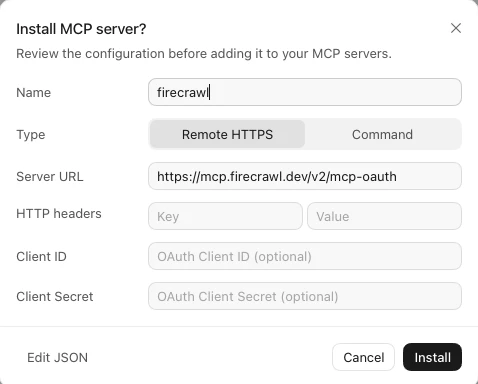
Connect your Firecrawl account
Use the server's sign-in option in Cursor's MCP settings. Firecrawl opens in your browser: sign in, choose a team with Alexandria enabled, and approve access. A green dot next to Firecrawl means it's connected.
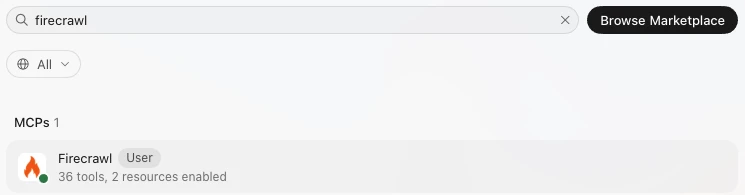
Ask Cursor's agent for the data
In the agent chat, ask in plain language and mention Canada Energy Regulator (CER) open data or Firecrawl Alexandria. The agent finds the Canada Energy Regulator (CER) open data capability that fits and runs it. For example:
Use Firecrawl to answer this: How full was the Trans Mountain pipeline at Westridge in 2025, month by month?
What can Cursor do with Canada Energy Regulator (CER) open data?
The Canada Energy Regulator's open data on www.cer-rec.gc.ca, read live and keyless from the CSV files the CER publishes under the Open Government Licence - Canada: pipeline profiles (operator, route, capacity, financials), daily and monthly pipeline throughput and capacity, pipeline tolls with their tariffs and REGDOCS filing ids, incidents at regulated pipelines since 2008, regulatory instruments (certificates, orders, licences, decision letters) with REGDOCS filing ids, Canada's Energy Future projections to 2050, and energy trade and production statistics (crude, gas, LNG, NGL, refined products, electricity). Every answer names its source file and carries the licence attribution.
Cursor can run any of Canada Energy Regulator (CER) open data's 7 capabilities through Alexandria. Each call is billed in Firecrawl credits on your Firecrawl team.
- Energy future: Projections from Canada's Energy Future, the CER's long-term energy supply and demand outlook to 2050, read from the edition's open data (2026, 2023 or 2021): benchmark oil and gas prices, crude oil, natural gas, NGL and hydrogen production, electricity capacity, generation and interchange, end-use demand and prices by sector, primary demand, greenhouse gas emissions, macro indicators and gas drilling, by scenario (e.g. Canada Net-zero, Current Measures), region and year. Filter by scenario, region, variable, sector or type and years; each answer lists the dataset's scenarios, regions, variables, categories and units to refine with. Costs 5 Firecrawl credits per call.
- Energy statistics: The CER's energy market and commodity statistics as open data: crude oil exports by US PADD, natural gas exports by port with values and prices, LNG exports by terminal and cargo, NGL and refined product exports, electricity exports and imports by province and US state with prices, estimated crude oil and marketable gas production by province, refinery crude runs, generating capacity and oil pipeline apportionment, monthly, weekly or annual. Filter any column by value (`filters`) and by period; newest first, paged. Each answer names the columns and lists the values of the categorical ones. Costs 5 Firecrawl credits per call.
- Incidents: Incidents reported to the CER at federally regulated pipelines and facilities since 2008, from the CER's comprehensive incident open data (about 2,000 incidents): number, types (release of substance, fire, explosion, serious injury, operation beyond design limits...), reported, occurrence and closed dates, company, province, nearest town and coordinates, substance and volume released, significance, what and why it happened, pipeline or facility, injuries, fatalities and evacuations, emergency level and investigation type. Look one up by incident number or filter by company, province, substance, type, significance, status, words and reported date; newest first, paged, with totals by year. Costs 5 Firecrawl credits per call.
- Pipelines: Key facts on the major CER-regulated oil and gas pipelines from the CER's Pipeline Profiles open data: operator and parent company, route, length, commodity, capacity, start year, interconnections, financial regulation group, links to the REGDOCS facility and toll folders and the Pipeline Profile page, and which systems have throughput and toll data here. Naming one pipeline (or company) also returns its annual financial series: revenue, cost of service, net income, rate base, return on equity and more. Costs 5 Firecrawl credits per call.
- Regulatory instruments: Regulatory instruments the CER (and the NEB before it) issued, from the CER's Regulatory Instruments Report open data (about 17,000): certificates, orders, toll orders, export licences and permits, amending orders and decision letters, each with its file number, company, decision, issued, effective, expiry and sunset dates, Governor in Council and Order in Council approval, and the REGDOCS filing ids of the decision with search links. Look one up by instrument number or filter by type, company, file number, REGDOCS filing id or issued date; newest first, paged. Costs 5 Firecrawl credits per call.
- Throughput: Pipeline throughput and capacity at a CER-regulated system's key points, from the CER's Pipeline Throughput and Capacity open data (the numbers behind the Pipeline Profiles traffic charts): natural gas systems daily (returned as monthly averages unless `granularity` is `daily`), oil systems monthly by product. Each row has throughput and capacity in thousand m3/d, GJ/d for gas, committed and available capacity and the reason for variance for oil, and utilization. Filter by key point, product, trade type and date; newest first, paged. 19 systems: NGTL, TC Canadian Mainline, Westcoast, Alliance, Foothills, M&NP, TQM, Brunswick, Suffield, Trans Mountain, Enbridge Mainline, Line 9, Keystone, Cochin, Trans-Northern, Southern Lights, Norman Wells, Westspur and Montreal. Costs 5 Firecrawl credits per call.
- Tolls: Tolls on a CER-regulated pipeline from the CER's Major Canadian Natural Gas and Oil Pipeline Tolls open data, collapsed from the CER's daily rows into effective periods: path, service, product, toll and unit, effective from and to, whether it is current, the tariff number it came from and replaced, and the REGDOCS folder and document ids of the tariff filing. Filter by path, service, product, current tolls only, or a date window; newest first, paged. Every answer also lists the system's paths, services and products. 25 systems, including Trans Mountain, Keystone, Enbridge Mainline, NGTL, TC Mainline, Westcoast, Alliance, Express and Cochin. Costs 5 Firecrawl credits per call.
What should I ask Cursor?
Name Canada Energy Regulator (CER) open data or Firecrawl Alexandria in the prompt so Cursor reaches for it. Each example opens in Cursor with the prompt filled in.
- Use Firecrawl to answer this: How full was the Trans Mountain pipeline at Westridge in 2025, month by month?
- Use Firecrawl to answer this: What is the current Trans Mountain toll from Edmonton to Westridge for heavy crude, and which tariff filing set it?
- Use Firecrawl to list significant incidents on Trans Mountain since 2024 and what caused them.
- Use Firecrawl to answer this: What Brent price does the CER's Energy Future 2023 Canada Net-zero scenario assume for 2030?
Troubleshooting
Why can't Cursor find Canada Energy Regulator (CER) open data?
If Firecrawl's tools in Cursor stop at search, scrape and parse, the connection is keyless and doesn't include Alexandria. Finish the sign-in from Cursor's MCP settings, or add an API key from a team with Alexandria enabled.
Firecrawl shows a red dot in Cursor. What should I do?
Open Cursor's MCP settings, sign in to Firecrawl again, and restart the agent chat so it loads the tools.
Use Canada Energy Regulator (CER) open data in other AI apps
The same Firecrawl account reaches Canada Energy Regulator (CER) open data from other AI apps. Pick one for its setup steps:
- Canada Energy Regulator (CER) open data in ChatGPT
- Canada Energy Regulator (CER) open data in Claude
- Canada Energy Regulator (CER) open data in Grok Bot
 Canada Energy Regulator (CER) open data in Muse
Other data providers you can connect to Cursor
Frequently Asked Questions
What is Firecrawl?
Firecrawl is the web data API to search, scrape and interact with the web at scale. It turns websites into clean, LLM-ready data for AI agents and apps. The Firecrawl MCP server brings those tools into Cursor, along with every data provider in Firecrawl Alexandria.
What is Firecrawl Alexandria?
Firecrawl Alexandria is Firecrawl's library of 550+ data providers for AI agents, Canada Energy Regulator (CER) open data among them. Each provider returns structured data through documented capabilities. Cursor finds the capability that fits your question and calls it through the Firecrawl MCP server, so you don't write any integration code. Alexandria needs a Firecrawl account signed in on a team with Alexandria enabled, or an API key from such a team; keyless connections don't include it.
Is there a Canada Energy Regulator (CER) open data MCP server for Cursor?
Cursor reaches Canada Energy Regulator (CER) open data through Firecrawl's hosted MCP server, which serves Canada Energy Regulator (CER) open data and every other Alexandria provider as tools. Add the Firecrawl MCP server once and you don't install or host a separate MCP server for Canada Energy Regulator (CER) open data.
What does connecting Canada Energy Regulator (CER) open data to Cursor unlock?
Cursor can run all 7 of Canada Energy Regulator (CER) open data's capabilities, including Energy future, Energy statistics and Incidents, from any chat, with structured results it can sort, compare and summarize. For example, ask: "Use Firecrawl to answer this: How full was the Trans Mountain pipeline at Westridge in 2025, month by month?" In the same conversation, Cursor can combine Canada Energy Regulator (CER) open data with Firecrawl's web search and scraping and the other providers in Firecrawl Alexandria.
Do I need my own Canada Energy Regulator (CER) open data account or API key to use it in Cursor?
No. Cursor calls Canada Energy Regulator (CER) open data through Firecrawl Alexandria and each call is billed in Firecrawl credits, so you don't need a separate Canada Energy Regulator (CER) open data account or API key.
How much does it cost to use Canada Energy Regulator (CER) open data in Cursor?
Each Canada Energy Regulator (CER) open data call costs 5 Firecrawl credits. The capability list on this page shows each price and its unit. The credits come from the Firecrawl team you connect to Cursor, and finding the right capability is free.
Can Cursor use other providers besides Canada Energy Regulator (CER) open data?
Yes. The same Firecrawl MCP server reaches every provider in Firecrawl Alexandria, along with Firecrawl's web search and scraping, so you connect once.
Can I use Canada Energy Regulator (CER) open data in other AI apps?
Yes. Connect Firecrawl to ChatGPT, Claude, Grok Bot, Muse signed in on a Firecrawl team with Alexandria enabled, or use the Firecrawl MCP server, CLI or API with an API key from that team, and the same Canada Energy Regulator (CER) open data capabilities are available there. Keyless connections don't include Alexandria.