How to connect Discogs to Cursor
Add the Firecrawl MCP server to Cursor once and it can call the Discogs API and every other provider in Firecrawl Alexandria, with no Discogs integration code.
To connect Discogs to Cursor, add the Firecrawl MCP server to Cursor, sign in on a Firecrawl team with Alexandria enabled, and ask for Discogs data in plain language. The connection works in Cursor's agent and chat, and you set it up once.
Cursor uses Discogs as an MCP tool through Firecrawl's hosted MCP server, so you don't install or host a separate MCP server for Discogs.
Cursor is an AI code editor. Its agent uses MCP servers for outside tools, and the Firecrawl MCP server adds web search, scraping and every data provider in Firecrawl Alexandria.
How do I connect Discogs to Cursor?
Install the Firecrawl MCP server
Open the install dialog in Cursor, check that the URL is Firecrawl's hosted server, then select Install.
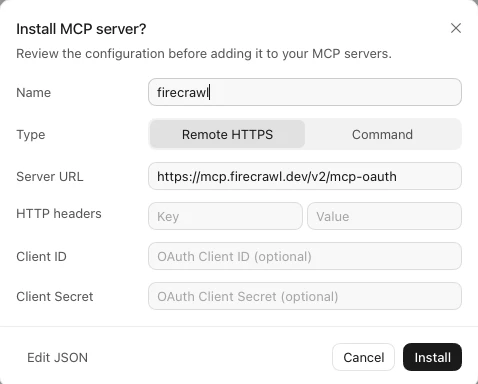
Connect your Firecrawl account
Use the server's sign-in option in Cursor's MCP settings. Firecrawl opens in your browser: sign in, choose a team with Alexandria enabled, and approve access. A green dot next to Firecrawl means it's connected.
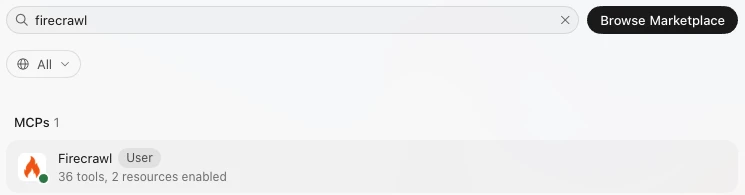
Ask Cursor's agent for the data
In the agent chat, ask in plain language and mention Discogs or Firecrawl Alexandria. The agent finds the Discogs capability that fits and runs it. For example:
Use Firecrawl to find US vinyl pressings of Radiohead’s OK Computer from 1997 and show the tracklist, label and matrix/runout identifiers for the first match.
What can Cursor do with Discogs?
Search the Discogs music database and look up releases, master releases, artists and labels, down to pressings, catalog numbers and barcodes.
Cursor can run any of Discogs's 8 capabilities through Alexandria. Each call is billed in Firecrawl credits on your Firecrawl team.
- Artist: One Discogs artist or group by artist ID: name, real name, profile text, name variations, aliases, members (for groups) or groups (for people), external URLs and images. Costs 5 Firecrawl credits per call.
- Artist releases: Releases by an artist (their discography as Discogs credits it), one page at a time: masters and standalone releases with role (Main, Remix, Appearance, ...), year, format and label, sortable by year, title or format. Costs 5 Firecrawl credits per call.
- Label: One Discogs label by label ID: name, profile, contact info, parent label, sublabels, external URLs and images. Costs 5 Firecrawl credits per call.
- Label releases: A label's catalog, one page at a time: every release on the label with its catalog number, artist, title, format and year, in Discogs' catalog-number order. Costs 5 Firecrawl credits per call.
- Master: One Discogs master release (the grouping of all pressings of the same album or single) by master ID: title, artists, original year, main and most recent release IDs, genres, styles, canonical tracklist, images, videos and marketplace summary. Use master_versions to list its pressings. Costs 5 Firecrawl credits per call.
- Master versions: Pressing variants of a master release: every release (country, label, catalog number, format, year) grouped under the master, one page at a time, with the filter facets Discogs offers (format, label, country, released) and optional filters and sort. Costs 5 Firecrawl credits per call.
- Release: One Discogs release (a specific pressing or edition) by release ID: artists, labels with catalog numbers, companies and pressing plants, formats and their descriptions, identifiers (barcodes, matrix/runout etchings, label codes), tracklist, notes, images, videos, marketplace count and lowest price, community have/want and rating. Costs 5 Firecrawl credits per call.
- Search: Search the Discogs database for releases, masters, artists or labels by free text, artist, release title, track, label, catalog number or barcode, optionally narrowed by year, format, country, genre and style. Returns one page of matches with type, title, year, country, formats, labels, catalog number, barcodes and IDs to pass to the detail functions. Costs 5 Firecrawl credits per call.
What should I ask Cursor?
Name Discogs or Firecrawl Alexandria in the prompt so Cursor reaches for it. Each example opens in Cursor with the prompt filled in.
- Use Firecrawl to find US vinyl pressings of Radiohead’s OK Computer from 1997 and show the tracklist, label and matrix/runout identifiers for the first match.
- Use Firecrawl to find the master release for Daft Punk’s Discovery and list up to 20 Japanese CD editions with release year and catalog number.
- Use Firecrawl to find Aphex Twin on Discogs and list the first 20 discography entries ordered by release year, including credited role.
- Use Firecrawl to find Warp Records on Discogs and return its label profile, parent label and sublabels.
Troubleshooting
Why can't Cursor find Discogs?
If Firecrawl's tools in Cursor stop at search, scrape and parse, the connection is keyless and doesn't include Alexandria. Finish the sign-in from Cursor's MCP settings, or add an API key from a team with Alexandria enabled.
Firecrawl shows a red dot in Cursor. What should I do?
Open Cursor's MCP settings, sign in to Firecrawl again, and restart the agent chat so it loads the tools.
Use Discogs in other AI apps
The same Firecrawl account reaches Discogs from other AI apps. Pick one for its setup steps:

Other data providers you can connect to Cursor
Frequently Asked Questions
What is Firecrawl?
Firecrawl is the web data API to search, scrape and interact with the web at scale. It turns websites into clean, LLM-ready data for AI agents and apps. The Firecrawl MCP server brings those tools into Cursor, along with every data provider in Firecrawl Alexandria.
What is Firecrawl Alexandria?
Firecrawl Alexandria is Firecrawl's library of 550+ data providers for AI agents, Discogs among them. Each provider returns structured data through documented capabilities. Cursor finds the capability that fits your question and calls it through the Firecrawl MCP server, so you don't write any integration code. Alexandria needs a Firecrawl account signed in on a team with Alexandria enabled, or an API key from such a team; keyless connections don't include it.
Is there a Discogs MCP server for Cursor?
Cursor reaches Discogs through Firecrawl's hosted MCP server, which serves Discogs and every other Alexandria provider as tools. Add the Firecrawl MCP server once and you don't install or host a separate MCP server for Discogs.
What does connecting Discogs to Cursor unlock?
Cursor can run all 8 of Discogs's capabilities, including Artist, Artist releases and Label, from any chat, with structured results it can sort, compare and summarize. For example, ask: "Use Firecrawl to find US vinyl pressings of Radiohead’s OK Computer from 1997 and show the tracklist, label and matrix/runout identifiers for the first match." In the same conversation, Cursor can combine Discogs with Firecrawl's web search and scraping and the other providers in Firecrawl Alexandria.
Do I need my own Discogs account or API key to use it in Cursor?
No. Cursor calls Discogs through Firecrawl Alexandria and each call is billed in Firecrawl credits, so you don't need a separate Discogs account or API key.
How much does it cost to use Discogs in Cursor?
Each Discogs call costs 5 Firecrawl credits. The capability list on this page shows each price and its unit. The credits come from the Firecrawl team you connect to Cursor, and finding the right capability is free.
Can Cursor use other providers besides Discogs?
Yes. The same Firecrawl MCP server reaches every provider in Firecrawl Alexandria, along with Firecrawl's web search and scraping, so you connect once.
Can I use Discogs in other AI apps?
Yes. Connect Firecrawl to ChatGPT, Claude, Grok Bot, Muse signed in on a Firecrawl team with Alexandria enabled, or use the Firecrawl MCP server, CLI or API with an API key from that team, and the same Discogs capabilities are available there. Keyless connections don't include Alexandria.