How to connect OpenRouter to Cursor
Add the Firecrawl MCP server to Cursor once and it can call the OpenRouter API and every other provider in Firecrawl Alexandria, with no OpenRouter integration code.
To connect OpenRouter to Cursor, add the Firecrawl MCP server to Cursor, sign in on a Firecrawl team with Alexandria enabled, and ask for OpenRouter data in plain language. The connection works in Cursor's agent and chat, and you set it up once.
Cursor uses OpenRouter as an MCP tool through Firecrawl's hosted MCP server, so you don't install or host a separate MCP server for OpenRouter.
Cursor is an AI code editor. Its agent uses MCP servers for outside tools, and the Firecrawl MCP server adds web search, scraping and every data provider in Firecrawl Alexandria.
How do I connect OpenRouter to Cursor?
Install the Firecrawl MCP server
Open the install dialog in Cursor, check that the URL is Firecrawl's hosted server, then select Install.
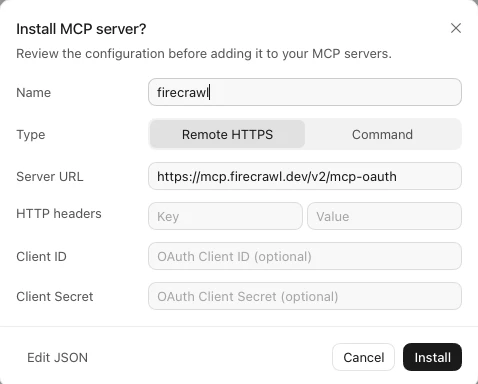
Connect your Firecrawl account
Use the server's sign-in option in Cursor's MCP settings. Firecrawl opens in your browser: sign in, choose a team with Alexandria enabled, and approve access. A green dot next to Firecrawl means it's connected.
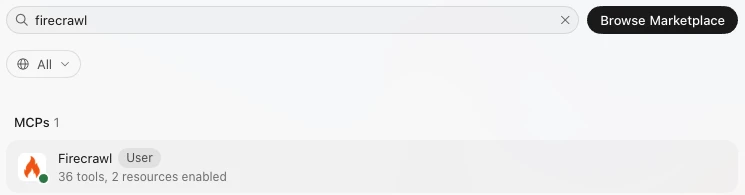
Ask Cursor's agent for the data
In the agent chat, ask in plain language and mention OpenRouter or Firecrawl Alexandria. The agent finds the OpenRouter capability that fits and runs it. For example:
Use Firecrawl to find 10 OpenRouter text models supporting tools with at least a 128,000-token context, sorted by lowest price.
What can Cursor do with OpenRouter?
OpenRouter model catalog and marketplace data: search models by modality, author, provider and price; per-model provider endpoints with pricing, limits, data policy and uptime; effective and listed price history; usage and availability stats; the provider directory; author lineups; and documentation pages such as the Decisions API reference and the Jev decision-model guide. Anonymous public endpoints only; no inference.
Cursor can run any of OpenRouter's 8 capabilities through Alexandria. Each call is billed in Firecrawl credits on your Firecrawl team.
- Get docs page: One page of the OpenRouter documentation as Markdown (`GET /docs/{path}.md`, the docs site's machine-readable rendering), e.g. the Decisions API reference (`api/api-reference/alphadecisions/submit-a-decisions-request`, request/response schema and error codes) or the Jev guide (`guides/community/jev`, question types and confidence semantics). Returns title, summary and the full Markdown, truncated at `max_chars` when set. Unknown paths are `not_found`. Costs 5 Firecrawl credits per call.
- Get model: One model by slug: the public catalog record (`GET /api/v1/model/{author}/{slug}`: permaslug, modalities, context, list pricing, supported parameters, router alias target) plus every provider endpoint serving it (`GET /api/v1/models/{author}/{slug}/endpoints`: provider, pricing, context, max tokens, quantization, tool support, status and recent uptime/latency/throughput). Unknown slugs are `not_found`. Costs 5 Firecrawl credits per call.
- Get model endpoints: Full provider-endpoint records for one model variant from the model page's data API (`GET /api/frontend/v1/stats/endpoint`): endpoint UUID, provider identifiers and base URL, display pricing per million tokens, data policy (training, retention, publishing), rate limits (`limit_rpm`, `limit_rpd`), capability flags, deprecation date and the recent latency/throughput percentiles. Empty for an unknown permaslug or variant, reported as `not_found`. Costs 5 Firecrawl credits per call.
- Get model pricing: Current and historical pricing for one model variant: traffic-weighted effective input/output prices and per-provider summaries with token volume (`GET /api/frontend/v1/stats/effective-pricing`), the daily effective price series, and each provider endpoint's listed price change history for input, output, cache read/write and discount (`GET /api/frontend/v1/stats/listed-pricing`). Prices are USD per million tokens. A permaslug with no priced endpoint is `not_found`. Costs 5 Firecrawl credits per call.
- Get model stats: Recent usage and availability for one model variant: daily request counts, prompt/completion/reasoning/cached tokens, tool calls, media counts and spend (`GET /api/frontend/v1/stats/model-activity`), plus daily uptime per provider endpoint and for OpenRouter's routing overall (`GET /api/frontend/v1/stats/uptime-recent`). A permaslug with no activity and no uptime rows is `not_found`. Costs 5 Firecrawl credits per call.
- List author models: All models published under one author/organization slug with each model's primary endpoint (`GET /api/frontend/v1/author-models`): slug, permaslug, modalities, context, group, and the primary endpoint's provider, pricing, limits and data policy. Router aliases (`~author/name`) appear with a null endpoint. Unknown authors are `not_found`. Costs 5 Firecrawl credits per call.
- List providers: Directory of every inference provider OpenRouter routes to (`GET /api/frontend/v1/all-providers`): slug, name, API base URL, headquarters, data policy (training, prompt retention, publishing, terms and privacy URLs), status page, BYOK and capability flags. Optional `q` filters by slug or name client-side; the result is the full list otherwise. Costs 5 Firecrawl credits per call.
- Search models: Search and list the OpenRouter model catalog (documented public API `GET /api/v1/models`) by free text, output/input modality, author, hosting provider, use-case category, supported parameters, price, context and data region, sorted server-side; offset-paginated. Each model carries its slug, versioned permaslug, modalities, context length, list pricing and the top provider's limits. Note the API defaults to text-output models: pass `output_modalities` (e.g. `decisions`, `image`, `all`) to see others. Costs 5 Firecrawl credits per call.
What should I ask Cursor?
Name OpenRouter or Firecrawl Alexandria in the prompt so Cursor reaches for it. Each example opens in Cursor with the prompt filled in.
- Use Firecrawl to find 10 OpenRouter text models supporting tools with at least a 128,000-token context, sorted by lowest price.
- Use Firecrawl to show the catalog record and provider endpoints for typesafe/jev-1.13, including modalities, pricing and recent uptime.
- Use Firecrawl to show the listed and effective price history for typesafe/jev-1.13, resolving its current versioned model identifier first.
- Use Firecrawl to read the OpenRouter Jev guide and summarize its question types and confidence semantics.
Troubleshooting
Why can't Cursor find OpenRouter?
If Firecrawl's tools in Cursor stop at search, scrape and parse, the connection is keyless and doesn't include Alexandria. Finish the sign-in from Cursor's MCP settings, or add an API key from a team with Alexandria enabled.
Firecrawl shows a red dot in Cursor. What should I do?
Open Cursor's MCP settings, sign in to Firecrawl again, and restart the agent chat so it loads the tools.
Use OpenRouter in other AI apps
The same Firecrawl account reaches OpenRouter from other AI apps. Pick one for its setup steps:

Other data providers you can connect to Cursor
Frequently Asked Questions
What is Firecrawl?
Firecrawl is the web data API to search, scrape and interact with the web at scale. It turns websites into clean, LLM-ready data for AI agents and apps. The Firecrawl MCP server brings those tools into Cursor, along with every data provider in Firecrawl Alexandria.
What is Firecrawl Alexandria?
Firecrawl Alexandria is Firecrawl's library of 550+ data providers for AI agents, OpenRouter among them. Each provider returns structured data through documented capabilities. Cursor finds the capability that fits your question and calls it through the Firecrawl MCP server, so you don't write any integration code. Alexandria needs a Firecrawl account signed in on a team with Alexandria enabled, or an API key from such a team; keyless connections don't include it.
Is there a OpenRouter MCP server for Cursor?
Cursor reaches OpenRouter through Firecrawl's hosted MCP server, which serves OpenRouter and every other Alexandria provider as tools. Add the Firecrawl MCP server once and you don't install or host a separate MCP server for OpenRouter.
What does connecting OpenRouter to Cursor unlock?
Cursor can run all 8 of OpenRouter's capabilities, including Get docs page, Get model and Get model endpoints, from any chat, with structured results it can sort, compare and summarize. For example, ask: "Use Firecrawl to find 10 OpenRouter text models supporting tools with at least a 128,000-token context, sorted by lowest price." In the same conversation, Cursor can combine OpenRouter with Firecrawl's web search and scraping and the other providers in Firecrawl Alexandria.
Do I need my own OpenRouter account or API key to use it in Cursor?
No. Cursor calls OpenRouter through Firecrawl Alexandria and each call is billed in Firecrawl credits, so you don't need a separate OpenRouter account or API key.
How much does it cost to use OpenRouter in Cursor?
Each OpenRouter call costs 5 Firecrawl credits. The capability list on this page shows each price and its unit. The credits come from the Firecrawl team you connect to Cursor, and finding the right capability is free.
Can Cursor use other providers besides OpenRouter?
Yes. The same Firecrawl MCP server reaches every provider in Firecrawl Alexandria, along with Firecrawl's web search and scraping, so you connect once.
Can I use OpenRouter in other AI apps?
Yes. Connect Firecrawl to ChatGPT, Claude, Grok Bot, Muse signed in on a Firecrawl team with Alexandria enabled, or use the Firecrawl MCP server, CLI or API with an API key from that team, and the same OpenRouter capabilities are available there. Keyless connections don't include Alexandria.