How to connect PubChem: chemical compounds, bioassays, targets and patents to Cursor
Add the Firecrawl MCP server to Cursor once and it can call the PubChem: chemical compounds, bioassays, targets and patents API and every other provider in Firecrawl Alexandria, with no PubChem: chemical compounds, bioassays, targets and patents integration code.
To connect PubChem: chemical compounds, bioassays, targets and patents to Cursor, add the Firecrawl MCP server to Cursor, sign in on a Firecrawl team with Alexandria enabled, and ask for PubChem: chemical compounds, bioassays, targets and patents data in plain language. The connection works in Cursor's agent and chat, and you set it up once.
Cursor uses PubChem: chemical compounds, bioassays, targets and patents as an MCP tool through Firecrawl's hosted MCP server, so you don't install or host a separate MCP server for PubChem: chemical compounds, bioassays, targets and patents.
Cursor is an AI code editor. Its agent uses MCP servers for outside tools, and the Firecrawl MCP server adds web search, scraping and every data provider in Firecrawl Alexandria.
How do I connect PubChem: chemical compounds, bioassays, targets and patents to Cursor?
Install the Firecrawl MCP server
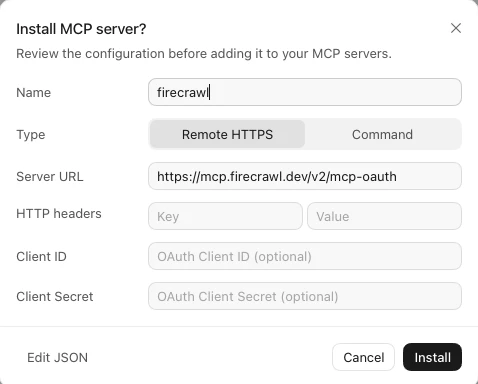
Open the install dialog in Cursor, check that the URL is Firecrawl's hosted server, then select Install.
Connect your Firecrawl account
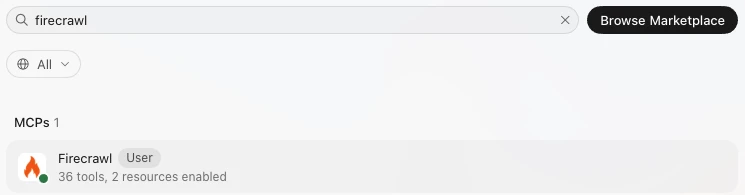
Use the server's sign-in option in Cursor's MCP settings. Firecrawl opens in your browser: sign in, choose a team with Alexandria enabled, and approve access. A green dot next to Firecrawl means it's connected.
Ask Cursor's agent for the data
In the agent chat, ask in plain language and mention PubChem: chemical compounds, bioassays, targets and patents or Firecrawl Alexandria. The agent finds the PubChem: chemical compounds, bioassays, targets and patents capability that fits and runs it. For example:
Use Firecrawl to answer this: What are semaglutide's molecular formula, molecular weight and CAS number?
What can Cursor do with PubChem: chemical compounds, bioassays, targets and patents?
PubChem, the U.S. National Library of Medicine's open chemistry database at NCBI, through its documented PUG REST and PUG View services: find compounds by name, synonym, brand name, CAS number, SMILES, InChI, InChIKey or molecular formula; read a compound's computed properties (formula, weights, XLogP, TPSA, hydrogen-bond counts, stereochemistry), InChI, SMILES, synonyms and cross-referenced identifiers (CAS, UNII, ChEBI, ChEMBL, DrugBank, DSSTox and more); find similar compounds, substructures and superstructures ranked by Tanimoto similarity; list a compound's bioassay results across depositors and aggregate the protein and gene targets it is active against; and list the patent publications linked to it. NCBI places no restrictions on PubChem data; cross-references are identifiers only, bioassays from depositors that restrict commercial use are excluded, and every answer carries its terms and the PubChem citation.
Cursor can run any of PubChem: chemical compounds, bioassays, targets and patents's 6 capabilities through Alexandria. Each call is billed in Firecrawl credits on your Firecrawl team.
- Bioassays: A compound's bioassay results in PubChem: every deposited assay outcome (active, inactive, inconclusive, unspecified, probe) with the assay, its type, target protein accession and NCBI Gene ID, activity value in µM and what it measures (IC50, Ki, EC50...), the PubMed ID and the depositor (ChEMBL, BindingDB, NCATS, DTP/NCI, IUPHAR/BPS, ToxCast and others). Filter by outcome (active by default), target accession or Gene ID, and assay type; counts give the compound's outcomes over all rows. Assays from depositors that restrict commercial use (NIAID ChemDB) are left out and counted in excluded. Costs 5 Firecrawl credits per call.
- Get: One PubChem compound by CID, name or synonym, InChIKey, SMILES, InChI or compound page URL: names (title, IUPAC name), formula, molecular weight, exact and monoisotopic mass, XLogP, TPSA, complexity, charge, hydrogen-bond donors and acceptors, rotatable bonds, heavy atoms, stereocentre counts, InChI, InChIKey and SMILES; its synonyms; and its cross-references (CAS, EC, UNII, ChEBI, ChEMBL, DrugBank, DrugCentral, DSSTox, KEGG, Wikidata, NSC and other identifiers), as identifiers only, each with the sources that supplied it. Costs 5 Firecrawl credits per call.
- Patents: The patent publications PubChem links to a compound (deposited by Google Patents, SureChEMBL, IBM and WIPO PATENTSCOPE): each publication's number, office, kind code, and Google Patents and PubChem links, deduplicated across PubChem's ID formats, with counts by office. Filter by office (US, EP, WO, CN, JP...) and page through them. Publication numbers only; no patent text. Costs 5 Firecrawl credits per call.
- Search: Find PubChem compounds by name or synonym (brand names, INNs, CAS numbers, ChEMBL and DrugBank IDs PubChem holds as synonyms), SMILES, InChI, InChIKey, molecular formula or CID. Each hit has its CID, name, formula, molecular weight, exact mass, XLogP, TPSA, InChIKey and SMILES. A name returns the compounds it names exactly, in PubChem's order, followed by compounds whose synonyms contain all its words; a formula returns every compound with that formula; a SMILES or InChI returns the compound with that exact structure. Costs 5 Firecrawl credits per call.
- Similar: Compounds structurally related to one compound, from PubChem's 2D structure searches: similarity (Tanimoto on PubChem's substructure fingerprint at or above a threshold), substructure (compounds containing the query) or superstructure (compounds the query contains). Similarity hits are scored here from PubChem's Fingerprint2D and sorted by score, highest first; the query compound itself is left out. Each hit has its CID, name, formula, molecular weight, InChIKey and SMILES. Costs 5 Firecrawl credits per call.
- Targets: The protein and gene targets a compound is active against in PubChem bioassays, aggregated from its active results: each target's accession (UniProt, RefSeq, GenBank or PDB chain), NCBI Gene ID, gene symbol and name, protein name, organism, how many assays and rows found it active, the most potent deposited value (IC50, Ki, Kd, EC50...) with its assay, and PubMed IDs. Most active assays first. Results from depositors that restrict commercial use are left out. Costs 5 Firecrawl credits per call.
What should I ask Cursor?
Name PubChem: chemical compounds, bioassays, targets and patents or Firecrawl Alexandria in the prompt so Cursor reaches for it. Each example opens in Cursor with the prompt filled in.
- Use Firecrawl to answer this: What are semaglutide's molecular formula, molecular weight and CAS number?
- Use Firecrawl to answer this: Which proteins is imatinib active against in PubChem bioassays, with the most potent value for each?
- Use Firecrawl to find compounds structurally similar to imatinib with Tanimoto similarity of at least 0.95.
- Use Firecrawl to answer this: How many patents does PubChem link to semaglutide, by office, and what are the US ones?
Troubleshooting
Why can't Cursor find PubChem: chemical compounds, bioassays, targets and patents?
If Firecrawl's tools in Cursor stop at search, scrape and parse, the connection is keyless and doesn't include Alexandria. Finish the sign-in from Cursor's MCP settings, or add an API key from a team with Alexandria enabled.
Firecrawl shows a red dot in Cursor. What should I do?
Open Cursor's MCP settings, sign in to Firecrawl again, and restart the agent chat so it loads the tools.
Use PubChem: chemical compounds, bioassays, targets and patents in other AI apps
The same Firecrawl account reaches PubChem: chemical compounds, bioassays, targets and patents from other AI apps. Pick one for its setup steps:
- PubChem: chemical compounds, bioassays, targets and patents in ChatGPT
- PubChem: chemical compounds, bioassays, targets and patents in Claude
- PubChem: chemical compounds, bioassays, targets and patents in Grok Bot
 PubChem: chemical compounds, bioassays, targets and patents in Muse
Other data providers you can connect to Cursor
Frequently Asked Questions
What is Firecrawl?
Firecrawl is the web data API to search, scrape and interact with the web at scale. It turns websites into clean, LLM-ready data for AI agents and apps. The Firecrawl MCP server brings those tools into Cursor, along with every data provider in Firecrawl Alexandria.
What is Firecrawl Alexandria?
Firecrawl Alexandria is Firecrawl's library of 550+ data providers for AI agents, PubChem: chemical compounds, bioassays, targets and patents among them. Each provider returns structured data through documented capabilities. Cursor finds the capability that fits your question and calls it through the Firecrawl MCP server, so you don't write any integration code. Alexandria needs a Firecrawl account signed in on a team with Alexandria enabled, or an API key from such a team; keyless connections don't include it.
Is there a PubChem: chemical compounds, bioassays, targets and patents MCP server for Cursor?
Cursor reaches PubChem: chemical compounds, bioassays, targets and patents through Firecrawl's hosted MCP server, which serves PubChem: chemical compounds, bioassays, targets and patents and every other Alexandria provider as tools. Add the Firecrawl MCP server once and you don't install or host a separate MCP server for PubChem: chemical compounds, bioassays, targets and patents.
What does connecting PubChem: chemical compounds, bioassays, targets and patents to Cursor unlock?
Cursor can run all 6 of PubChem: chemical compounds, bioassays, targets and patents's capabilities, including Bioassays, Get and Patents, from any chat, with structured results it can sort, compare and summarize. For example, ask: "Use Firecrawl to answer this: What are semaglutide's molecular formula, molecular weight and CAS number?" In the same conversation, Cursor can combine PubChem: chemical compounds, bioassays, targets and patents with Firecrawl's web search and scraping and the other providers in Firecrawl Alexandria.
Do I need my own PubChem: chemical compounds, bioassays, targets and patents account or API key to use it in Cursor?
No. Cursor calls PubChem: chemical compounds, bioassays, targets and patents through Firecrawl Alexandria and each call is billed in Firecrawl credits, so you don't need a separate PubChem: chemical compounds, bioassays, targets and patents account or API key.
How much does it cost to use PubChem: chemical compounds, bioassays, targets and patents in Cursor?
Each PubChem: chemical compounds, bioassays, targets and patents call costs 5 Firecrawl credits. The capability list on this page shows each price and its unit. The credits come from the Firecrawl team you connect to Cursor, and finding the right capability is free.
Can Cursor use other providers besides PubChem: chemical compounds, bioassays, targets and patents?
Yes. The same Firecrawl MCP server reaches every provider in Firecrawl Alexandria, along with Firecrawl's web search and scraping, so you connect once.
Can I use PubChem: chemical compounds, bioassays, targets and patents in other AI apps?
Yes. Connect Firecrawl to ChatGPT, Claude, Grok Bot, Muse signed in on a Firecrawl team with Alexandria enabled, or use the Firecrawl MCP server, CLI or API with an API key from that team, and the same PubChem: chemical compounds, bioassays, targets and patents capabilities are available there. Keyless connections don't include Alexandria.