How to connect PubChem: chemical compounds, bioassays, targets and patents to Grok Bot
Add the Firecrawl plugin to Grok Bot once and it can call the PubChem: chemical compounds, bioassays, targets and patents API and every other provider in Firecrawl Alexandria, with no PubChem: chemical compounds, bioassays, targets and patents integration code.
To connect PubChem: chemical compounds, bioassays, targets and patents to Grok Bot, add the Firecrawl plugin to Grok Bot, sign in on a Firecrawl team with Alexandria enabled, and ask for PubChem: chemical compounds, bioassays, targets and patents data in plain language. The connection works in every Bot in your Grok Bot account, and you set it up once.
Grok Bot uses PubChem: chemical compounds, bioassays, targets and patents as an MCP tool through Firecrawl's hosted MCP server, so you don't install or host a separate MCP server for PubChem: chemical compounds, bioassays, targets and patents.
Grok Bot is xAI's agent app. Plugins give your Bots outside tools, and the Firecrawl plugin adds web search, scraping and every data provider in Firecrawl Alexandria.
How do I connect PubChem: chemical compounds, bioassays, targets and patents to Grok Bot?
Add the Firecrawl plugin
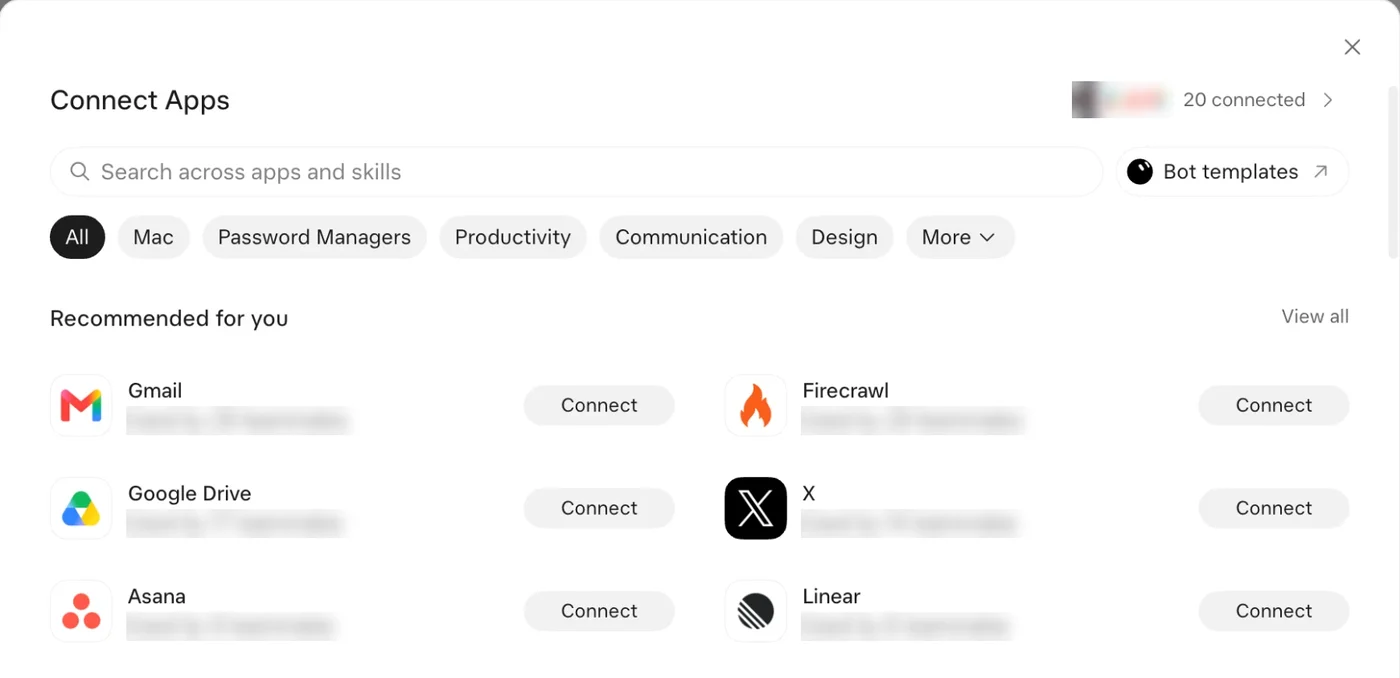
In Grok Bot, open Connect apps from the sidebar, find Firecrawl and select Connect. You can also open Firecrawl's plugin listing and select Add to Grok Bot, which opens the desktop app to finish the install.
Connect your Firecrawl account
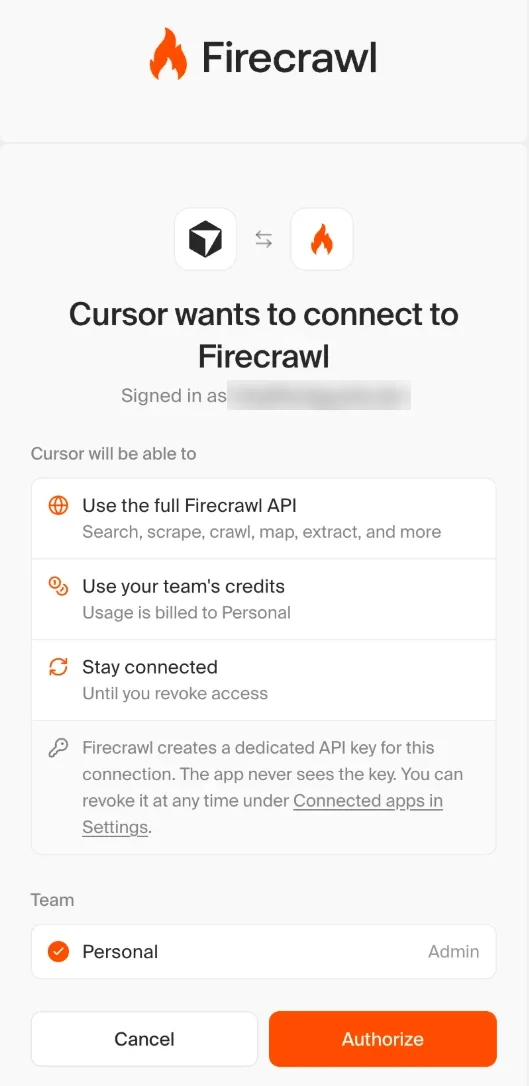
Grok Bot opens Firecrawl in your browser. Sign in, choose a team with Alexandria enabled, and select Authorize. The screen names Cursor, because the plugin is published on the Cursor Marketplace. No account yet? You can create one for free in the same flow.
Ask your Bot for the data
In a chat, ask in plain language and mention PubChem: chemical compounds, bioassays, targets and patents or Firecrawl Alexandria. To make sure the Bot uses Firecrawl, type @ and choose Firecrawl first. For example:
Use Firecrawl to answer this: What are semaglutide's molecular formula, molecular weight and CAS number?
What can Grok Bot do with PubChem: chemical compounds, bioassays, targets and patents?
PubChem, the U.S. National Library of Medicine's open chemistry database at NCBI, through its documented PUG REST and PUG View services: find compounds by name, synonym, brand name, CAS number, SMILES, InChI, InChIKey or molecular formula; read a compound's computed properties (formula, weights, XLogP, TPSA, hydrogen-bond counts, stereochemistry), InChI, SMILES, synonyms and cross-referenced identifiers (CAS, UNII, ChEBI, ChEMBL, DrugBank, DSSTox and more); find similar compounds, substructures and superstructures ranked by Tanimoto similarity; list a compound's bioassay results across depositors and aggregate the protein and gene targets it is active against; and list the patent publications linked to it. NCBI places no restrictions on PubChem data; cross-references are identifiers only, bioassays from depositors that restrict commercial use are excluded, and every answer carries its terms and the PubChem citation.
Grok Bot can run any of PubChem: chemical compounds, bioassays, targets and patents's 6 capabilities through Alexandria. Each call is billed in Firecrawl credits on your Firecrawl team.
- Bioassays: A compound's bioassay results in PubChem: every deposited assay outcome (active, inactive, inconclusive, unspecified, probe) with the assay, its type, target protein accession and NCBI Gene ID, activity value in µM and what it measures (IC50, Ki, EC50...), the PubMed ID and the depositor (ChEMBL, BindingDB, NCATS, DTP/NCI, IUPHAR/BPS, ToxCast and others). Filter by outcome (active by default), target accession or Gene ID, and assay type; counts give the compound's outcomes over all rows. Assays from depositors that restrict commercial use (NIAID ChemDB) are left out and counted in excluded. Costs 5 Firecrawl credits per call.
- Get: One PubChem compound by CID, name or synonym, InChIKey, SMILES, InChI or compound page URL: names (title, IUPAC name), formula, molecular weight, exact and monoisotopic mass, XLogP, TPSA, complexity, charge, hydrogen-bond donors and acceptors, rotatable bonds, heavy atoms, stereocentre counts, InChI, InChIKey and SMILES; its synonyms; and its cross-references (CAS, EC, UNII, ChEBI, ChEMBL, DrugBank, DrugCentral, DSSTox, KEGG, Wikidata, NSC and other identifiers), as identifiers only, each with the sources that supplied it. Costs 5 Firecrawl credits per call.
- Patents: The patent publications PubChem links to a compound (deposited by Google Patents, SureChEMBL, IBM and WIPO PATENTSCOPE): each publication's number, office, kind code, and Google Patents and PubChem links, deduplicated across PubChem's ID formats, with counts by office. Filter by office (US, EP, WO, CN, JP...) and page through them. Publication numbers only; no patent text. Costs 5 Firecrawl credits per call.
- Search: Find PubChem compounds by name or synonym (brand names, INNs, CAS numbers, ChEMBL and DrugBank IDs PubChem holds as synonyms), SMILES, InChI, InChIKey, molecular formula or CID. Each hit has its CID, name, formula, molecular weight, exact mass, XLogP, TPSA, InChIKey and SMILES. A name returns the compounds it names exactly, in PubChem's order, followed by compounds whose synonyms contain all its words; a formula returns every compound with that formula; a SMILES or InChI returns the compound with that exact structure. Costs 5 Firecrawl credits per call.
- Similar: Compounds structurally related to one compound, from PubChem's 2D structure searches: similarity (Tanimoto on PubChem's substructure fingerprint at or above a threshold), substructure (compounds containing the query) or superstructure (compounds the query contains). Similarity hits are scored here from PubChem's Fingerprint2D and sorted by score, highest first; the query compound itself is left out. Each hit has its CID, name, formula, molecular weight, InChIKey and SMILES. Costs 5 Firecrawl credits per call.
- Targets: The protein and gene targets a compound is active against in PubChem bioassays, aggregated from its active results: each target's accession (UniProt, RefSeq, GenBank or PDB chain), NCBI Gene ID, gene symbol and name, protein name, organism, how many assays and rows found it active, the most potent deposited value (IC50, Ki, Kd, EC50...) with its assay, and PubMed IDs. Most active assays first. Results from depositors that restrict commercial use are left out. Costs 5 Firecrawl credits per call.
What should I ask Grok Bot?
Name PubChem: chemical compounds, bioassays, targets and patents or Firecrawl Alexandria in the prompt so Grok Bot reaches for it.
- Use Firecrawl to answer this: What are semaglutide's molecular formula, molecular weight and CAS number?
- Use Firecrawl to answer this: Which proteins is imatinib active against in PubChem bioassays, with the most potent value for each?
- Use Firecrawl to find compounds structurally similar to imatinib with Tanimoto similarity of at least 0.95.
- Use Firecrawl to answer this: How many patents does PubChem link to semaglutide, by office, and what are the US ones?
Troubleshooting
Why doesn't my Bot use PubChem: chemical compounds, bioassays, targets and patents?
Attach Firecrawl to the chat with @ before you ask, and name PubChem: chemical compounds, bioassays, targets and patents or Firecrawl Alexandria in the prompt.
Add to Grok Bot doesn't open the app. What should I do?
Install the Grok Bot desktop app first, or open Connect apps in Grok Bot and search for Firecrawl.
Use PubChem: chemical compounds, bioassays, targets and patents in other AI apps
The same Firecrawl account reaches PubChem: chemical compounds, bioassays, targets and patents from other AI apps. Pick one for its setup steps:
- PubChem: chemical compounds, bioassays, targets and patents in ChatGPT
- PubChem: chemical compounds, bioassays, targets and patents in Claude
- PubChem: chemical compounds, bioassays, targets and patents in Cursor
 PubChem: chemical compounds, bioassays, targets and patents in Muse
Other data providers you can connect to Grok Bot
Frequently Asked Questions
What is Firecrawl?
Firecrawl is the web data API to search, scrape and interact with the web at scale. It turns websites into clean, LLM-ready data for AI agents and apps. The Firecrawl plugin brings those tools into Grok Bot, along with every data provider in Firecrawl Alexandria.
What is Firecrawl Alexandria?
Firecrawl Alexandria is Firecrawl's library of 550+ data providers for AI agents, PubChem: chemical compounds, bioassays, targets and patents among them. Each provider returns structured data through documented capabilities. Grok Bot finds the capability that fits your question and calls it through the Firecrawl plugin, so you don't write any integration code. Alexandria needs a Firecrawl account signed in on a team with Alexandria enabled, or an API key from such a team; keyless connections don't include it.
Is there a PubChem: chemical compounds, bioassays, targets and patents MCP server for Grok Bot?
Grok Bot reaches PubChem: chemical compounds, bioassays, targets and patents through Firecrawl's hosted MCP server, which serves PubChem: chemical compounds, bioassays, targets and patents and every other Alexandria provider as tools. Add the Firecrawl plugin once and you don't install or host a separate MCP server for PubChem: chemical compounds, bioassays, targets and patents.
What does connecting PubChem: chemical compounds, bioassays, targets and patents to Grok Bot unlock?
Grok Bot can run all 6 of PubChem: chemical compounds, bioassays, targets and patents's capabilities, including Bioassays, Get and Patents, from any chat, with structured results it can sort, compare and summarize. For example, ask: "Use Firecrawl to answer this: What are semaglutide's molecular formula, molecular weight and CAS number?" In the same conversation, Grok Bot can combine PubChem: chemical compounds, bioassays, targets and patents with Firecrawl's web search and scraping and the other providers in Firecrawl Alexandria.
Do I need my own PubChem: chemical compounds, bioassays, targets and patents account or API key to use it in Grok Bot?
No. Grok Bot calls PubChem: chemical compounds, bioassays, targets and patents through Firecrawl Alexandria and each call is billed in Firecrawl credits, so you don't need a separate PubChem: chemical compounds, bioassays, targets and patents account or API key.
How much does it cost to use PubChem: chemical compounds, bioassays, targets and patents in Grok Bot?
Each PubChem: chemical compounds, bioassays, targets and patents call costs 5 Firecrawl credits. The capability list on this page shows each price and its unit. The credits come from the Firecrawl team you connect to Grok Bot, and finding the right capability is free.
Can Grok Bot use other providers besides PubChem: chemical compounds, bioassays, targets and patents?
Yes. The same Firecrawl plugin reaches every provider in Firecrawl Alexandria, along with Firecrawl's web search and scraping, so you connect once.
Can I use PubChem: chemical compounds, bioassays, targets and patents in other AI apps?
Yes. Connect Firecrawl to ChatGPT, Claude, Cursor, Muse signed in on a Firecrawl team with Alexandria enabled, or use the Firecrawl MCP server, CLI or API with an API key from that team, and the same PubChem: chemical compounds, bioassays, targets and patents capabilities are available there. Keyless connections don't include Alexandria.