How to connect Rover to Cursor
Add the Firecrawl MCP server to Cursor once and it can call the Rover API and every other provider in Firecrawl Alexandria, with no Rover integration code.
To connect Rover to Cursor, add the Firecrawl MCP server to Cursor, sign in on a Firecrawl team with Alexandria enabled, and ask for Rover data in plain language. The connection works in Cursor's agent and chat, and you set it up once.
Cursor uses Rover as an MCP tool through Firecrawl's hosted MCP server, so you don't install or host a separate MCP server for Rover.
Cursor is an AI code editor. Its agent uses MCP servers for outside tools, and the Firecrawl MCP server adds web search, scraping and every data provider in Firecrawl Alexandria.
How do I connect Rover to Cursor?
Install the Firecrawl MCP server
Open the install dialog in Cursor, check that the URL is Firecrawl's hosted server, then select Install.
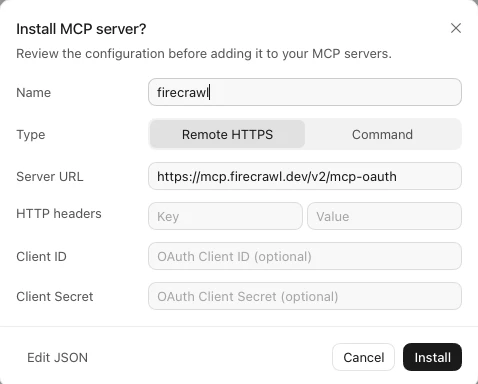
Connect your Firecrawl account
Use the server's sign-in option in Cursor's MCP settings. Firecrawl opens in your browser: sign in, choose a team with Alexandria enabled, and approve access. A green dot next to Firecrawl means it's connected.
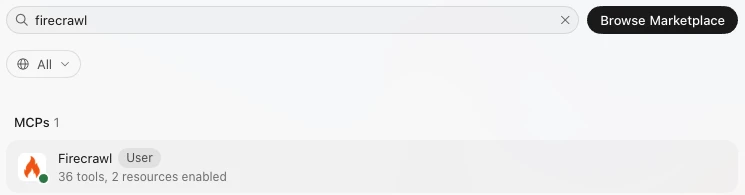
Ask Cursor's agent for the data
In the agent chat, ask in plain language and mention Rover or Firecrawl Alexandria. The agent finds the Rover capability that fits and runs it. For example:
Use Firecrawl to find the first page of dog-boarding sitters in Seattle, WA, USA for October 20–23, 2026, with listed nightly prices and ratings.
What can Cursor do with Rover?
Rover public pet-care discovery without an account: search sitters by service (boarding, house sitting, drop-in visits, dog walking, doggy day care), location, dates, dog size and price; read a sitter's public profile with every listed rate (sitter rate and the full price including Rover's owner-side service fee), acceptance rules and cancellation policy; read the sitter's public availability calendar for a date window; list the sitter's reviews; and resolve free-text places to the location strings the search accepts. Source: the www.rover.com /api/v7/ JSON API the website calls anonymously. US market from a US ISP exit (country and currency follow the request IP); prices are sitter-listed advertised rates in USD, not quotes; availability is what the sitter listed, not a booking guarantee.
Cursor can run any of Rover's 5 capabilities through Alexandria. Each call is billed in Firecrawl credits on your Firecrawl team.
- Get sitter: Read one sitter's public profile by profile `slug` or profile `url` (`GET /api/v7/people/full-sitter-profile/?slug=`, endpoint ep-full-profile). Returns identity (opk, slug, short name), profile texts, ratings and review counts, responsiveness, member-since date, badges, home attributes, and every active service with its listed rates: for each add-on rate (standard, holiday, additional dog, puppy, cat care, ...) both `price` (the sitter's listed rate) and `full_price` (that rate plus Rover's owner-side service fee as Rover displays it), the unit (night, visit, walk, day), which dog sizes and cats the service accepts, spaces, whether new customers are accepted, and the cancellation policy. Rates are advertised prices, not quotes: holiday adjustments and taxes are not included. Unknown slug is `not_found`. Costs 5 Firecrawl credits per call.
- Get sitter availability: Read a sitter's public availability calendar for one service over a date window (`GET /api/v7/people/{opk}/public-calendar/`, endpoint ep-calendar). Input `opk` from a search result or `get_sitter`, the service slug, and `start_date`/`end_date` (default: today through six weeks ahead, at most 120 days). Returns the sitter's calendar preferences (spaces, days of week, away flag) and one entry per day with `spaces_available`/`spaces_occupied` per calendar, plus `updated_at` (when the sitter last updated the calendar) and a count of days with at least one space. This is sitter-listed availability, not a booking guarantee. Unknown opk is `not_found`. Costs 5 Firecrawl credits per call.
- List sitter reviews: List one sitter's public reviews, newest first, one page at a time (`GET /api/v7/people/{opk}/reviews/?page=`, endpoint ep-reviews). Returns the rating distribution and totals (ratings vs. text reviews), and per review: id, timestamp with offset as Rover stores it, star rating, text, reviewer short name, the service reviewed, the pets, and the sitter's response when any. `next_page` (and the continuation) is null when exhausted. Unknown opk is `not_found`. Costs 5 Firecrawl credits per call.
- Search sitters: Search Rover sitters for one service around a location (`GET /api/v7/search-optimized/`, endpoint ep-search-api). Filters: `service_type` (overnight-boarding = boarding in the sitter's home, overnight-traveling = house sitting in the owner's home, drop-in = drop-in visits, dog-walking, doggy-day-care), `location` as a free-text place (use the exact `description` from `suggest_locations`, e.g. `Seattle, WA, USA`), `pet_type` dog or cat, optional `start_date`/`end_date`, dog-size flags, `min_price`/`max_price` and `page` (20 results per page; `next_page` and the continuation give the next one). Each result is a sitter card: opk and slug (the identifiers `get_sitter`, `get_sitter_availability` and `list_sitter_reviews` take), name, headline, listed price per unit in the market currency, rating and review counts, neighbourhood and distance from the search centre, badges, and `available_for_selected_dates` exactly as Rover reports it (`unknown` is a real value: search results never confirm availability; use `get_sitter_availability`). The response `location` block says what Rover geocoded the input to. A location Rover cannot geocode makes it fall back to the request IP's area; this program refuses that with `invalid_input` instead of returning unrelated sitters. Market follows the proxy exit (US, USD); a non-US location therefore also fails as not resolvable. Costs 5 Firecrawl credits per call.
- Suggest locations: Resolve free text to the place strings Rover's search accepts (`GET /api/v7/utilities/location-autocomplete/`, endpoint ep-autocomplete). Returns Rover's place predictions (Google Places-backed): `description` is the exact `location` value to pass to `search_sitters`, with main/secondary text, place id and place types. An empty list with status ZERO_RESULTS is a legitimate no-match. Costs 5 Firecrawl credits per call.
What should I ask Cursor?
Name Rover or Firecrawl Alexandria in the prompt so Cursor reaches for it. Each example opens in Cursor with the prompt filled in.
- Use Firecrawl to find the first page of dog-boarding sitters in Seattle, WA, USA for October 20–23, 2026, with listed nightly prices and ratings.
- Use Firecrawl to read Rover sitter tianci-d-staycation-for-your-dog and show active services, listed rates with owner service fees and cancellation policies.
- Use Firecrawl to find the first Seattle dog-boarding sitter and read their boarding availability calendar for October 20–23, 2026, including available spaces and last update.
- Use Firecrawl to run Rover's Get sitter capability. Inspect the Alexandria inputs, ask for any missing required details, and return a small sample with sources.
Troubleshooting
Why can't Cursor find Rover?
If Firecrawl's tools in Cursor stop at search, scrape and parse, the connection is keyless and doesn't include Alexandria. Finish the sign-in from Cursor's MCP settings, or add an API key from a team with Alexandria enabled.
Firecrawl shows a red dot in Cursor. What should I do?
Open Cursor's MCP settings, sign in to Firecrawl again, and restart the agent chat so it loads the tools.
Use Rover in other AI apps
The same Firecrawl account reaches Rover from other AI apps. Pick one for its setup steps:

Other data providers you can connect to Cursor
Frequently Asked Questions
What is Firecrawl?
Firecrawl is the web data API to search, scrape and interact with the web at scale. It turns websites into clean, LLM-ready data for AI agents and apps. The Firecrawl MCP server brings those tools into Cursor, along with every data provider in Firecrawl Alexandria.
What is Firecrawl Alexandria?
Firecrawl Alexandria is Firecrawl's library of 550+ data providers for AI agents, Rover among them. Each provider returns structured data through documented capabilities. Cursor finds the capability that fits your question and calls it through the Firecrawl MCP server, so you don't write any integration code. Alexandria needs a Firecrawl account signed in on a team with Alexandria enabled, or an API key from such a team; keyless connections don't include it.
Is there a Rover MCP server for Cursor?
Cursor reaches Rover through Firecrawl's hosted MCP server, which serves Rover and every other Alexandria provider as tools. Add the Firecrawl MCP server once and you don't install or host a separate MCP server for Rover.
What does connecting Rover to Cursor unlock?
Cursor can run all 5 of Rover's capabilities, including Get sitter, Get sitter availability and List sitter reviews, from any chat, with structured results it can sort, compare and summarize. For example, ask: "Use Firecrawl to find the first page of dog-boarding sitters in Seattle, WA, USA for October 20–23, 2026, with listed nightly prices and ratings." In the same conversation, Cursor can combine Rover with Firecrawl's web search and scraping and the other providers in Firecrawl Alexandria.
Do I need my own Rover account or API key to use it in Cursor?
No. Cursor calls Rover through Firecrawl Alexandria and each call is billed in Firecrawl credits, so you don't need a separate Rover account or API key.
How much does it cost to use Rover in Cursor?
Each Rover call costs 5 Firecrawl credits. The capability list on this page shows each price and its unit. The credits come from the Firecrawl team you connect to Cursor, and finding the right capability is free.
Can Cursor use other providers besides Rover?
Yes. The same Firecrawl MCP server reaches every provider in Firecrawl Alexandria, along with Firecrawl's web search and scraping, so you connect once.
Can I use Rover in other AI apps?
Yes. Connect Firecrawl to ChatGPT, Claude, Grok Bot, Muse signed in on a Firecrawl team with Alexandria enabled, or use the Firecrawl MCP server, CLI or API with an API key from that team, and the same Rover capabilities are available there. Keyless connections don't include Alexandria.